

Cleaning a workplace looks straightforward until a regulator walks through the door. Many businesses assume that if surfaces look clean, they are compliant. They are not. Why commercial cleaning compliance matters goes far beyond appearances: it determines whether your chemical handling is legally defensible, your staff are adequately protected, and your business survives an audit without a six-figure penalty. This guide covers the current regulatory frameworks, the health and safety links that most compliance guides skip over, and the practical steps you need to build a system that actually holds up under scrutiny.
Key takeaways
| Point | Details |
|---|---|
| Compliance is not just cleanliness | Meeting regulatory standards requires documented training, correct product use, and up-to-date records. |
| Documentation gaps trigger enforcement | Most fines result from missing or outdated paperwork, not visible accidents or health incidents. |
| Chemical management is regulated | Safety Data Sheets, hazard labels, and staff training must be kept current with each product change. |
| Non-compliance carries serious costs | OSHA penalties for hazard communication violations can reach $16,131 per violation in 2026. |
| A compliant contractor supports your audit | Professional cleaning firms should provide cleaning logs and training records as part of their service. |
Why commercial cleaning compliance matters
The phrase âcleaning complianceâ is widely used in commercial settings, but the recognised regulatory term is occupational health and safety compliance within cleaning operations. Understanding that distinction matters because it signals what regulators actually inspect: not whether floors are shiny, but whether you have a written hazard communication programme, whether your staff have been trained on every chemical they handle, and whether your records match your current operations.
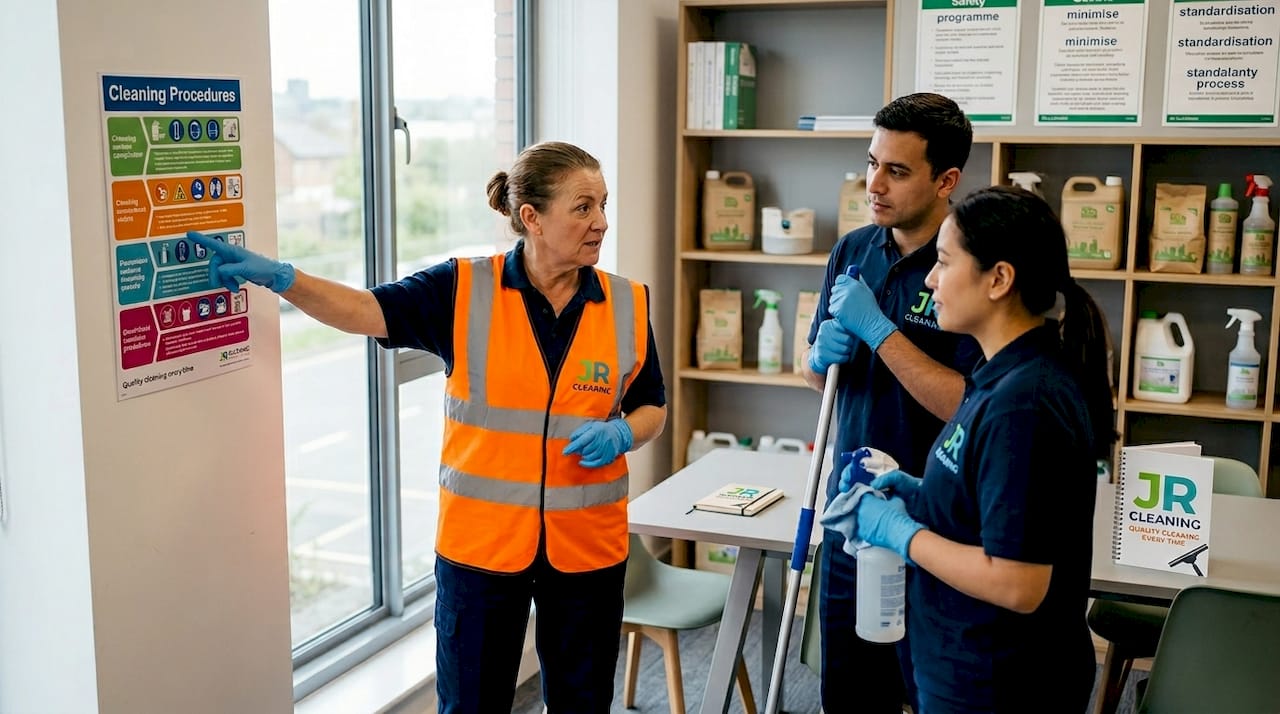

In the UK, commercial cleaning falls under the Health and Safety at Work Act 1974, the Control of Substances Hazardous to Health (COSHH) Regulations, and sector-specific guidance from the Health and Safety Executive (HSE). In workplaces with US regulatory exposure or multinational operations, OSHA HazCom compliance deadlines for the updated Hazard Communication Standard run to May and November 2026, giving UK-facing multinationals a live compliance obligation right now.
The critical difference between commercial and residential cleaning obligations is accountability. A residential cleaner who mixes the wrong chemicals risks harming themselves. A commercial cleaning contractor who does the same risks harming dozens of employees, triggering an enforcement investigation, and exposing both the contractor and the client business to regulatory penalties.
Here is a summary of the key regulatory frameworks you need to know:
| Framework | Jurisdiction | What it governs |
|---|---|---|
| COSHH Regulations 2002 | UK | Hazardous substance assessment, exposure control, training |
| Health and Safety at Work Act 1974 | UK | Employer duty of care across all workplace activities |
| OSHA HazCom Standard (1910.1200) | US/multinational | Hazard communication, SDS, labelling for chemicals |
| EPA FIFRA | US/multinational | Disinfectant registration, efficacy claims, label legality |
| HSE cleaning guidance | UK | Sector-specific cleaning standards and inspection expectations |
Key obligations across most commercial environments include:
- Maintaining a written hazard communication programme that reflects current chemicals in use
- Providing workers with access to current Safety Data Sheets (SDS) for every product
- Ensuring all chemical labels are legible and compliant with current GHS standards
- Documenting employee training at initial assignment and whenever new hazards are introduced
- Selecting only registered disinfectants whose label claims match the pathogens and surfaces in your environment
Compliance and health and safety outcomes
The link between cleaning compliance and workplace safety is not abstract. It is causal. When cleaning staff handle chemical products without documented training on contact times, dilution ratios, or incompatible surfaces, accidents follow. Skin burns, respiratory incidents, and cross-contamination events are the most common outcomes, and all of them are preventable through a functioning compliance programme.
Infection control is where the gap between looking clean and being compliant becomes most visible. Using disinfectants inconsistently with label instructions undermines compliance regardless of whether the product carries EPA registration. A disinfectant that requires a four-minute contact time on a surface achieves nothing if staff wipe it off in thirty seconds. The label is a legal document, and deviation from it is a compliance failure, full stop.
Pro Tip: Print and laminate the required contact times for each disinfectant product used in your facility and post them at the point of use. This one step closes one of the most common audit gaps without any additional cost.
There is also a fire safety dimension that most cleaning guides overlook entirely. Stored cleaning chemicals that are incorrectly labelled or segregated can create fire risks and complicate emergency response. Clean, well-organised chemical storage areas aligned with COSHH guidance directly reduce these risks.
Common hazards that a compliant cleaning programme actively controls include:
- Chemical exposure through skin contact, inhalation, or accidental ingestion
- Slip and fall risks from incorrectly diluted floor cleaning products
- Cross-contamination between food preparation areas and non-food surfaces
- Respiratory sensitisation from cleaning aerosols used in inadequately ventilated spaces
- Fire hazards from incompatible chemical storage
Operational benefits and risk management
Beyond health outcomes, the importance of cleaning compliance translates directly into business performance. The most underappreciated risk is what regulators call permit drift: operational changes that outpace documentation updates, leaving businesses exposed not because of an accident but because their records no longer reflect reality. One US enforcement case resulted in a $781,175 Clean Air Act fine triggered precisely by this kind of documentation mismatch.
The operational case for maintaining cleaning standards for businesses builds across four areas:
-
Audit readiness. Inspectors from the HSE or environmental agencies do not give advance notice. A business with current SDS files, signed training records, and accurate cleaning logs survives an unannounced visit. A business with a folder of outdated paperwork does not.
-
Insurance validity. Many commercial insurance policies require evidence of health and safety compliance as a condition of cover. A liability claim arising from a cleaning-related incident in a non-compliant workplace can result in a rejected claim, leaving the business to absorb the full cost.
-
Reduced liability exposure. OSHA HazCom violations carry serious penalties of up to $16,131 per violation in 2026, with wilful or repeat violations reaching $161,323. For UK businesses, HSE enforcement notices, prohibition orders, and prosecution carry equivalent financial and reputational weight.
-
Reputation and confidence. Employees who see a business actively managing cleaning protocols trust their employer more. Clients visiting commercial premises notice the difference between a building that is merely tidy and one where compliance is visibly managed.
| Compliance gap | Likely consequence |
|---|---|
| Missing or outdated SDS files | Audit citation, potential HSE enforcement notice |
| Untrained staff handling chemicals | Liability exposure, insurance complications |
| Incorrect disinfectant contact times | Infection control failure, regulatory non-compliance |
| Documentation not matching current operations | Fines triggered by permit drift |
Practical steps to achieve cleaning compliance
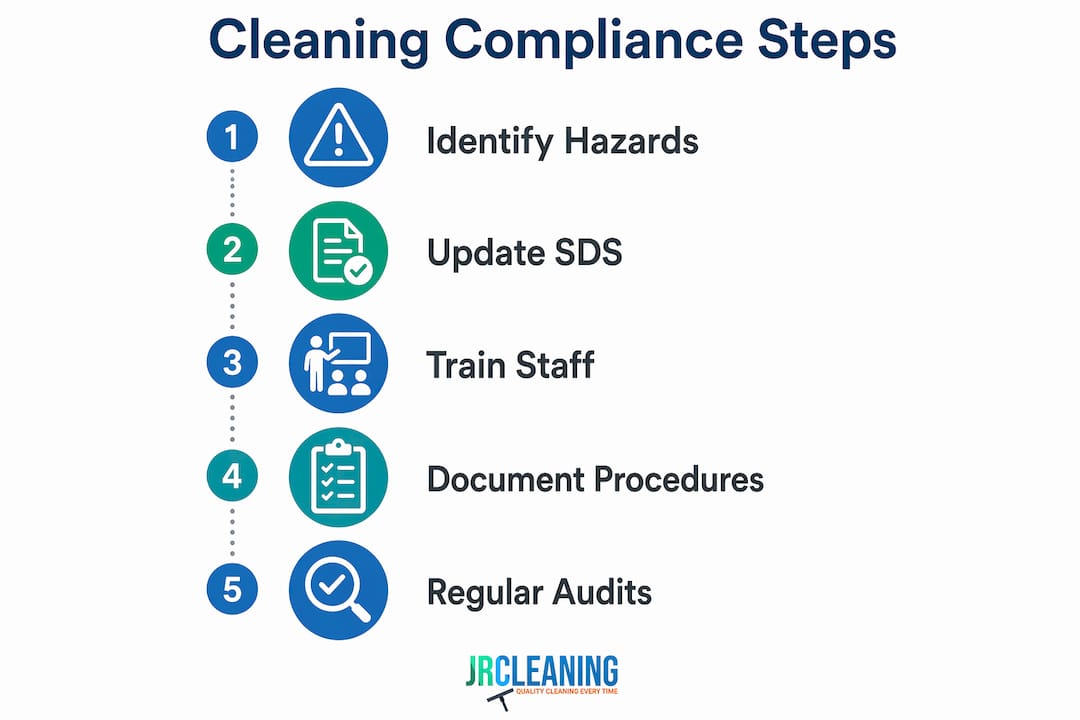

Building a compliant cleaning programme does not require a dedicated regulatory team. It requires a system. The most important shift is treating compliance as a live control mechanism rather than a box ticked at setup and forgotten.
Outdated SDS and labels are among the most common audit citations, precisely because businesses update their chemical stock without updating the associated documentation. Every time a cleaning product changes, even a like-for-like swap, the SDS must be updated and the relevant staff must be retrained on any new hazards.
Your practical compliance checklist should include:
- Chemical inventory audit. Review all cleaning products currently in use quarterly. Remove anything not on the approved list and update SDS files immediately when products change.
- SDS accessibility. SDS must be accessible to all workers at all times, not filed in a locked office. Digital SDS management systems make this straightforward and create an automatic audit trail.
- Training records. Document every training session, who attended, what chemicals were covered, and when the next update is due. Training must be ongoing, covering initial assignment and any introduction of new hazards.
- Disinfectant procurement protocol. EPA-registered disinfectants require that their registered uses match your actual environment. A product registered for food contact surfaces cannot be assumed safe for general environmental use unless the label says so.
- Cleaning logs and schedules. Professional cleaning firms should provide these as standard. Cleaning logs and training records are the documentation that auditors reach for first, and a contractor who cannot supply them is a liability, not an asset.
Pro Tip: Set a recurring calendar reminder every six months to cross-check your current chemical inventory against your SDS files and training records. This single habit prevents the documentation drift that causes most compliance failures.
For a practical starting point, a commercial cleaning checklist tailored for UK businesses gives you the structure to begin systematising your approach without having to build everything from scratch.
My perspective on cleaning compliance culture
I have spent years watching businesses treat compliance as a filing exercise rather than a management discipline, and the pattern is consistent. The businesses that get cited are almost never the ones that were negligent in spirit. They genuinely thought they were compliant. The problem was that their documentation had quietly fallen out of step with their actual operations.
The most dangerous compliance state is not knowing you are non-compliant. I have seen businesses confidently hand over their SDS folders during an audit, only for an inspector to identify that three of the listed products had been replaced months ago and the replacement chemicals had no corresponding SDS, no training record, and no label update. That is a serious citation waiting to happen, and the business had no idea.
What I find works is treating the cleaning compliance programme as something with a named owner who is accountable for keeping it current, not just setting it up. The health and safety guidance for UK properties makes clear that duty of care is ongoing. It does not lapse between audits.
Beyond the regulatory obligation, there is a genuine business case for getting this right. A workplace that demonstrably manages cleaning compliance communicates professionalism to clients, lowers insurance risk, and builds the kind of employee trust that reduces turnover. Those benefits are not incidental. They are the impact of cleaning compliance done properly.
â jamie
How Jrcleaning supports your compliance needs
If you have read this far, you already know that cleaning compliance is not a one-time project. It is an ongoing commitment to documentation, training, and verified operational practice. Jrcleaning brings over 20 years of commercial cleaning experience and a working knowledge of current health and safety regulations to every contract.

Whether you need a compliant commercial kitchen cleaning service with full hygiene documentation, or a wider commercial cleaning contract that keeps your audit records current, Jrcleaning delivers. Our fully insured team works to recognised cleaning standards and provides the logs, schedules, and training evidence your business needs to meet inspection requirements with confidence. Get in touch today for a free quote tailored to your compliance requirements.
FAQ
What does commercial cleaning compliance actually mean?
Commercial cleaning compliance means meeting all applicable health, safety, and environmental regulations governing how cleaning is carried out, which products are used, and how staff are trained. It covers documentation, chemical management, and audit readiness, not just cleanliness.
What are the risks of non-compliance in commercial cleaning?
Non-compliance can result in HSE enforcement notices, prosecution, insurance claim rejections, and significant fines. OSHA penalties for hazard communication violations reach up to $16,131 per violation in 2026, and equivalent UK enforcement carries comparable financial and reputational consequences.
How often should cleaning compliance records be updated?
Compliance records must be updated whenever a new chemical is introduced, a product changes, or new hazards are identified. Training records should also be reviewed at least annually and refreshed whenever cleaning protocols change.
Does using a professional cleaning company help with compliance?
Yes. A reputable commercial cleaning contractor provides cleaning logs, product SDS files, and training records that support your audit readiness. These documents form the core of what inspectors review during an unannounced visit.
What is the biggest cause of cleaning compliance failures?
Most compliance failures result from documentation drift, where operational practices or chemical stock changes but the associated records are not updated. This mismatch between what is written down and what is actually happening is the primary trigger for regulatory enforcement.
Recommended
- Industrial facility cleaning: safety, compliance, efficiency | J R Cleaning
- How to manage cleaning contracts for quality and compliance | J R Cleaning
- 5 key benefits of commercial cleaning for UK businesses | J R Cleaning
- Interior cleaning must-haves for spotless results in 2026 | J R Cleaning

