What is one-off cleaning? Your complete guide

Most people assume one-off cleaning is just a quick tidy-up. In reality, what is one-off cleaning is a far more thorough question than that assumption suggests. A one-off cleaning service is a single, standalone visit by professional cleaners who tackle your home top to bottom, including the areas that regular weekly cleaning never reaches. Whether you need it before a big event, after a renovation, or simply because life got busy, this guide covers everything you need to know: what it includes, when to book it, what it costs, and how to get the most from it.

Table of Contents

Key takeaways

PointDetails
It’s a one-time deep cleanA one-off cleaning service is a single visit focused on thorough, deep cleaning rather than surface maintenance.
Covers neglected areasTasks include grout, appliances, baseboards, and other spots that regular cleaning routinely misses.
Suits specific occasionsMoving house, post-party clean-ups, seasonal deep cleans, and post-renovation tidying are ideal triggers.
Cost depends on size and scopeProperty size, condition, and specialist tasks like oven or carpet cleaning all affect the final price.
Book with a clear briefProviding a detailed checklist and confirming the scope upfront gets you far better results.

What one-off cleaning actually includes

A one-off cleaning service is a single, scheduled visit where professional cleaners work through your home in a structured, thorough way. It is not a subscription. There is no recurring commitment. You book it once, they come, they clean, and the job is done to a deep-clean standard rather than a maintenance standard.

One-off cleaning tasks typically cover the entire home in one session, including dusting, floor cleaning, bathroom cleaning, kitchen cleaning, and window wiping. But it goes well beyond that. Unlike a standard regular clean, one-off cleaning goes deeper, reaching grout lines, baseboards, the inside and outside of appliances, and areas that a weekly cleaner simply does not have time to address.

Here is what a thorough one-off cleaning checklist usually covers:

  • Kitchen: inside and outside of oven, microwave, fridge, and cupboard doors; degreasing hobs; cleaning sink and taps; wiping down all surfaces
  • Bathrooms: scrubbing tiles and grout, descaling showerheads and taps, cleaning inside the toilet, polishing mirrors
  • Living areas: dusting light fittings, skirting boards, window sills, and blinds; vacuuming upholstered furniture; mopping hard floors
  • Bedrooms: dusting all surfaces including tops of wardrobes, vacuuming under beds, cleaning mirrors and glass
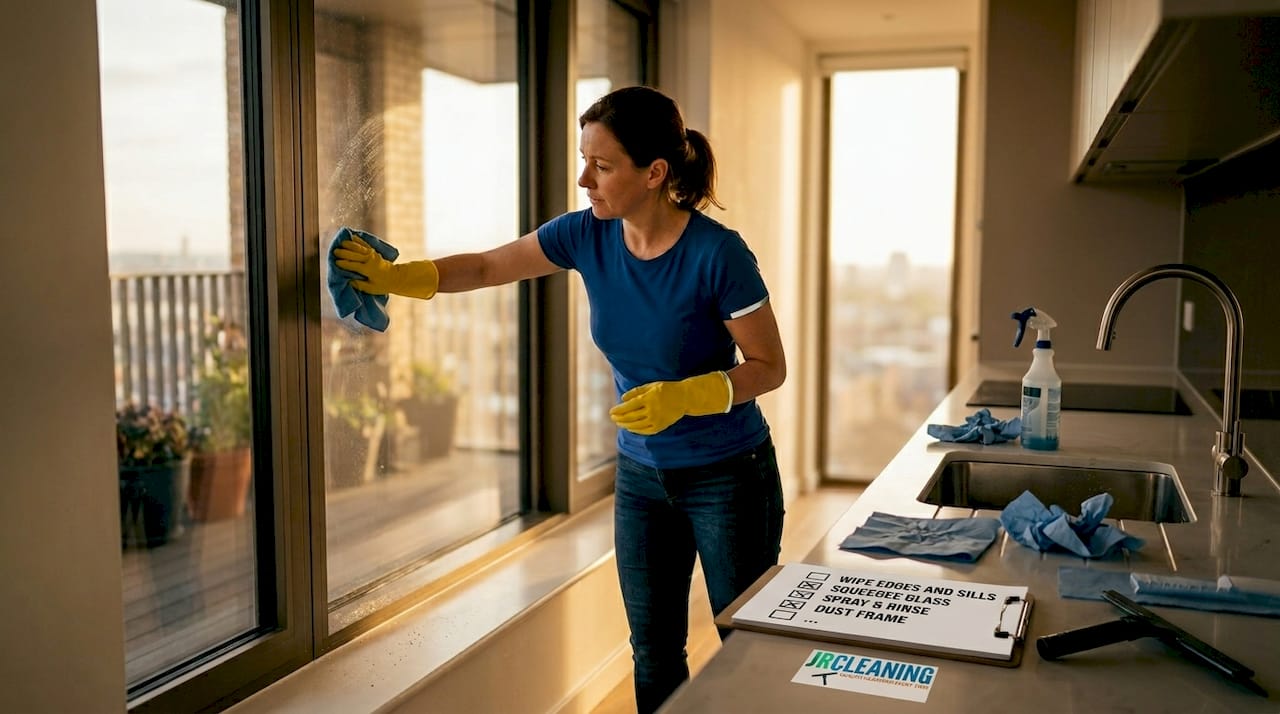
  • Windows: interior glass wiping and frame cleaning as standard, with exterior options available

The key distinction between a one-off and regular cleaning sits in intensity. Regular cleaning maintains a home that is already reasonably clean. One-off cleaning is best suited for homes that need resetting, refreshing, or preparing for a specific purpose.

Pro Tip: Ask your cleaning company for a written checklist before the appointment. This removes all ambiguity about what is and is not included, and gives you something to reference when the job is done.
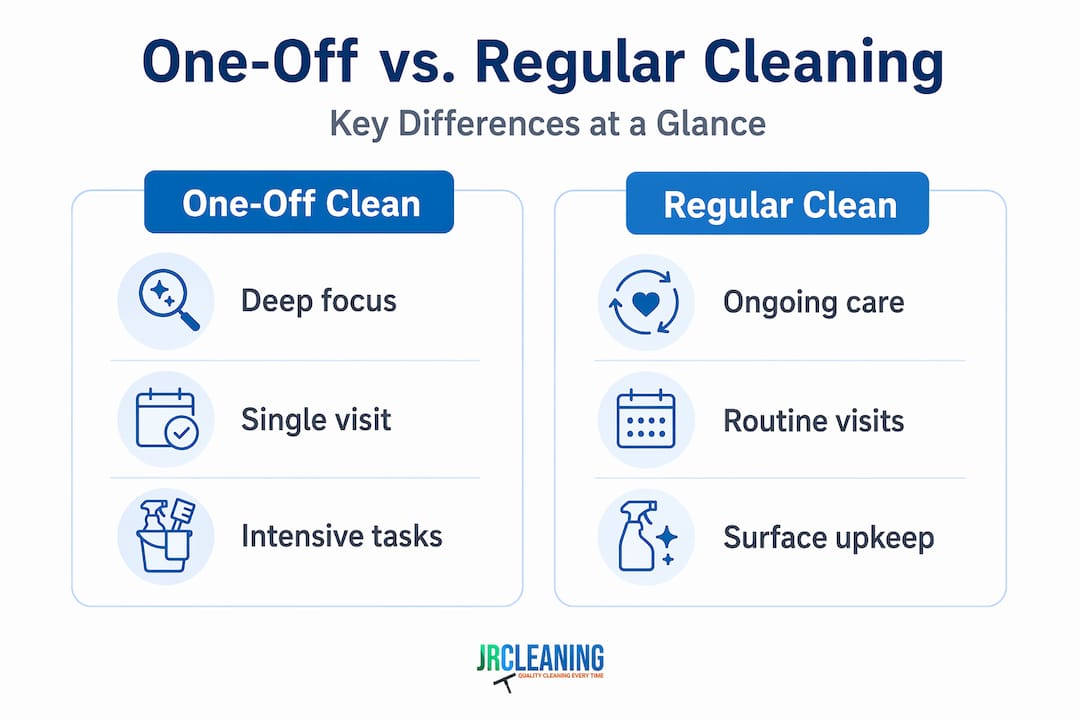
1779469166534 Infographic comparing one off and regular cleaning - J R Cleaning

When people typically use a one-off cleaning service

Life does not follow a neat cleaning schedule. There are specific moments when even the most organised household needs a professional one-off clean, and recognising those moments is half the battle.

Here are the most common situations where a one-time cleaning makes genuine sense:

  1. Moving house. Whether you are leaving a property or arriving at one, end of tenancy cleaning is one of the most common triggers. A thorough clean before handover protects your deposit and leaves the property in the right condition for the next occupant.

  2. Before or after a party or event. Hosting a large gathering takes a toll on a home. A one-off clean beforehand sets the right impression; one afterwards restores order without you spending the next three days scrubbing.

  3. Spring or seasonal deep cleaning. Many households book a one-off deep clean once or twice a year to reset the home after winter or before the warmer months. It tackles all the accumulated grime that regular cleaning never quite addresses.

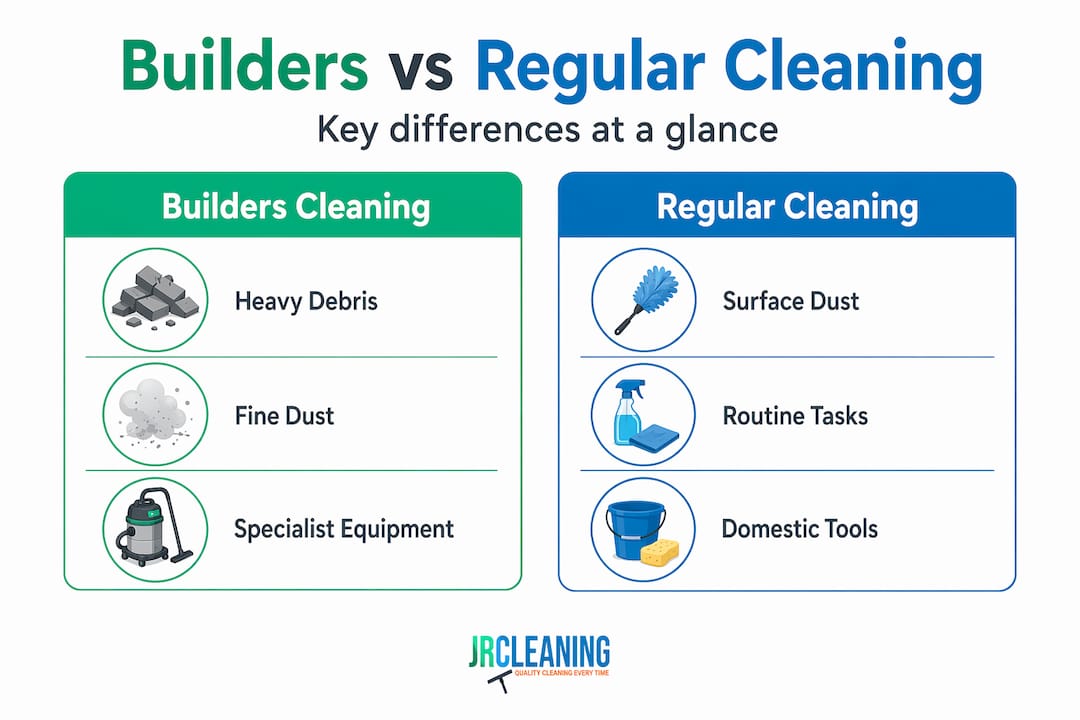
  4. Post-renovation or building work. Construction leaves behind dust, residue, and debris that ordinary cleaning cannot handle. One-off cleaning after construction covers builders’ cleans and sparkle finishes, leaving the property genuinely ready to use.

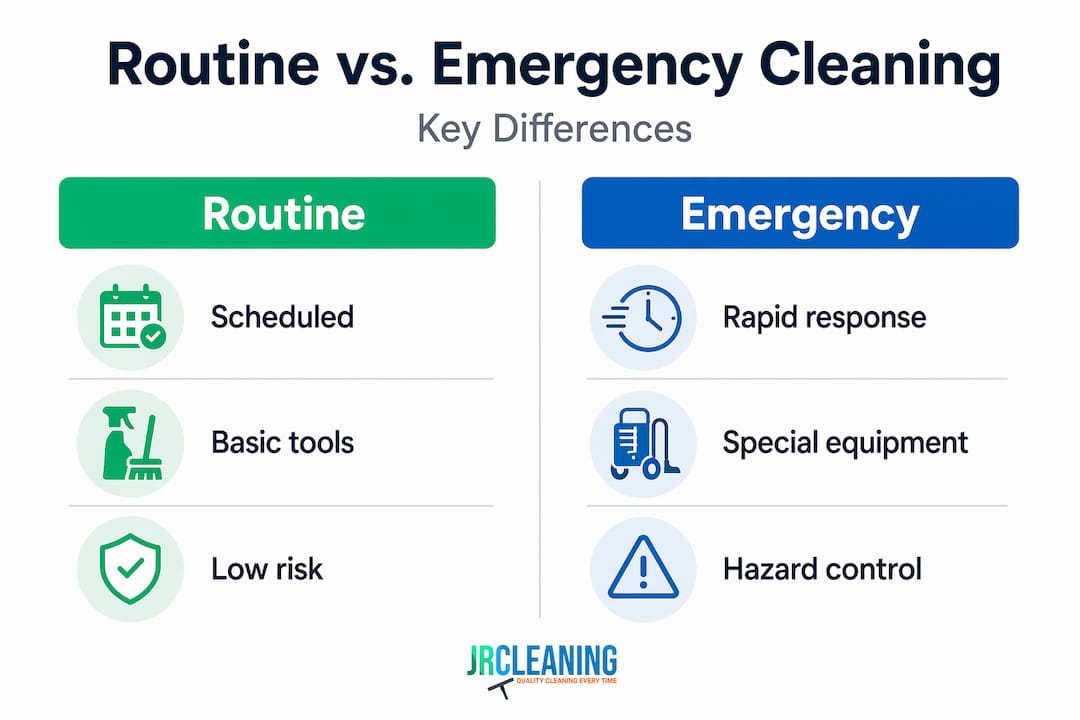
  5. Emergency or last-minute situations. Unexpected guests, a property inspection at short notice, or simply a week that got away from you can all call for urgent help. Emergency cleaning requires flexibility from providers and can cost more at short notice, but the option exists.

  6. After illness or a long absence. If a family member has been unwell, or the house has been unoccupied for a period, a one-off clean with a sanitisation focus brings everything back to a hygienic standard quickly.

The benefits of one-off cleaning in these situations go beyond convenience. You get a service tailored to your specific circumstances, booked at a time that suits you, with no obligation to continue. That flexibility is genuinely valuable.

How to choose a one-off cleaning service
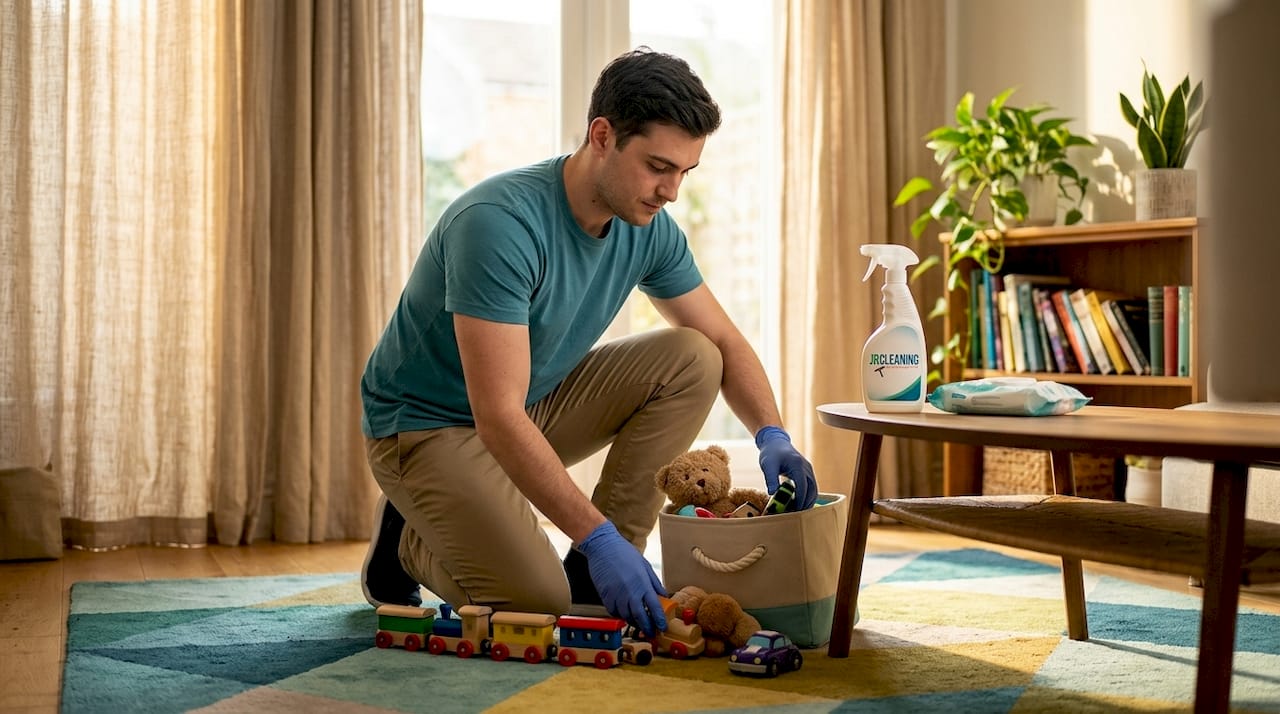
1779468234046 Cleaner picking up toys in lived in living room - J R Cleaning

Not every cleaning company offers the same quality or scope. Choosing the right one-off house cleaning service takes a little research, but it is worth getting right. A poorly executed clean wastes both money and time.

The difference between a good and a mediocre provider often comes down to a few specific factors:

  • Clarity of scope. A reputable provider will confirm exactly what is included, either via a checklist or a detailed quote. If a company is vague about what they will actually clean, treat that as a warning sign.

  • Pricing transparency. One-off cleaning costs vary by location, home size, and task complexity. Reputable companies provide itemised or clearly explained quotes rather than a flat figure with hidden extras.

  • Insurance and professional standards. Professional cleaners should be fully insured. IOSH-trained cleaning professionals are better equipped to manage workplace risks safely, which matters both for your property and the staff working in it. Always ask.

  • Reviews and reputation. Look for specific reviews that mention thoroughness, punctuality, and communication. Generic five-star ratings tell you little; detailed comments tell you a great deal.

  • Communication before the appointment. A company that asks about your property, your priorities, and any problem areas before they arrive will almost always deliver a better result than one that simply turns up and begins.

Pro Tip: Before booking, walk through your home and note the three areas you most want attention on. Share these with the cleaning company when you enquire. It helps them allocate time properly and means the areas that matter most to you will not get rushed.

Understanding why professional cleaning matters for hygiene and safety can also help you frame your expectations before booking.

One-off cleaning costs: what affects the price

Pricing for a one-off cleaning service is not fixed. Several variables influence the final cost, and knowing them in advance helps you budget accurately and avoid surprises.

A deep clean typically takes between 4 and 10 hours depending on the size and condition of the property. Smaller homes of around 1,000 to 2,000 square feet usually fall in the 6 to 8 hour range, while larger properties can require multiple days. Time directly affects cost.

FactorImpact on price
Property sizeLarger homes take more time and cost more
Current conditionHeavily soiled properties require longer, more intensive work
Specialist tasksOven cleaning, carpet cleaning, and exterior windows add to the total
LocationUrban areas, particularly London, carry higher hourly rates
Team sizeLarger cleaning crews complete jobs faster but may carry higher labour costs
UrgencyLast-minute or same-day bookings often attract a premium

As a rough guide, one-off deep cleaning in London starts at around £17 to £20 per hour, though rates outside major cities are generally lower. The total cost for an average three-bedroom home will typically sit between £150 and £350, depending on the factors above.

Getting a tailored quote is always the right approach. A good company will ask about your property before providing a figure rather than offering a flat rate that may not reflect the actual work involved.

My honest take on getting the most from a one-off clean

I have seen a lot of people book a one-off cleaning service and then undercut it in ways that were entirely avoidable.

The most common mistake I see is people failing to prepare the space. Cleaners are there to clean, not to sort through clutter, move piles of clothes, or deal with blocked access to areas. If the kitchen counter is stacked high before they arrive, the surfaces underneath it will not get the attention they need. Clear the surfaces, put things away, and let the professionals do what they are actually good at.

The second thing I notice is unclear communication. In my experience, the clients who get the best results are the ones who treat the pre-appointment conversation seriously. Tell the company which rooms matter most. Mention the things that have not been touched in months. Ask specifically whether the tasks you care about are included in the quote. Most of the disappointment I have heard about comes from a mismatch between what the client assumed and what the cleaner was briefed to do.

My broader observation is this: one-off cleaning works best when it is part of a strategy rather than a reaction to a crisis. Booking it before a major event, at the start of a new season, or when you move into a new home gives you a clean baseline to maintain. Booking it only when things have reached a difficult point means paying more for a harder job and starting from a worse position.

Use a one-off clean to reset. Then keep it that way.

— jamie

Ready to book a one-off clean?

If this article has helped clarify what a one-off cleaning service actually involves, the next step is finding a provider who delivers it properly.
1774551979294 jrcleaning - J R Cleaning

Jrcleaning has over 20 years of experience delivering professional residential and commercial cleaning across the UK. Whether you need a one-off deep clean before a house move, a post-renovation sparkle clean, or a thorough seasonal refresh, the team can tailor the service to your specific property and priorities. Every visit is carried out by fully insured professionals who work to strict health and safety standards. You can explore the full range of cleaning services available or visit the Jrcleaning homepage to request a free quote. Getting a tailored price takes minutes, and there is no obligation to proceed.

FAQ

What is a one-off cleaning service?

A one-off cleaning service is a single professional clean of your home, carried out to a deep-clean standard. It covers areas that regular cleaning misses, including appliances, grout, baseboards, and hard-to-reach surfaces.

How is one-off cleaning different from regular cleaning?

Regular cleaning maintains a home that is already reasonably clean, focusing on surface upkeep during each visit. One-off cleaning is more intensive and targets neglected or built-up areas in one thorough session.

How much does one-off cleaning cost in the UK?

Costs vary based on property size, condition, and location. As a rough guide, a three-bedroom home typically costs between £150 and £350, with hourly rates in London starting around £17 to £20.

How long does a one-off deep clean take?

A deep clean generally takes between 4 and 10 hours depending on property size and current condition. Smaller homes average 6 to 8 hours, while larger properties may need more than one day.

When should I book a one-off cleaning service?

Common triggers include moving house, preparing for or recovering from an event, post-renovation cleaning, seasonal deep cleans, or any situation where your home needs a thorough reset rather than routine maintenance.
Commercial window cleaning steps for facility managers

Streaky glass, mineral residue, and half-finished cleaning runs are not just cosmetic problems. For facility managers and business owners, they signal a process that is costing time, money, and professional credibility. Getting the commercial window cleaning steps right requires more than a squeegee and a bucket. It demands preparation, the right equipment, sequenced technique, and a clear understanding of safety requirements. This guide breaks down exactly how to clean windows commercially, whether you are managing a mid-rise office block, a retail unit, or a multi-storey facility where working at height is part of the equation.

Table of Contents

Key takeaways

PointDetails
Preparation prevents poor resultsDust frames and remove debris before any wet cleaning to avoid streaks being dragged across glass.
Sequence controls the outcomeWork top to bottom on every pane, whether using traditional methods or a water-fed pole system.
Water-fed poles need precise rinsingPurified water must be the last substance to contact the glass to prevent spotting and residue.
Safety cannot be improvisedHigh-rise and elevated cleaning requires documented procedures, certified staff, and independent fall arrest systems.
Hard-water stains need specialist treatmentRoutine washing cannot remove mineral etching. Professional restoration products are required for stubborn deposits.

Commercial window cleaning steps: preparation first

Before any water touches glass, preparation determines whether your team achieves a professional finish or repeats the job the following week.

Tools and equipment you need

EquipmentPurpose
Squeegee (various sizes)Core tool for removing solution from flat glass surfaces cleanly
Microfibre clothsLint-free drying and detailing around frames and edges
Water-fed pole systemReach and clean upper storeys without access equipment
Telescopic extension polesExtend reach for upper interior and exterior panes
Buckets with wringerControl solution and reduce drips during application
Soft-bristle scrubbing sleeveAgitate and loosen surface contamination before squeegeeing
Safety harness and fall arrestRequired for any work at elevated height
Non-slip footwearReduce slip risk on wet surfaces or elevated platforms

Beyond equipment, a pre-job site assessment should be standard practice before every visit. Check weather conditions, access routes, and structural anchor points where relevant. Cleaning in direct sunlight causes solution to dry too fast and leaves streaks regardless of technique. Schedule cleaning during overcast periods or in the shade wherever possible.

Pro Tip: Standardise your tool kit per crew and maintain a checklist. Worn squeegee blades and fraying microfibre cloths are two of the most common causes of repeat streaking on large commercial facades.

Traditional method: step-by-step window cleaning process

The manual, squeegee-based process remains the benchmark for interior glass and lower-floor exterior work. Discipline in sequencing is what separates professional results from amateur ones.

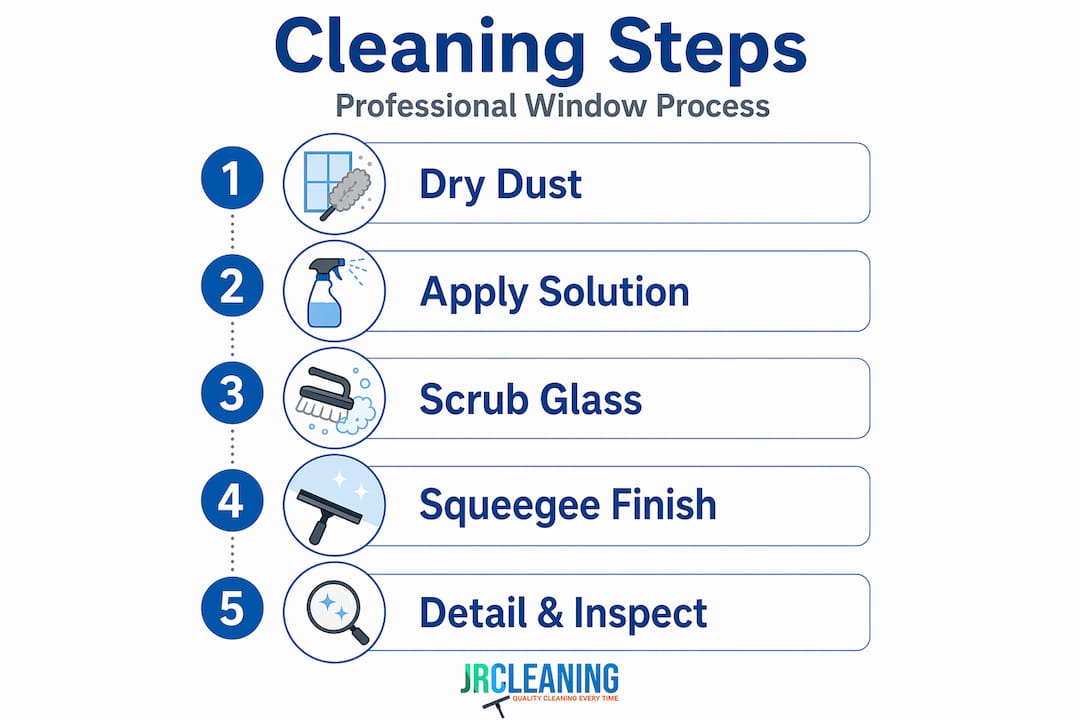
  1. Dry dust all frames, tracks, and sills first. Vacuuming or dusting before wet cleaning removes loose debris that would otherwise drag across glass and cause streaking. Work the frame before you touch the glass.

  2. Mix your cleaning solution. A few drops of washing-up liquid in warm water works effectively for routine commercial glass cleaning. For heavy soiling or construction residue, use a purpose-made commercial glass cleaner. Avoid anything with excess soap as it leaves film.

  3. Apply solution to glass with a scrubbing sleeve. Soak the sleeve and work the entire pane in overlapping horizontal passes. Do not skip corners. Allow 20 to 30 seconds of dwell time on heavily soiled glass.

  4. Squeegee from top to bottom without lifting mid-stroke. Hold the upper edge of the squeegee blade slightly ahead of the lower edge through each stroke. This angle prevents solution from running back under the blade and leaving lines. Overlap each stroke by around two centimetres.

  5. Wipe the blade after every single pass. This is where most in-house teams lose consistency. Controlling blade-wipe timing between strokes prevents dirt redeposition on large commercial facades. Use a clean, folded microfibre cloth each time.

  6. Detail edges and corners with a dry microfibre cloth. Run the cloth along the frame perimeter to catch any pooling solution. Work inside-out to avoid spreading residue back onto the glass.

  7. Clean window screens and frames separately. Brushing screens with warm water and a soft brush, then air drying, prevents them from depositing grit back onto clean glass once reinstalled.

  8. Verify the result. Step back and view the glass at an angle from two different positions. Streaks are easier to spot under raking light. If a streak appears, identify which side it is on by comparing the direction of your wipe strokes. Interior streaks run vertical; exterior streaks run horizontal if you used opposite wipe orientations on each side.

Pro Tip: Use a different wipe orientation on interior and exterior glass. Horizontal strokes outside, vertical strokes inside. When a streak appears, you will know immediately which side needs re-cleaning without guessing.

Water-fed pole method: the professional window washing guide

1779361899192 Infographic of commercial window cleaning steps - J R Cleaning

1779361403105 Technician cleaning windows with water fed pole - J R Cleaning

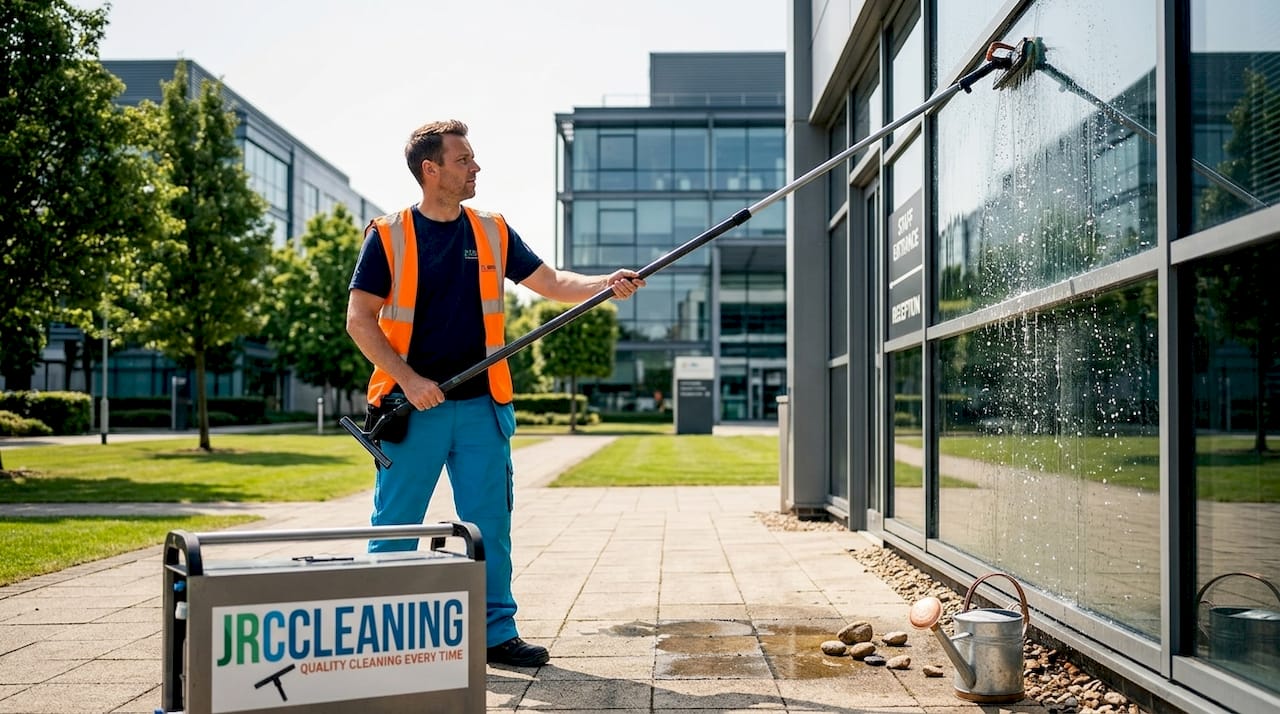
The water-fed pole system has become the standard for efficient window cleaning methods on commercial buildings with multiple storeys. It removes the need for ladders on most low-to-mid-rise work, improving safety and speed.

The system pumps purified water through a telescopic pole to a brush head, dissolving and rinsing dirt without leaving mineral deposits on drying. The critical principle: purified water must always be the last thing to contact the glass.

  1. Start at the top of each window. Work downward from the head of the frame. This prevents dirty water from running over already-cleaned sections.

  2. Leave the top two to three inches untouched during the initial scrub. Beginning the scrub two to three inches from the top and rinsing that strip first avoids dragging grime from the very top edge back down the pane during rinsing.

  3. Scrub in controlled overlapping passes. Use consistent brush pressure across the pane. Avoid scrubbing the entire window before rinsing as this causes soil redeposition. Scrub a section, then rinse it before moving down.

  4. Rinse in controlled two-foot-wide sections. Move the brush in slow, vertical passes letting purified water flush the surface thoroughly. Rinsing mistakes are the most frequent cause of spots and streaking with pole systems. Do not rush this stage.

  5. Final rinse contact must be purified water only. After the scrubbing brush has completed its pass, remove it from the glass and make one clean purified-water-only pass from top to bottom. This is non-negotiable for a spotless result.

  6. Decide whether to clean frames. Cleaning frames with the brush removes grime but can introduce more debris to the glass during rinsing. For heavily soiled commercial properties, cleaning frames first and then completing the glass sequence separately gives better results.

Proper rinsing discipline when using water-fed pole systems is what separates truly streak-free commercial results from acceptable ones. If your team is producing spots consistently, the rinsing sequence is where to investigate first.

Pro Tip: Test your water supply’s TDS (total dissolved solids) reading before each job. Purified water should read below 10 parts per million. Above that threshold, spotting becomes likely regardless of technique.

Safety protocols for commercial window cleaning

Safety management in commercial window cleaning is not just about compliance. It directly affects whether your team comes home and whether your business faces liability.

  • Document standard operating procedures for every site. Site-specific safety plans should include anchor point verification, equipment inspection checklists, and emergency rescue procedures. A generic SOP is not sufficient for high-rise work.

  • Conduct a pre-job building assessment. Pre-job anchor inspections and parapet condition checks should be completed before any elevated work begins. Do not assume previous inspections are still current.

  • Use independent fall arrest systems at height. Fall protection must not rely on the work positioning system itself. A tethered fall arrest must be independent and separately anchored.

  • Inspect all equipment daily. Ropes, harnesses, anchor connectors, and platforms must be checked before every shift. Record these inspections. If a piece of equipment shows wear, it must be removed from service immediately.

  • Only deploy trained, certified operatives for elevated work. Technicians working at height should hold current qualifications under the relevant IRATA or equivalent certification scheme.

  • Plan for weather changes. Wind and rain are live hazards for elevated window cleaning. Define wind-speed thresholds above which work is suspended and communicate these to every crew member.

Effective high-rise window cleaning demands site-specific safety plans with anchor point verification, daily gear inspections, certified staff, and documented emergency rescue preparation. Every item on that list is a failure point if it is missing.

Pro Tip: Brief your cleaning crew on the specific building hazards each day before work begins. Most incidents in commercial window cleaning involve known hazards that were not formally communicated to the team that day.

Hard-water stains and ongoing maintenance

Understanding the difference between routine cleaning and specialist stain removal prevents wasted effort and recurring disappointment.

Routine washing removes surface dirt, grime, fingerprints, and pollution deposits. It does not remove mineral scale, calcium carbonate deposits, or glass etching. Hard-water stains require specialised removal that is distinct from standard window washing. Once minerals etch into glass at a microscopic level, water and squeegee work will not resolve them.

Cleaning typeWhat it removesWhat it cannot remove
Routine washDirt, grime, fingerprints, light soilingMineral deposits, etching, heavy scale
Specialist restorationMineral buildup, calcium scale, etchingStructural glass damage, deep scratches

Professional restoration uses polishing compounds and acid-based or chelating solutions to dissolve mineral deposits and restore glass clarity that routine cleaning cannot recover. For facility managers, this distinction matters for scheduling and budgeting.

Regular cleaning prevents the buildup that leads to mineral etching in the first place. Scheduling routine window cleaning every four to eight weeks for most commercial properties reduces the likelihood of needing specialist restoration work, which is significantly more expensive. Build cleaning frequency into your maintenance calendar and treat it as a preventive cost rather than a reactive one.

Pro Tip: If your building is near a hard-water supply area or exposed to irrigation runoff from landscaped areas, inspect glass for early mineral spotting every six weeks. Early intervention with a specialist cleaner prevents the etching stage entirely.

My perspective on what actually works in practice

I have spent years working with commercial properties of all sizes, and the single most underrated element of the whole window cleaning process is what happens before the first drop of water lands on the glass.

Most in-house teams rush straight to wet cleaning. They skip the dry dusting, they skip the pre-inspection, and then they spend the next hour trying to diagnose why the glass is still streaking. The answer is almost always in the preparation. Professional window cleaners control variables sequentially, dry cleaning followed by directional wet cleaning, because that discipline is what makes the rest of the process predictable.

My honest view on water-fed poles: they are the right tool for most commercial exterior work above the ground floor. But they require proper team training, particularly on rinsing sequences. I have seen facilities invest in expensive pole systems and then operate them incorrectly for months, producing worse results than a basic squeegee and bucket would have. Equipment is only as good as the process behind it.

Invest in training before you invest in equipment. For any team managing commercial glass cleaning at scale, that sequence is what determines long-term results and safety outcomes.

— jamie

Get professional support for your commercial property

Managing commercial window cleaning at a high standard takes process discipline, the right tools, and ongoing commitment to safety. If your in-house team is stretched or you need a contractor who takes both results and risk management seriously, Jrcleaning has over 20 years of experience delivering professional cleaning services across commercial and residential properties in the UK.

1774551979294 jrcleaning - J R Cleaning

Jrcleaning is fully insured, trained to strict health and safety standards, and covers a full range of commercial cleaning services including window cleaning, gutter cleaning, and building exterior maintenance. Whether you need a one-off clean or a structured maintenance programme, the team at Jrcleaning is equipped to deliver results you can count on. Contact us today for a free, no-obligation quote.

FAQ

What are the basic steps for commercial window cleaning?

The core commercial window cleaning steps are: dry dust frames and sills, apply cleaning solution, scrub glass, squeegee from top to bottom using overlapping strokes, wipe the blade between passes, and detail edges with a microfibre cloth.

How does the water-fed pole process differ from traditional cleaning?

Water-fed pole systems use purified water delivered through a brush head to scrub and rinse glass without leaving mineral deposits. The critical difference is that purified water must be the last thing to contact the glass, replacing the squeegee and drying step used in traditional methods.

Why do commercial windows streak after cleaning?

Streaking is almost always caused by three things: cleaning in direct sunlight where solution dries too fast, failing to wipe the squeegee blade between strokes, or skipping dry dusting before wet cleaning. Each issue introduces contamination or speeds up drying unevenly.

What safety equipment is required for high-rise window cleaning?

High-rise commercial window cleaning requires an independent fall arrest system that is separate from the work positioning system, daily inspection of all harnesses and connectors, site-specific safety documentation, and certified operatives trained for working at height.

Can routine window cleaning remove hard-water stains?

No. Routine washing removes surface dirt and grime but cannot dissolve mineral deposits or address glass etching. Hard-water stain removal requires specialist restoration products and polishing techniques that go beyond standard window washing.

Questions to ask cleaners before you hire

Getting this wrong costs more than money. When you let someone into your home or commercial property, you are placing real trust in them. Knowing the right questions to ask cleaners before you commit can mean the difference between a service that runs smoothly for years and one that leaves you frustrated, out of pocket, or worse. This guide gives you a practical framework covering background checks, products, pricing, and contracts so you can hire with confidence.

Table of Contents

Key takeaways

PointDetails
Verify insurance and credentialsAlways confirm a cleaner carries liability insurance before they set foot in your property.
Ask about background checksReputable companies vet their staff; independent cleaners should offer references you can actually contact.
Clarify scope in writingAgree exactly what tasks are covered in each visit to avoid disputes later.
Confirm product safetyIf you have pets or young children, ask specifically about the products used and request safer alternatives.
Trial periods reduce riskA short trial clean lets you assess quality and reliability before any long-term commitment.

What to consider before asking cleaning service questions

Before you pick up the phone or send an enquiry, it helps to understand what you are actually evaluating. Hiring a cleaner is not just about finding someone who can hold a mop. You are assessing trustworthiness, professionalism, and fit for your specific property.

Here are the core areas to have in mind as you prepare your cleaning company inquiries:

  • Company or independent cleaner. An agency provides accountability and cover if a cleaner is ill or leaves. An independent cleaner may offer more consistency but carries more personal risk if something goes wrong.
  • Insurance and bonding. Liability insurance covers damage or loss caused by cleaning staff. Without it, you may struggle to recover costs.
  • References and track record. How long have they been operating, and can they provide clients you can speak to directly?
  • Scope of service. Do they cover everything you need, from kitchens and bathrooms to windows and carpets?
  • Scheduling. Can they work around your routine, or will you need to reorganise your week every time they visit?
  • Pricing transparency. Are the rates clear, or is there room for unexpected additions to the bill?
  • Safety for your household. Pets, young children, and people with allergies all have specific needs that affect which products are appropriate.

Pro Tip: Write your priorities down before you speak to any cleaner. Knowing what matters most to you makes it far easier to spot when an answer is vague or evasive.

Understanding why detailed quotes matter is a good starting point before you start comparing services.

1. Are you a cleaning company or an independent cleaner?

This is the first question worth asking, and the answer shapes everything else. A registered cleaning company typically has employer liability insurance, handles tax and national insurance for its workers, and can send a replacement if your usual cleaner is unavailable.

An independent cleaner may be highly skilled and offer a more personal service, but you will need to verify insurance and references yourself. Neither option is inherently better. What matters is that you understand exactly what you are getting.

2. Are you fully insured and bonded?

This question is non-negotiable. Cleaning services should carry insurance to protect you against damage or theft during a visit. Ask for proof, not just assurance. A reputable company will be happy to show you their policy details.

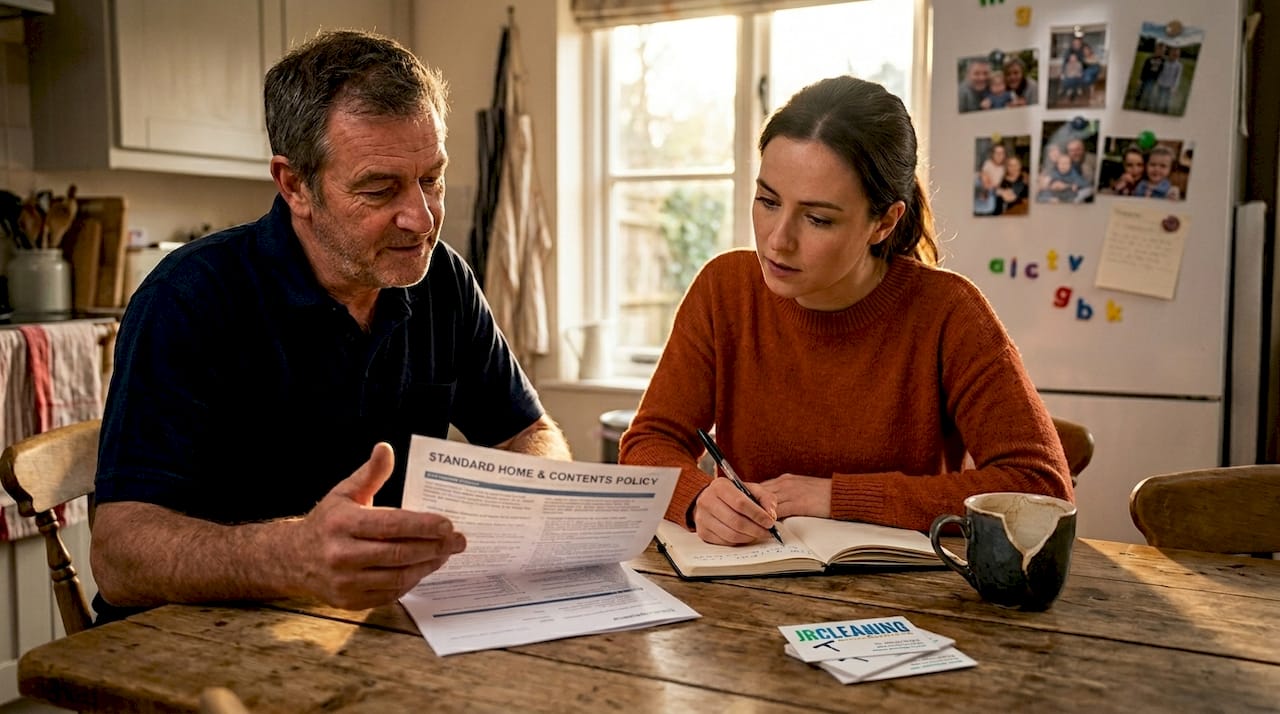
1779287625689 Cleaner presenting insurance paperwork at kitchen table - J R Cleaning

If a cleaner hesitates or becomes defensive when you ask, treat that as a warning sign. You should also ask whether their insurance covers all members of staff who may visit your property, not just the business owner.

3. Do you carry out background checks on your staff?

Background checks are a critical step in ensuring the people entering your home are trustworthy. Ask a cleaning company directly whether all employees are screened before they are assigned to client properties. For independent cleaners, ask for at least two references from previous or current clients, and follow up on them.

Many homeowners skip the reference check because it feels awkward. That is precisely why those who do it tend to have far better long-term experiences with the cleaners they hire.

4. Can you provide references from current clients?

A cleaner with confidence in their work will have no hesitation providing references. When you contact referees, ask specific questions. How long have they used the service? Have there been any problems, and if so, how were they handled? Would they recommend them without reservation?

Vague or generic praise is less useful than a specific account of reliability and quality over time. You want to hear from someone whose home resembles yours in size and type where possible.

5. What cleaning products do you use?

This question matters more than most people realise. Some disinfectants can be toxic to pets, and certain chemicals pose risks to young children or people with respiratory conditions. Ask what products are used as standard, and whether eco-friendly or fragrance-free alternatives are available.

A professional cleaner will know exactly what is in their cleaning kit and should be able to provide safety data sheets or product names if asked. If they cannot answer this question confidently, that tells you something important about how they approach their work. See domestic cleaning methods explained for more on what professional standards look like.

Pro Tip: If you have a pet, ask the cleaner to list the specific products used on floors and surfaces. Several common floor cleaners contain compounds that are harmful to cats and dogs even after drying.

6. Do you bring your own equipment and supplies?

Some cleaners bring everything. Others expect to use your products and equipment. Both arrangements are common, but you need to know which applies before the first visit.

If they bring their own supplies, confirm that the products are appropriate for your surfaces, particularly if you have natural stone worktops, hardwood floors, or delicate fixtures. If you are expected to supply products, check whether they have specific preferences or requirements.

7. What exactly is included in a standard clean?

Clarifying the scope of work prevents the most common source of dissatisfaction: the homeowner who assumed the oven was included, and the cleaner who assumed it was not. Ask for a written list of what is covered in a standard visit.

Typical standard clean inclusions cover vacuuming, mopping, wiping surfaces, and cleaning bathrooms and kitchens. Tasks like cleaning inside the oven, washing windows, or moving heavy furniture are almost always extras. Get this in writing before you agree to anything.

8. How do you handle specialist or delicate items?

Antique furniture, artwork, expensive rugs, smart home equipment and certain fabrics all require specific handling. Ask how the cleaner approaches items that need particular care, and whether there are things they will not touch or areas they avoid.

A good cleaner will ask you about these things before the first visit. If they do not raise the subject at all, raise it yourself and observe how they respond. Confidence and clarity here suggest experience. Vagueness suggests the opposite.

9. How are your rates structured?

Hidden fees cause real dissatisfaction and are among the most frequent complaints about cleaning services. When asking about best questions for cleaners, pricing transparency is one of the most revealing areas. Ask whether the rate is hourly or per visit, what determines the final cost, and whether first cleans or deep cleans are priced differently.

It is also worth asking what happens if a visit runs over the estimated time, or if you need to add tasks at short notice. Get clear answers before work begins, not after you see the invoice.

10. What is your cancellation and rescheduling policy?

Life is unpredictable, and you will occasionally need to cancel or move a booking. Ask what notice is required, whether there are cancellation fees, and how the cleaner handles situations where they need to cancel or send a different person.

Scheduling flexibility varies considerably between providers. Some operate with considerable room for change; others are very rigid. Knowing this upfront helps you decide whether the arrangement suits your lifestyle.

11. Do you offer a written contract?

A written contract protects both parties by formalising the agreed scope, price, and policies. Any professional cleaning company should be willing to provide one. For independent cleaners, a simple written agreement setting out what was agreed is still far better than a verbal understanding.

Read it carefully. Check for clauses relating to damage liability, price increases, and termination notice. Understanding how to manage cleaning contracts can save you considerable trouble down the line.

12. Can I start with a trial period?

Trial periods increase trust and reduce risk on both sides. A single visit or a short run of two or three cleans lets you evaluate whether the standard meets your expectations before you commit to a regular arrangement.

A cleaner who is confident in their work will welcome this approach. One who resists it is worth treating with caution.

Comparing cleaners: a quick reference

QuestionWhy it matters
Insurance and bondingProtects you if damage or loss occurs
Background checksConfirms trustworthy personnel
Scope of work in writingPrevents disputes about what is included
Product safetyCritical if you have pets, children, or allergies
Transparent pricingAvoids unexpected charges
Written contractFormalises expectations and protects both parties
Trial period availableLets you assess quality before committing

Red flags to watch for

There are situations where you should trust your instincts and walk away. Be cautious of any cleaner who cannot provide proof of insurance, refuses to give references, quotes verbally without any written confirmation, or becomes uncomfortable when you ask straightforward questions.

Also watch for a lack of specificity. If you ask what is included in a standard clean and receive a vague answer, that vagueness will likely show up in the work itself.

My honest take on what questions actually matter

I have spoken to a lot of homeowners who felt they were being too demanding by asking detailed questions before hiring a cleaner. In my experience, the opposite is true. The cleaners who perform best over time are almost always the ones who welcomed thorough questions from the start.

The insurance question is the one most people skip because they assume it is a given. It is not. I have seen situations where uninsured cleaners caused accidental damage and there was no straightforward route to recovery. That one question, asked upfront, makes a significant difference.

I also think the product safety conversation is underrated. Most people only think to ask after something goes wrong. Asking about it before the first visit signals to the cleaner that you are attentive, and it often prompts them to be more careful throughout the whole job.

My personal view is that the trial period is the single most useful thing you can request. No reference, however glowing, tells you as much as watching the actual quality of work in your own property. Ask for it every time, and treat any reluctance to offer one as meaningful information.

— jamie

Why Jrcleaning takes the guesswork out of hiring

1774551979294 jrcleaning - J R Cleaning

If reading through this checklist has made you realise how much legwork goes into vetting a cleaner properly, you are not alone. That is exactly why many homeowners and property managers turn to a trusted professional service rather than starting from scratch.

Jrcleaning brings over 20 years of experience to both residential and commercial cleaning across the UK. Every member of the team is fully insured, and the company adheres to strict health and safety regulations so you never have to chase proof of cover or guess about product safety. From interior cleans and window cleaning to specialist exterior work, Jrcleaning offers a full range of professional cleaning services tailored to your property’s specific needs. Get in touch for a free, no-obligation quote and see exactly what is included before you commit to a single visit.

FAQ

Does a house cleaner need to be insured?

Yes. Liability insurance covers damage or loss caused during a clean, protecting you from being left out of pocket. Always ask for proof of cover before agreeing to any service.

What should be included in a standard house clean?

A standard clean typically covers vacuuming, mopping, surface wiping, and bathroom and kitchen cleaning. Tasks such as oven cleaning or window washing are usually priced separately, so always confirm the scope in writing.

How do I know if a cleaner is trustworthy?

Ask for references from current clients and confirm whether the company conducts background checks on staff. Following up on references directly is one of the most reliable ways to verify trustworthiness before hiring.

Is a written contract necessary for a house cleaner?

A written contract is strongly advisable. It formalises the agreed scope, pricing, and cancellation terms, reducing the risk of disputes and giving both parties a clear reference point if questions arise.

How can I test the quality of a new cleaner?

Request a trial period of one to three visits before committing to a regular arrangement. This gives you a direct measure of their standard of work in your own property rather than relying on descriptions or references alone.

How to prepare for cleaning service: your full guide

Getting a professional cleaner in is one of the best things you can do for your home, but knowing how to prepare for cleaning service makes the real difference between a good result and a great one. Many homeowners waste their cleaner’s time without realising it, simply because the home is not set up for efficient work. This guide covers everything from decluttering and communicating special instructions to day-of safety measures and post-clean quality checks. Follow these steps and your cleaner can focus on what they do best.

Table of Contents

Key takeaways

PointDetails
Clear clutter, not surfacesProfessionals prefer free access over pre-cleaned surfaces, so tidy personal items rather than scrubbing ahead.
Communicate your prioritiesShare room-specific instructions and product preferences before your cleaner arrives to avoid misunderstandings.
Secure valuables and medicationsStore sensitive items safely before the team arrives to protect your privacy and limit liability.
Prepare the home environmentOpen windows and remove pets from areas being cleaned to support safety and efficiency.
Verify results with a walkthroughA quick check of floors, surfaces, and bins after the clean helps maintain standards and gives useful feedback.

How to prepare for cleaning service: decluttering first

One of the biggest misconceptions homeowners have is that they need to pre-clean their home before the cleaners arrive. You do not. Professionals prefer clear access to surfaces rather than clients scrubbing ahead, which can actually interfere with specialist techniques. Your job is to remove clutter. Their job is to clean.

1779201155522 Man declutters kitchen surfaces before cleaning - J R Cleaning

Think about what is sitting on your floors, surfaces, and countertops. Toys scattered across the living room, clothes piled on chairs, papers spread across desks, and dishes stacked in the sink all prevent your cleaner from reaching the surfaces underneath. These items need to go before the team arrives.

A practical approach is to keep a few baskets or boxes in each room specifically for rapid clutter collection. Scoop loose items in, pop the lid on, and move it out of the way. You do not need to sort, fold, or organise. You just need surfaces and floors to be accessible.

One critical step many people skip: secure valuables, medications, and important documents before the team arrives. This is not about distrust. It is about protecting your privacy, limiting any potential liability, and making sure nothing gets accidentally misplaced during a thorough clean.

Pro Tip: A 10 to 15 minute daily reset where you clear floors and surfaces each evening is worth more than any last-minute blitz. Cleaners can apply their methods far more effectively when a home is consistently tidy rather than occasionally cleared in a rush.

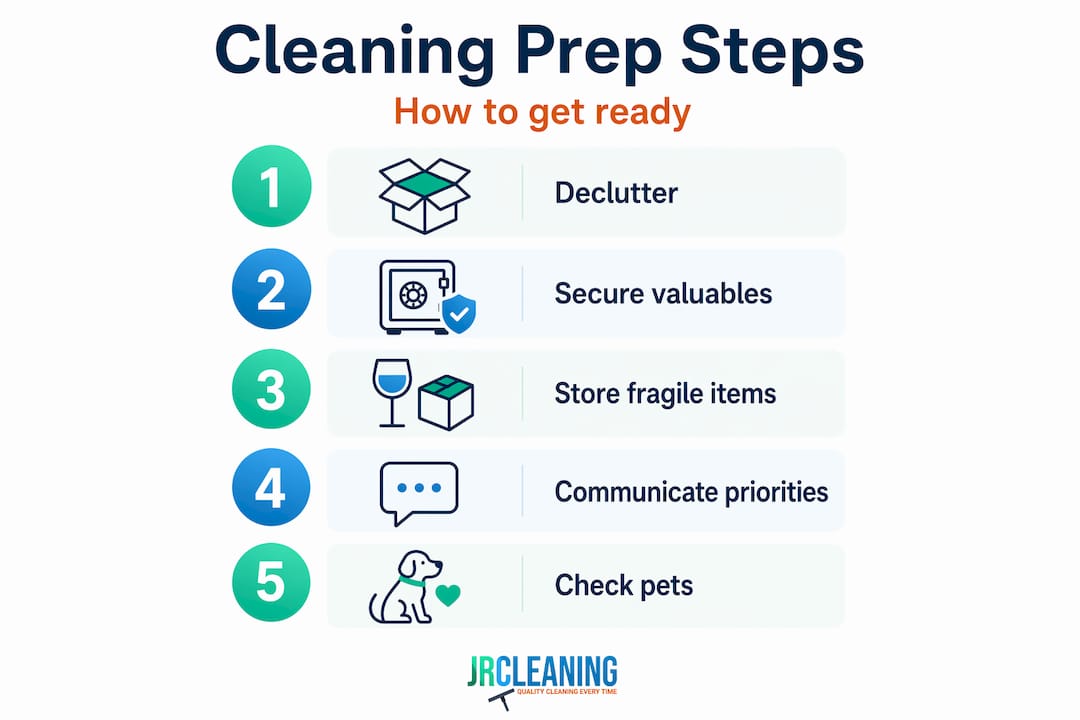
Here is a quick summary of what to pick up before your cleaner arrives:

  • Clothing, shoes, and bags left on floors or chairs
  • Children’s toys, games, or sports equipment
  • Loose papers, magazines, and opened post
  • Dishes from tables, countertops, and sinks
  • Toiletries and personal grooming items from bathroom surfaces
  • Pet bedding, leads, or accessories left in walkways

Communicating with your cleaning service

Good preparation is not just physical. What you say to your cleaning team before they arrive shapes the entire visit. Professional cleaning companies use checklist-driven processes with client-specific instructions, so the more clearly you communicate, the better your results.

Start by distinguishing between a standard clean and a deep clean. These are not the same service. A standard clean covers regular maintenance tasks such as hoovering, mopping, wiping surfaces, and cleaning bathrooms. A deep clean goes much further, tackling skirting boards, inside appliances, grout lines, and areas rarely touched during weekly maintenance. If you are not clear on which you have booked, ask before the day.

Follow these steps to communicate your needs effectively:

  1. Write out room-specific priorities. If your kitchen needs more attention than your spare bedroom, say so. A short note left on the worktop or sent by message saves a lot of guesswork.
  2. Flag any surface-specific concerns. Marble, natural stone, and untreated wood all require different products. Alert your cleaner to these materials in advance.
  3. Mention product preferences. If you or anyone in the household has allergies or sensitivities to fragrances or chemicals, request hypoallergenic or fragrance-free alternatives before the appointment.
  4. Confirm access and security details. Will you be home? Is there a key safe? Does the cleaner need a gate code? Sort this out the day before, not on the morning.
  5. Discuss pet management. Let your cleaner know where pets will be during the visit. Some animals become stressed around strangers or cleaning equipment, and some cleaning products require that pets stay clear of treated areas until fully dry.

Clear, early communication means your cleaner can tailor requests and budget accordingly rather than making assumptions on the day.

Health and safety before your cleaner arrives

Preparing your home for professional cleaning is not just about logistics. There are genuine health and safety considerations that protect both you and your cleaning team.

Proper ventilation during and after cleaning is one of the most straightforward precautions you can take. Open windows in the rooms being cleaned and, if possible, run extractor fans. This is especially important when disinfectants or stronger cleaning agents are in use. Chemical vapours can build up quickly in enclosed spaces, and good airflow significantly reduces exposure. Some homeowners find it helpful to look at broader home ventilation and safety advice to understand how air quality connects to cleaning practices throughout the property.

“Surfaces should be cleaned with soap and water before sanitising or disinfecting to remove germs and dirt. Cleaning removes most germs; disinfecting kills remaining viruses. Effective cleaning also requires good ventilation and clutter-free surfaces.”
— CDC guidance on home cleaning and disinfection

Never attempt to mix or prepare cleaning chemicals yourself before the team arrives. Mixing cleaning products yourself is genuinely dangerous. Certain combinations, such as bleach and ammonia-based cleaners, produce toxic fumes. Professionals are trained to use the right product for each surface and situation. Your role is to clear the area and let them work safely.

Also consider storing sensitive electronics, artwork, and fragile items away from areas where heavy cleaning products will be used. This is about avoiding accidental damage as much as anything else. Understanding UK property cleaning guidelines can help you set the right expectations and keep your home in the best possible condition.

Your day-of cleaning checklist

The morning of your cleaning appointment is where preparation meets execution. A clear, focused routine in the hour before your cleaner arrives removes friction and means the team can get straight to work. A day-of checklist reduces delays and keeps the focus on actual cleaning rather than clearing.

Here is a step-by-step sequence to work through:

  1. Clear all floors. Walk through every room and remove anything on the floor. This includes shoes near doors, gym bags, and children’s items. Hoovering and mopping require completely clear surfaces underfoot.
  2. Load the dishwasher or clear the sink. Stacked dishes in the sink prevent proper kitchen cleaning. Load them or wash them up so the cleaner has full access to the sink and surrounding worktops.
  3. Tidy bathroom surfaces. Toothbrushes, razors, skincare bottles, and soap dispensers should be moved into a cupboard or a small basket. It takes two minutes and allows thorough surface cleaning.
  4. Set out fresh bed linen. If you want beds changed, leave the clean linen on top of the bed or on a nearby chair. Do not assume the team will find it in the airing cupboard.
  5. Secure or relocate pets. Move pets to a room that will not be cleaned, or arrange for them to be elsewhere during the visit. Leave a clear note if needed.
  6. Leave written instructions. Even if you have already spoken to your cleaner, a brief note on the day confirms priorities and prevents anything from being overlooked.
TaskWithout prepWith prep
Floor cleaningDelayed by clutter removalBegins immediately
Kitchen surfacesPartial access onlyFull coverage achieved
Bathroom cleanItems must be moved mid-cleanCompleted without interruption
Bed changingLinen hunted for or skippedDone efficiently as planned

Pro Tip: If you want the best results from interior cleaning, set a 30-minute timer before the team arrives and work through this list room by room. Treat it as a warm-up, not a full clean.

1779201836906 Infographic showing five cleaning preparation steps - J R Cleaning

Verifying results and keeping up standards

Once the clean is done, a quick walkthrough takes about five minutes and is worth doing every time. Quality control includes checking floors, surfaces, and bins to catch any missed spots before the team leaves or before you settle the invoice.

Common areas that benefit from a second look include:

  • Skirting boards at floor level, which are easy to miss during standard visits
  • Behind doors and in corners of rooms where dust accumulates
  • Bathroom grout and tap bases, which require specific attention during deep cleans
  • The tops of door frames and kitchen cabinet fronts at eye level
  • Pedal bins in kitchens and bathrooms, which are sometimes overlooked during a busy clean

If you notice something that has been missed, raise it calmly and constructively with your cleaner or the company. Most professional services welcome feedback and will address gaps on the spot or at the next visit. Good communication works both ways.

Scheduling regular appointments also plays a bigger role than most homeowners realise. A fortnightly standard clean is far easier to prepare for and far more effective than an occasional deep clean following weeks of buildup. If you maintain a light daily reset routine alongside your regular bookings, your home will consistently benefit from professional-level results rather than just recovering from disorder. Knowing why quality cleaning protects your home’s health and value adds another good reason to stay consistent.

My honest take on preparing for cleaners

I have spoken with enough homeowners and worked alongside enough cleaning professionals to know that the biggest mistake people make is over-preparing in the wrong direction. They scrub surfaces before the cleaner arrives, convinced they are being helpful. In reality, they are duplicating effort and potentially interfering with the processes professionals rely on.

What I have found actually matters is the declutter. Not the deep clean. Not the pre-wipe. Just clearing the path so your cleaner can do their job properly. That 10-minute tidy the night before is genuinely more valuable than an hour of anxious pre-cleaning on the morning.

The other thing I have come to believe strongly is that honest communication with your cleaning team is worth more than any checklist. Tell them what you actually care about. Tell them what frustrates you. Tell them if a product makes you or your family react. The best cleaning professionals treat your instructions as the starting point, not an inconvenience.

And trust the expertise. People who clean professionally every day know things about surfaces, products, and technique that most homeowners simply do not. Preparing well means getting out of their way while giving them everything they need to deliver excellent results.

— jamie

Get the most from your professional clean with Jrcleaning

1774551979294 jrcleaning - J R Cleaning

Preparation gets you halfway there. The other half is choosing a cleaning team that actually deserves your trust. Jrcleaning has been delivering residential and commercial cleaning services across the UK for over 20 years, fully insured and committed to high standards on every visit. Their team works with your prepared home to deliver efficient, thorough results, and they are flexible when it comes to special instructions, product preferences, and scheduling. Whether you need a regular maintenance clean or a full deep clean, you can explore the full range of professional cleaning services or get in touch for a free, personalised quote.

FAQ

Do I need to clean before my cleaner arrives?

No. Professionals prefer that you clear clutter rather than pre-clean surfaces. Pre-cleaning can interfere with the methods your cleaner uses and wastes your time.

What should I do with my pets on cleaning day?

Secure pets in a room that will not be cleaned or arrange for them to be out of the property. Some cleaning products require treated areas to be pet-free until dry.

How do I prepare for a deep clean versus a standard clean?

For a deep clean, clear out cupboards or areas you want tackled internally and flag specific surfaces or materials that need special products. For a standard clean, focus on decluttering floors and surfaces as outlined in this guide.

Should I be home during the cleaning service?

This is a personal preference. If you are home for the first visit, you can answer questions and confirm priorities directly. If you are out, leave clear written instructions and confirm access arrangements with your cleaning company in advance.

How do I raise concerns about the quality of a clean?

Do a quick walkthrough as soon as the clean is finished and note anything that has been missed. Raise it directly with the cleaner or contact the company the same day. A reliable cleaning service will address your concerns promptly and use the feedback to improve future visits.

Why choose accredited cleaning companies

Not all cleaning companies are created equal, and the gap in standards can be striking. When you understand why choose accredited cleaning companies over unverified providers, you realise that accreditation is not a formality. It is a signal of verified skill, safety compliance, and accountability. This article explains what cleaning accreditation actually means, what it does for your health and property, and how to spot a genuinely qualified company from one that simply presents itself as professional.

Table of Contents

Key takeaways

PointDetails
Accreditation is third-party verifiedCertifications like CIMS confirm a company meets independently assessed operational and safety standards.
Health outcomes are measurableProfessional cleaning reduces surface bacteria by 90% and allergen loads by up to 97%.
Indoor air quality mattersCertified products and HEPA-filter equipment protect occupants from VOCs and fine airborne particles.
Verification protects your investmentAccredited companies carry insurance, follow regulations, and deliver consistent results that preserve property value.
Ask specific questionsRequest certification names, scope, and renewal dates before committing to any cleaning provider.

What accreditation in cleaning companies actually means

Most people assume that a cleaning company with a professional-looking website and a reasonable price must be competent. Accreditation goes far beyond appearances. It means an independent body has assessed the company’s operations against a defined set of standards and found them to be compliant.

The most widely recognised framework in the professional cleaning industry is the Cleaning Industry Management Standard, known as CIMS, developed by ISSA. CIMS evaluates companies across five pillars: quality systems, service delivery, human resources, health, safety and environment, and management commitment. A company cannot simply claim CIMS compliance. An approved independent assessor must verify it on site.

Beyond CIMS, there are further layers of recognition worth understanding:

  • CIMS Green Building (CIMS-GB): Adds sustainability requirements including green cleaning policies and indoor environmental quality standards, recognised by the U.S. Green Building Council’s LEED programme.
  • Green Seal: An independent certification for cleaning products and service providers focused on reduced environmental impact.
  • EPA Safer Choice: A product-level certification confirming that all ingredients in a cleaning formulation meet strict health and environmental criteria.
  • ISO 9001: A quality management standard applicable across industries, including cleaning services, covering processes, consistency and continuous improvement.

What unites these frameworks is third-party verification. A company claiming to use eco-friendly products is a marketing statement. A company certified under CIMS-GB has been independently assessed for sustainable procurement, waste reduction, and energy efficiency. That distinction matters when you are making a decision that affects the people in your home or building.

CertificationWhat it assessesVerified by
CIMSOperations, safety, quality systemsISSA-approved independent assessor
CIMS-GBAbove, plus sustainability and green cleaningISSA-approved independent assessor
Green SealProducts and service environmental impactGreen Seal organisation
EPA Safer ChoiceIngredient safety in cleaning productsU.S. Environmental Protection Agency
ISO 9001Quality management and process consistencyAccredited certification body

Health, safety, and reliability benefits

The case for accredited cleaners is strongest when you look at what they actually do to the surfaces and air in your space. Professional industrial carpet cleaning reduces surface bacteria by 90% and allergen loads by 91% to 97%, which is a result that domestic cleaning methods simply cannot replicate.

That gap exists because accredited companies use validated methods, certified equipment, and approved chemical formulations rather than general-purpose products. HEPA-filter vacuums, for instance, are a requirement in many certified cleaning programmes. They capture fine particles down to 0.3 microns and prevent dust and allergens from being redistributed into the air during the cleaning process. Standard domestic vacuums cannot claim the same.

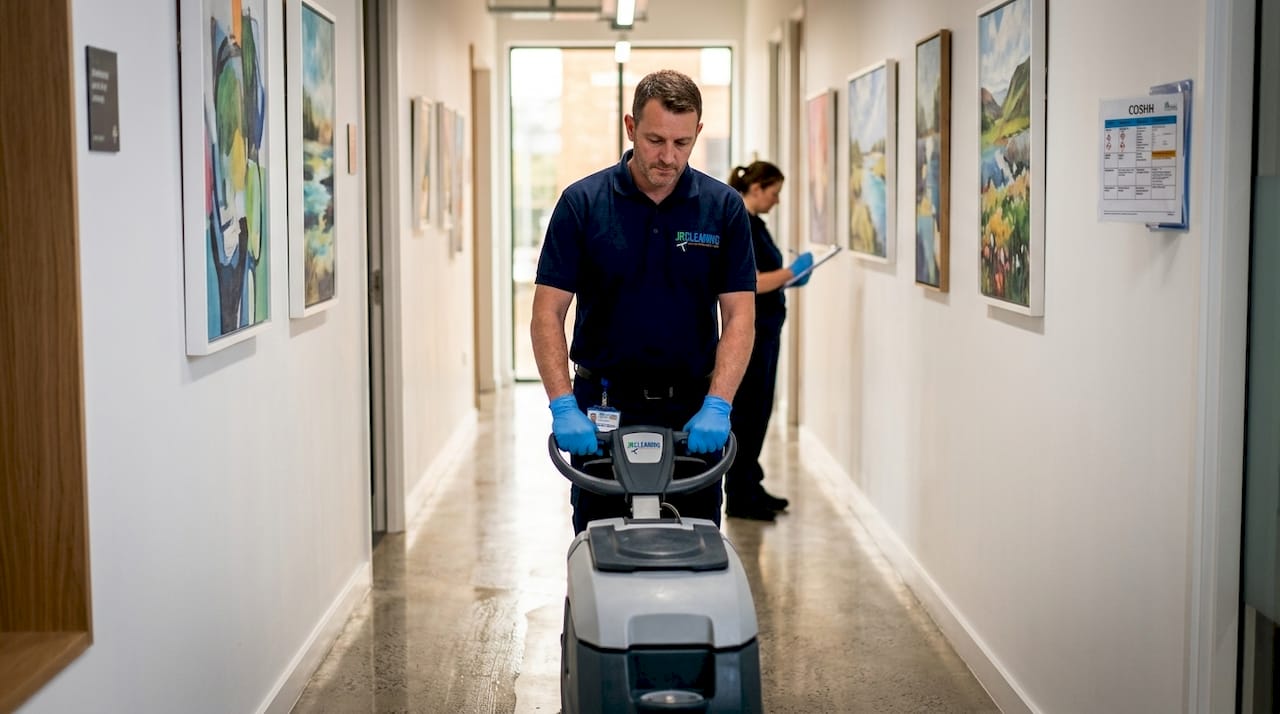
1779108079106 Certified cleaners using approved cleaning equipment - J R Cleaning

Air quality is another area where the evidence is compelling. Indoor air is 2 to 5 times more polluted than outdoor air in typical conditions and up to 100 times more polluted in extreme cases. Much of that contamination comes from the cleaning products used in the space itself. Certified cleaning formulations reduce volatile organic compound (VOC) exposure significantly, and understanding why quality cleaning matters for your indoor environment helps put the choice into context.

Beyond health, the advantages of certified cleaning companies include reliability and regulatory alignment. Accreditation frameworks like CIMS help organisations implement consistent best practices and take environmental and social responsibility seriously at an operational level. For business owners, that translates into confidence when regulators or insurers ask about cleaning protocols.

Pro Tip: Ask any prospective cleaning company whether their staff are trained to the same standard across the team, or whether training varies by individual employee. Consistent team-wide training is a key indicator of an accredited provider.

Key health and safety benefits of accredited cleaners include:

  • Measurable reductions in bacteria and allergen concentrations on surfaces
  • Lower VOC exposure from certified, lower-toxicity chemical formulations
  • HEPA filtration preventing airborne particle redistribution
  • Documented compliance with health and safety regulations
  • Reduced risk of chemical injuries or adverse reactions to occupants

Accredited vs. non-accredited providers

The difference between a certified provider and an unverified one is not always visible on the day of service. Both will leave your property looking clean. The divergence shows up over time, and in the details that do not catch the eye.

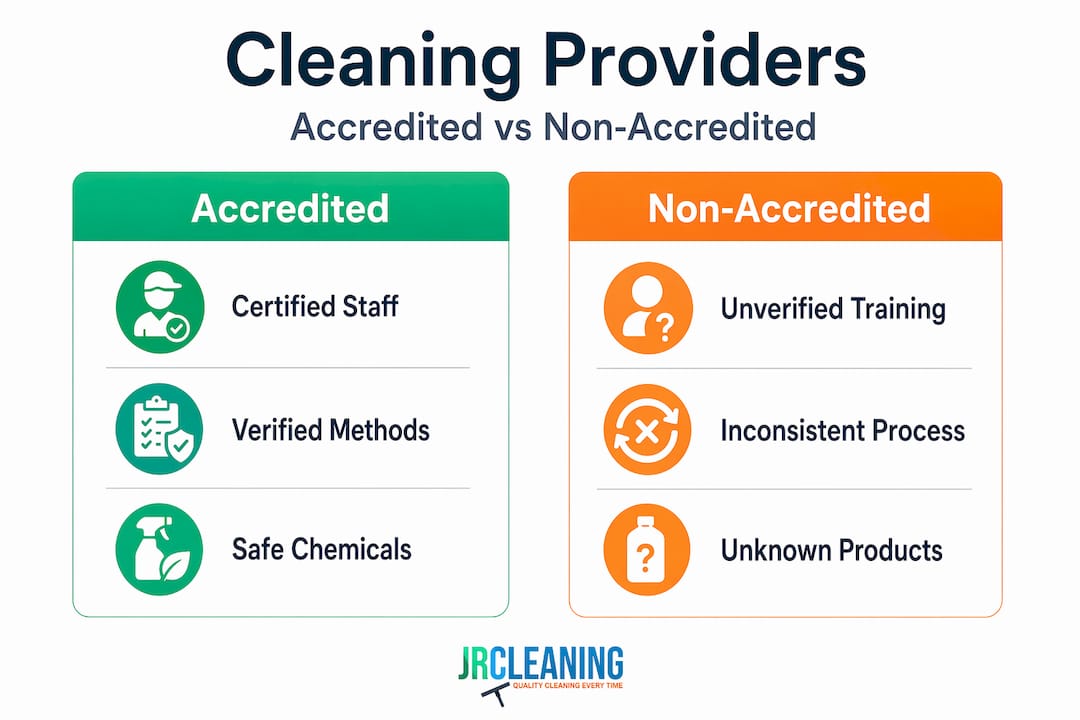
FactorAccredited providerNon-accredited provider
Cleaning methodsValidated, industry-standard protocolsVariable, based on individual preference
Products usedCertified, lower-VOC formulationsUnverified, potentially harsh chemicals
Staff trainingStructured, documented, consistentInformal, inconsistent
Insurance and liabilityVerified and maintainedMay be inadequate or absent
Regulatory complianceAssessed and documentedSelf-reported or absent
AccountabilityIndependent third-party oversightSelf-regulated

1779108534439 Infographic comparing accredited and non accredited cleaners - J R Cleaning

Skipping professional cleaning in commercial facilities leads to higher replacement costs and more frequent staff health complaints over time. Non-accredited providers may offer lower quotes, but the saving rarely accounts for the risk of inconsistent results, unvetted chemicals, or inadequate insurance cover when something goes wrong.

For property owners, the stakes extend to asset preservation. Surfaces treated repeatedly with harsh, non-approved chemicals degrade faster. Carpets, upholstery, and exterior cladding all have longer service lives when cleaned with methods validated for those materials. You can read more about professional carpet cleaning to understand how certified methods protect your investment at the material level.

Pro Tip: Never accept verbal assurances of insurance cover. Ask for a current copy of the company’s public liability certificate and check the policy limit. A reputable accredited provider will have this ready without hesitation.

How to verify and select an accredited cleaning company

Knowing that accreditation matters is only useful if you know how to check it. Here is a practical process for verifying any company you are considering.

  1. Request the specific certification name and number. Ask for the full name of the accreditation, the certifying body, and the certificate reference number. Legitimate companies have this on file and will share it readily.

  2. Verify directly with the certifying body. ISSA, Green Seal, and ISO certification bodies all maintain public registers or offer verification services. A quick check confirms whether the certificate is current and what scope it covers.

  3. Ask about renewal and maintenance. Certifications expire and must be renewed through reassessment. Ask when the current certificate was last renewed and when it is next due. A lapsed certificate is not an active one.

  4. Check what the certificate actually covers. Some companies hold certification for a specific service line or location, not their entire operation. Make sure the scope matches the service you need.

  5. Ask about staff training programmes. Questions to ask cleaning companies about their credentials should include how often staff are retrained, whether training records are maintained, and who is responsible for quality oversight.

  6. Look for red flags. Vague answers about certifications, reluctance to share documentation, or claims of certification that cannot be independently verified are all warning signs. Legitimate companies welcome scrutiny.

  7. Confirm insurance and compliance. Ask to see current public liability insurance, employer’s liability insurance, and any sector-specific compliance documentation relevant to your property type.

Understanding how to manage cleaning contracts for compliance gives you the additional context needed to structure your agreement with any provider you select.

Long-term value and sustainability

Choosing a certified cleaning provider is an investment that compounds over time. Certification programmes require companies to use eco-friendly methods that improve indoor environmental quality in line with recognised standards, which means every clean contributes to a healthier space rather than simply a tidier one.

Accredited companies embed sustainability as a core operational principle rather than marketing language. CIMS-GB with Honors requires independent verification of sustainable procurement, waste reduction, and energy-efficient equipment use, all of which align with LEED building standards.

The long-term value of hiring accredited cleaning providers includes:

  • Reduced chemical exposure for occupants over months and years of service
  • Lower material degradation rates on floors, textiles, and exterior surfaces
  • Alignment with corporate sustainability reporting and green building certifications for commercial clients
  • Predictable service quality that reduces the cost and disruption of switching providers repeatedly
  • Compliance readiness if your property is subject to audit or regulatory inspection

For homeowners, the sustainability angle often comes down to a simpler question: do you want the products used in your home to be certified as safe, or do you want to take a company’s word for it? Exploring eco-friendly cleaning options helps clarify what certified product standards actually mean in practice.

My perspective on accreditation being overlooked

In my experience, accreditation is the single most under-used filter when people choose a cleaning company. Most clients I have observed make their decision based on price, availability, and how professional the company’s social media looks. Certification barely enters the conversation, and that is a significant gap in thinking.

What I have found is that the variation in quality between accredited and non-accredited providers is rarely obvious in the first clean. It shows up later. In the carpet that degrades faster than it should. In the recurring allergy complaints in an office. In the liability question when a contractor causes damage and their insurance turns out to be inadequate.

I think the misconception is that cleaning is a low-stakes commodity service. It is not. The chemicals used in your home affect the air your family breathes. The methods applied to your building’s surfaces affect how long those surfaces last. Accreditation is the mechanism that brings independent scrutiny to those decisions, and that scrutiny is genuinely valuable.

The companies I have worked with that hold recognised certifications behave differently at an operational level. They document more. They train more consistently. They ask better questions about your space before beginning work. That is not coincidence. It is what structured accountability produces.

— jamie

Why Jrcleaning is the trusted choice

1774551979294 jrcleaning - J R Cleaning

If the reasoning above resonates with you, Jrcleaning is the kind of provider that puts those principles into practice. With over 20 years of experience delivering residential and commercial cleaning services across the UK, Jrcleaning operates to strict health and safety standards and carries full insurance cover. Their team is trained consistently across all service lines, from interior deep cleaning and carpet care to exterior services including gutter cleaning, roof treatment, conservatory valeting, and commercial kitchen hygiene. Every job is backed by a commitment to safety, accountability, and measurable results. If you are ready to work with a provider whose standards you can rely on, explore the full range of cleaning services or request a free quote directly through the Jrcleaning website today.

FAQ

What does accreditation mean for a cleaning company?

Accreditation means an independent body has assessed the company’s operations against defined standards covering quality, safety, staff training, and environmental responsibility. It is not self-reported. It requires on-site verification.

Why are accredited cleaners better for indoor air quality?

Certified cleaning products contain lower VOC concentrations than unverified alternatives, and accredited providers typically use HEPA-filter equipment that captures fine particles rather than redistributing them. Both factors directly improve the air occupants breathe.

How much better is professional cleaning at removing allergens?

Professional cleaning reduces allergen loads by 91% to 97% compared to domestic methods, which produce minimal measurable reduction. The difference comes from validated methods, professional-grade equipment, and certified chemical formulations.

What questions should I ask a cleaning company about their credentials?

Ask for the specific certification name and reference number, the certifying body, the renewal date, and whether the certificate covers your required service type. Then verify the certificate independently through the certifying body’s public register.

Does accreditation matter for one-off residential cleaning?

Yes. Even for a single clean, accreditation confirms that the company carries adequate insurance, uses safe products, and employs trained staff. The risk of using an unverified provider does not reduce simply because the job is smaller.

The role of professionalism in cleaning services

Most people think of cleaning as straightforward work. You show up, you clean, you leave. But the role of professionalism in cleaning goes far beyond whether the floors are shiny or the bins have been emptied. It shapes the health of the people in a space, the reputation of a business, and whether clients keep coming back. This article breaks down what genuine professionalism looks like in the cleaning industry, from technical standards and ethical conduct to documented systems and customer expectations, so you can make better decisions about the services you hire or the practices you run.

Table of Contents

Key takeaways

PointDetails
Professionalism is more than tidinessIt combines technical expertise, ethical conduct, and consistent systems to deliver reliable results.
SOPs are the backbone of qualityDocumented procedures reduce errors, shorten training time, and give clients confidence in what they are paying for.
Cleanliness directly affects healthProfessional cleaning reduces allergens, bacteria, and poor air quality, with real consequences for occupant wellbeing.
Customer perceptions hinge on cleanlinessBusiness owners who overlook cleaning standards risk losing client trust and repeat business.
Credentials and ethics matterChoosing or building a cleaning service means looking beyond the lowest price to training, accountability, and compliance.

The role of professionalism in cleaning: skills, ethics, and standards

There is a persistent misconception that cleaning is unskilled work. In reality, professional cleaning requires a specific combination of technical knowledge, interpersonal ability, and ethical responsibility that most people never see.

On the technical side, a professional cleaner must understand which products work on which surfaces, how long disinfectants need to dwell before they are effective, and how to use equipment safely. Using the wrong chemical on a delicate surface can cause irreversible damage. Selecting the right one and applying it correctly is a form of expertise. Technical skills and soft skills both determine whether a cleaner performs at a professional level or simply goes through the motions.

Beyond technical knowledge, soft skills separate adequate cleaners from genuinely professional ones. Reliability means showing up on time, every time. Communication means flagging a problem you notice rather than ignoring it. Initiative means spotting what needs attention without waiting to be told. Teamwork matters in larger commercial settings where coordination between staff directly affects the quality of the output. These qualities are not incidental. They are what clients actually experience day to day.

The role of ethics in cleaning is often overlooked but deeply practical. Cleaners regularly work in private homes, offices, and spaces containing sensitive information or valuable property. Accountability, discretion, and respect for those environments are non-negotiable. Regulatory compliance sets a baseline, but truly professional services go further, holding themselves to higher benchmarks even when no one is checking.

Pro Tip: When vetting a cleaning company or hiring staff, ask specifically about their approach to product selection and surface care. A professional will give you a clear, informed answer rather than a vague assurance.

SOPs: the backbone of consistent service

Standard operating procedures, or SOPs, are the most visible difference between a professional cleaning operation and an ad hoc one. They are not bureaucratic documents. They are practical tools that define exactly how a task gets done, every single time.

The value of SOPs is consistency. Without them, quality depends entirely on the individual cleaner’s memory and judgement on a given day. With them, a new team member can step in and deliver the same standard as a veteran. SOPs reduce training time and serve as a quality signal to clients who want to know their investment is protected.

Here is a side-by-side view of what professional SOP-driven cleaning looks like compared to ad hoc approaches:

AreaWith SOPsWithout SOPs
TrainingStructured phases: observe, practise, certifyOn-the-job guesswork with variable results
ConsistencySame standard regardless of who is cleaningDependent on individual effort and memory
Error rateLower, with built-in checks at each stageHigher, with no systematic catch mechanism
Client confidenceDemonstrable process builds trustReliant on personal reputation alone
AccountabilityMeasurable against documented standardsDifficult to assess or improve objectively

Good SOPs cover more than task lists. Effective cleaning procedures specify cleaning sequences (top to bottom, back to front), correct dwell times for disinfectants, which products are appropriate for which materials, and how to flag exceptions. Skipping disinfectant dwell time is one of the most common professional failures in commercial cleaning, and it is entirely preventable with a properly followed SOP.

Auditing is the other half of the equation. Visual quality standards and periodic spot checks keep the system honest. An SOP without inspection is just a document. With structured reviews, it becomes a live quality control system that actually improves outcomes over time.

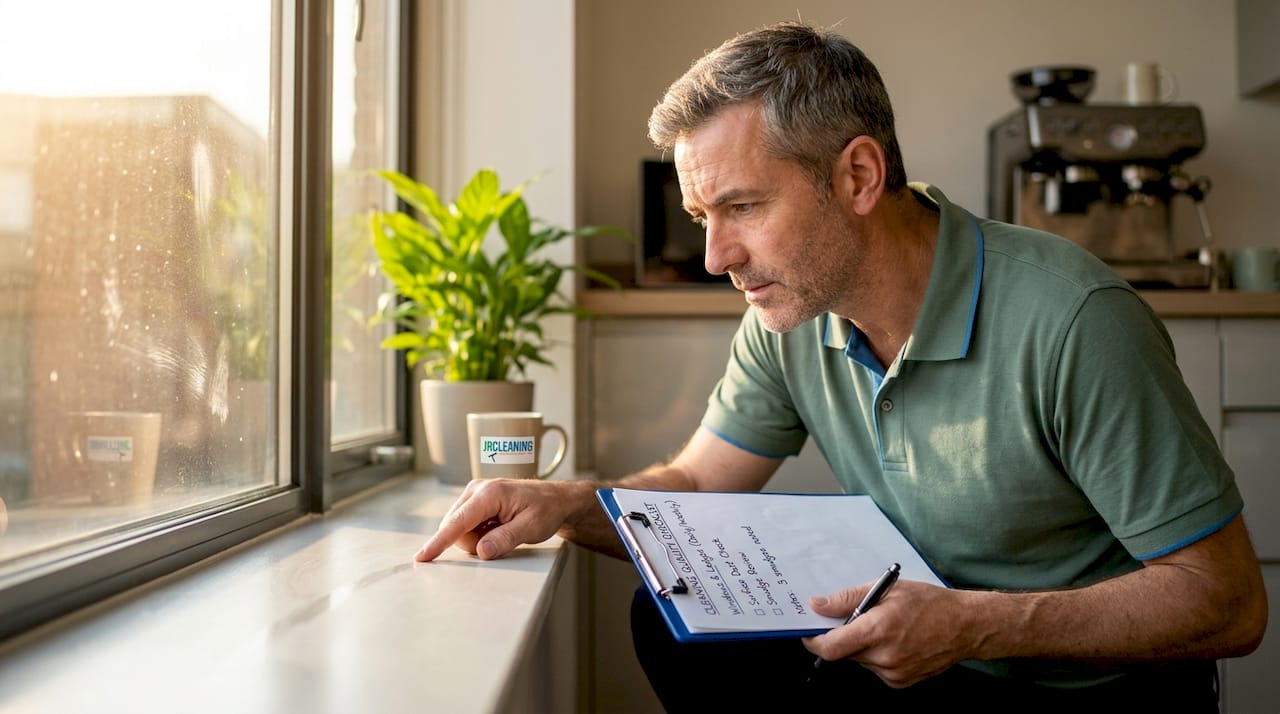
1779000629428 Supervisor conducting cleaning quality inspection - J R Cleaning

Pro Tip: If you are building SOPs for your cleaning team, include photographs of the expected finished standard for each task. Visual benchmarks eliminate ambiguity far more effectively than written descriptions alone.

Health, safety, and the environment

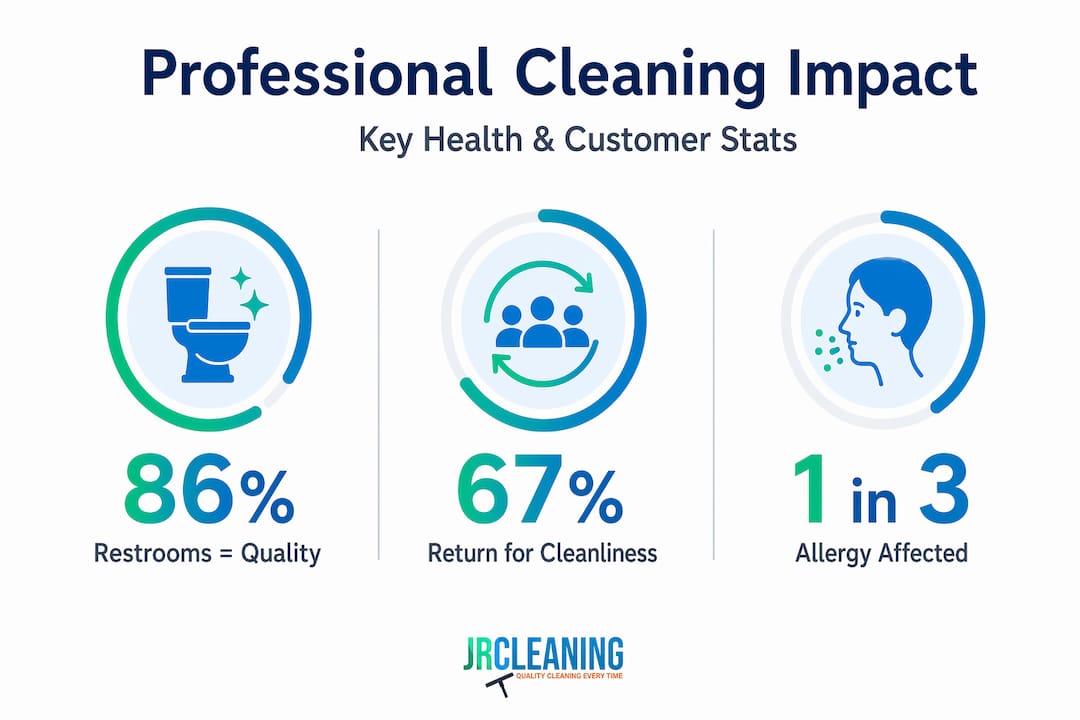
Professional cleaning has measurable effects on the health of the people who live and work in a space. This is not abstract. Indoor air can be two to five times more polluted than outdoor air, and sometimes up to one hundred times more. Allergens, bacteria, dust mites, and volatile organic compounds (VOCs) accumulate in ways that standard surface-level cleaning does not address.

1779001428071 Infographic with stats on professional cleaning benefits - J R Cleaning

Consider what proper professional practice looks like against common shortcuts:

PracticeProfessional standardCommon shortcut
VacuumingHEPA-filtered equipment trapping fine particlesStandard vacuum redistributing allergens into the air
Chemical selectionCertified low-VOC or Safer Choice productsCheapest available, regardless of chemical load
Air qualityProtocols to maintain airflow and reduce pollutant build-upNo consideration of ventilation during or after cleaning
Surface disinfectionCorrect dwell times observed before wipingImmediate wipe-off, negating disinfection effect

One in three people suffer from allergies, and the cleaning protocols used in a space directly affect their daily experience. Professional cleaning is one of the most cost-effective ways to safeguard health and property simultaneously. Choosing a provider that understands this, and uses certified equipment and approved products, is a practical health decision, not just a lifestyle preference.

Compliance with health and safety regulations is the legal minimum. Professional services treat it as a starting point rather than a finish line.

How professionalism shapes customer perceptions

Cleanliness is one of the most immediate signals customers use to form an opinion about a business. They may not be able to evaluate the quality of your product at a glance, but they can absolutely assess whether your facilities are clean. And they do.

86% of adults expect business restrooms to reflect the overall quality of a business. More than 85% form a negative impression from dirty facilities, and over two-thirds say they are more likely to return to businesses where restrooms are consistently clean. That is a direct line from cleaning standards to repeat business. The importance of cleanliness standards is not soft. It has real financial consequences.

The impact of professionalism in cleaning extends to how businesses position themselves in competitive markets. Hospitality brands have long understood this. Luxury hotel housekeeping standards, including uniformed staff, structured inspection programmes, and an occupant-centred experience focus, are now influencing commercial janitorial services as clients demand the same level of consistency and presentation they have come to expect elsewhere.

Here is what customers actually notice and remember:

  • Whether common areas look and smell clean at any time of day, not just first thing in the morning
  • Whether consumables are stocked and maintained without prompting
  • Whether cleaning staff present themselves professionally in appearance and conduct
  • Whether problems (spillages, visible soiling) are addressed promptly without requiring a complaint
  • Whether the overall environment communicates that someone takes it seriously

For business owners, this is not a peripheral concern. It is a core part of your brand experience. Investing in professional cleaning services is directly tied to how your clients perceive and trust you.

Practical steps to raise cleaning professionalism

Whether you are a business owner managing a cleaning contract or a cleaning professional trying to improve your own practice, these steps make a measurable difference.

  1. Document your cleaning procedures. Write down exactly how each task should be completed, including product names, dwell times, and sequence. Even a basic SOP beats none. Use it as a living document and update it as your knowledge grows.

  2. Build a structured training pathway. SOP-based training works best in phases: observation, supervised practice, then solo performance with spot checks before certification. Do not skip the supervised stage.

  3. Schedule regular audits. Block time each week or month to inspect completed work against your documented standards. Use a simple checklist. If you find consistent gaps, that is a systems problem, not just a people problem.

  4. Prioritise certified, compliant products. Know what you are applying and why. Certified low-VOC products protect both occupants and staff. Keep a record of product data sheets and safety information.

  5. Vet providers thoroughly. When choosing a cleaning company, ask about their training programmes, insurance, SOP documentation, and how they handle quality complaints. Good answers are specific, not vague. Use guidance on managing cleaning contracts to set clear performance expectations from the start.

  6. Treat ethics as a practical standard. Accountability, discretion, and respect for the client’s space should be written expectations, not assumed qualities. Include them in any service agreement or staff handbook.

My view on professionalism in the cleaning industry

I have seen the full range of what cleaning looks like in practice, and what strikes me most is how consistently professionalism is undervalued until something goes wrong. A business owner rarely notices the cleaning company doing excellent work. They notice the day something is missed, the morning a client walks into a facility that does not meet expectations, or the week staff start complaining about air quality.

That reactive pattern costs more than most owners realise, in reputation, in retention, in staff morale. What I have found is that the cleaning businesses that genuinely stand out treat their work as stewardship rather than task completion. Anticipating client needs rather than waiting to be told, caring about outcomes rather than just outputs. That shift in mindset is not taught overnight, but it starts with the right systems and the right expectations set from day one.

If you are a cleaner, invest in understanding your products, your procedures, and your client’s environment. If you are a business owner, stop treating cleaning as the budget line to cut first. The cost of getting it wrong is always higher than the cost of getting it right.

— jamie

How Jrcleaning brings this to life

1774551979294 jrcleaning - J R Cleaning

Jrcleaning has spent over 20 years building the kind of professional cleaning service that this article describes rather than just talking about it. Every aspect of their operation reflects cleaning industry best practices: trained and insured staff, documented procedures, certified products, and a genuine focus on client satisfaction across both residential and commercial work. Their residential and commercial cleaning services cover everything from routine maintenance to specialist tasks such as gutter clearing, conservatory cleaning, and exterior work. If you want to see what the full range of professional offerings looks like in practice, their service overview lays it out clearly. For businesses with specific hygiene requirements, their commercial kitchen cleaning service demonstrates exactly the kind of specialist, compliance-driven professionalism that separates serious providers from the rest. Get in touch for a free quote today.

FAQ

What does professionalism mean in the cleaning industry?

Professionalism in cleaning covers technical skill, ethical conduct, reliable communication, and adherence to documented procedures. It is the combination of these qualities, not just physical thoroughness, that defines a genuinely professional service.

Why are standard operating procedures important for cleaning teams?

SOPs create consistent results regardless of who is cleaning. They reduce training time, lower error rates, and give clients measurable confidence in the service they are paying for.

How does professional cleaning affect health outcomes?

Indoor air can be up to five times more polluted than outdoor air, and professional cleaning with HEPA equipment and certified low-VOC products directly reduces allergens, bacteria, and chemical exposure in a space.

Does cleanliness really affect customer loyalty?

Yes. Research shows that over two-thirds of adults are more likely to return to a business with consistently clean facilities, making cleanliness a direct driver of repeat business.

How should I choose a professional cleaning company?

Ask specifically about their training methods, insurance, SOP documentation, and how they handle quality issues. A professional provider will give specific, confident answers rather than generic reassurances.

Why emergency cleaning services matter for your property

When a pipe bursts at midnight, a kitchen fire fills your home with acrid smoke, or a sewage leak contaminates your workplace, the last thing you need is confusion about who to call. Understanding why emergency cleaning services exist as a distinct category, separate from your regular cleaning company, could be the difference between a manageable restoration and a catastrophic, expensive rebuild. This article explains what genuinely qualifies as an emergency cleaning situation, the real risks of hesitation, and how professional fast response cleaning services protect your health, your property, and your finances when every hour counts.

Table of Contents

Key takeaways

PointDetails
Emergency cleaning is specialist workIt focuses on safety and risk control, not appearance, requiring specialist equipment and training.
The 24-hour window is criticalMould can germinate within 24 to 48 hours of water damage, making immediate action non-negotiable.
Delays cost significantly moreA delay in water extraction beyond 60 minutes can exponentially increase both damage and repair costs.
Professional documentation aids insuranceQualified emergency cleaners follow compliant procedures that support successful insurance claims.
Not all providers are equalChoose fully insured specialists with regulatory compliance and 24/7 availability for genuine crises.

Why emergency cleaning services differ from routine cleaning

Most people picture a faster, more thorough version of their usual cleaner when they hear “emergency cleaning.” That assumption is understandable, but it is wrong in a way that can cost you dearly.

Emergency cleaning focuses on risk control and safety, not aesthetics. The primary objective is to stabilise the environment, contain the hazard, and prevent further loss. A standard cleaner arriving with a mop and spray bottles simply does not have the tools, training, or insurance to handle what you are actually dealing with.

The types of incidents that require emergency cleaning include:

  • Flood and water damage from burst pipes, appliance failures, or storm ingress
  • Fire and smoke damage, including soot residue and chemical contamination from synthetic materials
  • Sewage or biohazard spills, which carry serious pathogenic risk
  • Hazardous substance leaks in commercial or industrial settings
  • Major structural leaks causing widespread material saturation

Each of these scenarios demands structural drying, dehumidification, and safe disposal of biohazards, alongside adherence to UK health and safety regulations. Routine cleaning cannot substitute for this. The risks involved, and the specialist techniques required, are categorically different.

Pro Tip: Ask any emergency cleaning provider whether they carry public liability insurance specifically for hazardous incidents. If they hesitate, look elsewhere.

1778919342187 Infographic comparing routine and emergency cleaning - J R Cleaning

Professional emergency teams carry industrial dehumidifiers, moisture metres, HEPA filtration units, thermal imaging cameras, and personal protective equipment rated for biohazard exposure. These are not items your local domestic cleaner owns or is trained to use safely. When you contact a specialist, you are not paying for speed. You are paying for the right expertise applied at the right moment.

The real cost of waiting even a few hours

The timeline of damage after a water or fire incident is far more aggressive than most property owners realise. Understanding this is what separates those who contain a crisis from those who end up with a full structural rebuild.

Consider water damage first. Mould spores begin germinating on wet materials within 24 to 48 hours of exposure. Visible colonies can appear within 48 to 72 hours. Once mould takes hold in wall cavities, subfloors, or insulation, the remediation required becomes vastly more complex and expensive. The problem is that you often cannot see the worst of it, which is where specialist tools make a critical difference. Hidden moisture detection requires thermal imaging and moisture metres to catch what the naked eye misses entirely during that crucial first day.

1778916198329 Homeowner inspecting water damage and mold - J R Cleaning

Delay periodLikely consequenceEstimated impact
Under 60 minutesSurface water controlled, materials salvageableMinimal cost increase
1 to 24 hoursAbsorption into subfloor, walls, insulation beginsModerate restoration required
24 to 48 hoursMould germination window opensSignificant remediation needed
48 hours or moreStructural damage, mould colonies visibleFull remediation or replacement

Delaying water extraction beyond 60 minutes exponentially increases both the spread of damage and the eventual claim cost. And professional water damage restoration, even when started promptly, takes three to five days for minor cases and up to two weeks for severe incidents. A 24-hour delay at the start can double that timeline.

Fire damage follows a different but equally aggressive path. Smoke and soot are not just dirty. They are chemically active. Soot particles bond to surfaces, corrode metals, and etch glass within hours of a fire. Synthetic materials release hydrogen cyanide and other toxic compounds when they burn, and those residues do not simply evaporate. Waiting even 24 hours before professional intervention means permanent staining, accelerated corrosion, and ongoing inhalation risk for anyone in the building.

For biohazards and sewage, the risk is immediately pathogenic. Contaminated water carries bacteria including E. coli and salmonella, alongside potential viral pathogens. Spread is rapid, and without proper containment and disposal, cross-contamination can affect areas far beyond the original incident site.

Practical benefits of hiring emergency cleaning professionals

Knowing the risks of delay is one side of the argument. The benefits of acting quickly with qualified professionals is the other, and they go well beyond simply having a cleaner property.

Here is what you genuinely gain from professional emergency cleaning services:

  • Health protection: Qualified teams safely remove contaminants, biohazards, and hazardous residues using appropriate PPE and disposal methods, reducing the risk of illness for occupants and workers.
  • Asset preservation: Immediate professional intervention prevents permanent staining and damage, including chemical bonding of tannins and synthetic dyes to carpet fibres that occurs within hours. Professional carpet cleaning after an incident can save flooring that would otherwise need complete replacement.
  • Reduced overall costs: Rapid professional cleaning prevents secondary issues such as mould outbreaks, corrosion, persistent odours, and material failure, avoiding the far greater cost of reconstruction.
  • Business continuity: Businesses without fast professional emergency cleaning face disruption, reputational damage, and financial loss. A prompt response minimises downtime and keeps your premises safe for staff and customers.
  • Insurance claim support: Professionally documented, compliant cleaning procedures provide evidence insurers need for a valid claim. Attempting to handle an emergency yourself, or using an unqualified cleaner, can undermine your claim significantly.

Pro Tip: Take photographs of the damage before any cleaning begins and request a written report from your emergency cleaning provider. This documentation is often the deciding factor in insurance pay-outs.

The financial logic here is straightforward. Spending on a qualified specialist in the first hours almost always costs less than the compounding damage, health consequences, and reconstruction costs that accumulate with every hour of inaction.

When and how to engage emergency cleaning services

Knowing you need emergency cleaning is sometimes obvious, but in the immediate aftermath of an incident, stress and shock can cloud your judgement. Here are clear signs that you need specialist help rather than your regular cleaner or your own effort:

  1. Visible water damage or saturation in walls, flooring, or ceilings following a leak, burst pipe, or flooding event.
  2. Smoke, soot, or chemical residues following any fire, even a small contained one in a single room.
  3. Sewage or biohazard exposure, including backing up drains, toilet overflow, or any contact with blood or bodily fluids.
  4. Structural instability or unsafe conditions, such as waterlogged ceilings or chemically contaminated surfaces that pose direct risk.
  5. Strong, persistent odours that indicate contamination beyond surface level.

Once you have identified the need, act within the first 24 to 48 hours wherever possible. Reliable emergency providers offer 24/7 immediate communication and rapid mobilisation, so the time of day should never be a barrier to making that first call.

When choosing a provider, verify they are fully insured for hazardous and emergency work, that they comply with relevant UK health and safety regulations, and that they use specialist equipment rather than domestic-grade tools. Ask specifically whether they carry out a full moisture survey and provide written documentation of their process. If you are dealing with internal water damage, for example, a thorough drying assessment is non-negotiable.

During the process itself, expect the team to conduct an initial risk assessment, establish a containment zone where relevant, begin extraction or decontamination, apply drying and dehumidification equipment, and provide a full written report upon completion.

My perspective: why people still get this wrong

In my experience, the single biggest mistake people make in a cleaning emergency is treating it as a cleaning problem. It is not. It is a property protection problem, and the distinction matters enormously.

I have seen homeowners spend an afternoon with borrowed fans and towels after a flooded bathroom, genuinely believing they have handled it. Three weeks later, they are dealing with a mould removal service call-out and a cavity wall that needs to be opened up. The original damage cost them perhaps a few hundred pounds to address professionally. The remediation after their DIY attempt cost several thousand.

What specialists catch early is rarely visible to the untrained eye. Moisture migrates. It travels through skirting boards, under parquet floors, behind plasterboard. Thermal imaging reveals pockets of damp in locations you would never think to check. That knowledge, and the tools to act on it, is what you are actually paying for.

My honest take: the importance of urgent cleaning services is almost always underestimated until someone has experienced the alternative firsthand. If you are reading this before an incident occurs, consider it a useful warning. If you are reading it in the middle of one, stop waiting and make the call.

— jamie

How Jrcleaning can help when it matters most

When a crisis strikes your home or business, you need a team you can trust to respond fast and get it right. Jrcleaning has over 20 years of experience delivering residential and commercial cleaning solutions across the UK, including specialist response for sudden cleaning emergencies.

1774551979294 jrcleaning - J R Cleaning

Whether you are facing water damage, post-fire contamination, or a hazardous spill, Jrcleaning’s trained professionals arrive with the specialist equipment, regulatory compliance, and documentation processes that protect your property and support your insurance claim. The company is fully insured and operates to strict UK health and safety standards, so you know the job is being handled correctly from the first assessment to the final sign-off. Explore the full range of specialist cleaning services available, or contact Jrcleaning directly by phone, email, or WhatsApp to get an immediate response for your emergency situation. Do not wait until the damage compounds. Get expert help working for you now.

FAQ

What counts as an emergency cleaning situation?

An emergency cleaning situation involves sudden incidents such as flooding, fire and smoke damage, sewage overflow, or hazardous spills that pose immediate health or structural risks. These events require specialist equipment and training beyond the scope of routine cleaning.

Why can’t a regular cleaner handle emergency cleaning?

Standard cleaners are not equipped, trained, or insured for hazardous conditions. Emergency cleaning requires industrial drying equipment, biohazard disposal protocols, and regulatory compliance that domestic or commercial cleaning companies do not typically provide.

How quickly should I call an emergency cleaning service?

You should call within the first hour wherever possible. Water extraction delayed beyond 60 minutes increases damage and costs exponentially, and mould can begin germinating within 24 to 48 hours of water exposure.

Does professional emergency cleaning help with insurance claims?

Yes. Qualified emergency cleaners follow compliant, documented procedures that insurers recognise. A written report from a professional service significantly strengthens your claim and helps avoid disputes over the extent of damage.

Can emergency cleaning save my carpets and flooring?

In many cases, yes. Tannins and synthetic dyes bond chemically to carpet fibres within hours, causing permanent staining if left untreated. Professional intervention within the first few hours can preserve flooring that would otherwise require full replacement.

Commercial cleaning checklist for UK businesses

A poorly maintained workplace does more damage than you might expect. Beyond the obvious hygiene risks, inconsistent cleaning signals to clients, staff, and regulators that standards are slipping. For UK business owners and property managers, keeping on top of a commercial cleaning checklist is not simply about appearances — it is about protecting people, meeting compliance requirements, and preserving the long-term value of your premises. This guide gives you a practical, expert-backed framework covering everything from daily routines to periodic deep cleans, so you can run a facility that genuinely reflects the professionalism of your operation.

Table of Contents

Key Takeaways

PointDetails
Professional standards matterFollowing BICSc standards ensures cleaning meets UK usage and hygiene benchmarks.
Prepare with right toolsUse eco-friendly, certified products and trained staff for effective and compliant cleaning.
Follow an organised checklistDaily to periodic tasks divided clearly maintain cleanliness and reduce health risks.
Verify with auditsIndependent BICSc audits help maintain service quality and compliance consistently.
Cleaning improves air qualityThorough cleaning supports healthier indoor air and occupant wellbeing beyond visible dirt removal.

Understanding commercial cleaning standards and requirements

Before you write a single task on your checklist, it helps to understand the benchmarks you are working towards. In the UK, the British Institute of Cleaning Science (BICSc) sets the professional standard for commercial cleaning. They define not just what should be cleaned, but how often and by what method — a distinction that separates reactive cleaning from genuinely effective hygiene management.

BICSc standards require that cleaning frequency is based on usage levels, with routine daily high-touch cleaning, periodic quarterly maintenance, and restoration work carried out one to two times per year for medium-traffic areas such as vinyl floors, using pH-neutral cleaners and approved BICSc CM1 and CM7 methods. This tiered approach is the backbone of any credible commercial cleaning routine.

Understanding your office cleaning standards also means matching frequency to reality. A reception area in a busy professional services firm needs different attention than a back-office storeroom used once a week. Traffic levels, surface types, and the nature of work being carried out all dictate what belongs on your checklist and how often.

Key considerations when setting cleaning standards for your facility:

  • Facility type: Healthcare, hospitality, retail, and office environments each carry distinct hygiene obligations
  • Traffic volume: High-footfall areas require daily or twice-daily attention; low-traffic zones may only need weekly care
  • Regulatory context: Some sectors, such as food service and healthcare, face legal cleaning requirements under UK health and safety legislation
  • Surface compatibility: Matching cleaning products to surfaces prevents damage and ensures effective sanitation
  • Documentation: Keeping records of cleaning activities protects you during inspections and audits

Preparing your cleaning toolkit and personnel

A checklist is only as good as the resources behind it. Using the wrong products on the wrong surfaces wastes time and can cause damage. Equally, sending untrained staff to clean a commercial kitchen or a medical reception area is a compliance risk, not a solution.

1778823627180 Cleaner prepares eco friendly cleaning supplies in break room - J R Cleaning

Green and low-VOC products are increasingly specified in premium buildings, with microfibre cloths, HEPA-filtered vacuums, and chemical dilution control systems recommended as standard for 2026 commercial cleaning specifications. This matters not just for environmental reasons but because VOC-heavy products can worsen indoor air quality and trigger respiratory issues in building occupants.

Explore eco-friendly cleaning materials and professional cleaning methods to understand how product choice directly affects outcomes.

Equipment or materialBest used forKey benefit
Microfibre clothsDesks, screens, surfacesTraps bacteria without chemicals
HEPA-filtered vacuumCarpets, upholstery, hard floorsCaptures fine particles and allergens
pH-neutral cleanerTiles, vinyl, laminatesSafe across most surfaces
Low-VOC disinfectantWashrooms, kitchens, high-touch areasReduces airborne chemical exposure
Flat-head mop systemHard floors, corridorsFaster coverage, reduces water usage
Microfibre mop headsPolished or delicate flooringPrevents scratching and streaking

Essential materials every commercial cleaning team should carry:

  • Colour-coded cloths to prevent cross-contamination between zones (typically red for washrooms, blue for general areas, yellow for kitchens)
  • Dilution-controlled dispensing systems to ensure consistent product strength
  • PPE including gloves, aprons, and eye protection where required
  • Trigger sprays pre-labelled with product names and dilution ratios
  • A signed COSHH assessment for every chemical in use on your premises

Pro Tip: If you are managing a cleaning contractor rather than in-house staff, ask for proof of BICSc accreditation for their operatives. Accredited staff are trained to the same national standard and are far less likely to cut corners or use incorrect products on sensitive surfaces.

Executing a comprehensive commercial cleaning checklist

This is where standards become action. A well-structured commercial cleaning checklist divides tasks by frequency so nothing gets missed and nothing gets over-serviced at the expense of what actually needs attention.

1778824346237 Infographic showing steps in business cleaning checklist - J R Cleaning

Daily tasks include emptying bins, vacuuming, mopping, cleaning washrooms, wiping kitchen surfaces, and cleaning glass partitions. Weekly and periodic tasks extend to high-dusting, carpet extraction, and deep kitchen cleaning. Refer to a business property cleaning guide for a fuller breakdown by facility type.

Daily cleaning tasks:

  1. Empty and reline all waste bins, including recycling and confidential waste
  2. Wipe all high-touch surfaces: door handles, light switches, lift buttons, reception desks, shared equipment
  3. Vacuum carpeted areas and sweep or dry-mop hard floors
  4. Damp-mop hard floors using appropriate product for the surface type
  5. Clean and sanitise all washroom surfaces: toilets, sinks, mirrors, taps, hand dryers, and dispensers
  6. Restock consumables: soap, paper towels, toilet tissue
  7. Wipe down kitchen or breakout area surfaces, clean the sink, and wipe appliance exteriors
  8. Clean internal glass at eye level including partitions and door panels
  9. Spot-clean walls, skirting boards, and furniture as needed

Weekly and monthly tasks:

  • High-dust all horizontal surfaces above head height: shelves, tops of cabinets, light fittings, air vents
  • Deep-clean carpets with hot-water extraction or encapsulation where soiling warrants it
  • Clean skirting boards, door frames, and window sills
  • Degrease kitchen extraction and behind appliances monthly
  • Clean inside microwaves, fridges, and other communal appliances
  • Inspect and clean floor drains in kitchens and washrooms

Periodic and seasonal tasks, as recommended by facility cleaning checklists, include sweeping floors and emptying bins daily as a baseline, then layering in weekly deep floor cleaning, and scheduling HVAC inspection and grounds maintenance seasonally.

Task categoryFrequencyResponsible party
Bin emptying and waste removalDailyCleaning operative
High-touch surface disinfectionDailyCleaning operative
Washroom deep cleanDailyCleaning operative
Carpet vacuumingDailyCleaning operative
High-dusting and air ventsWeekly or monthlySenior operative
Floor restoration or buffingQuarterlySpecialist contractor
HVAC filter and vent cleaningBi-annuallySpecialist contractor
Exterior grounds and drainageSeasonallyGrounds or cleaning contractor

Use BICSc cleaning services to find accredited contractors who can handle periodic and specialist tasks. For cleaning contract management, clear task schedules and sign-off sheets protect both you and your contractor.

Pro Tip: Schedule your most disruptive cleaning tasks — carpet extraction, floor buffing, high-dusting — outside core business hours. Early mornings or Friday evenings work well. Not only does this protect productivity, it gives products the dwell time they need to work properly without foot traffic breaking the process.

Verifying cleaning quality and compliance

Having a checklist is one thing. Knowing it is being followed correctly is another matter entirely. Many business owners sign off on a cleaning contract and then discover months later that certain tasks have been skipped, diluted, or done to a standard that would not pass even a basic inspection.

BICSc audits use a dedicated app that delivers red, amber, and green reports with actionable insights, enabling property managers to verify contractor productivity and ensure compliance independently without being on-site at every clean.

Steps to build a verification process into your cleaning programme:

  • Conduct spot inspections at irregular intervals so contractors cannot predict when they will be checked
  • Use a sign-off sheet where operatives record tasks completed, time, and any issues noted
  • Review cleaning outcomes with your contractor at monthly meetings and keep written records of any concerns raised
  • Ask for photographic evidence of specialist tasks like HVAC cleaning or carpet extraction
  • Request the contractor’s own internal audit scores, not just assurances

For ongoing managing cleaning compliance, digital reporting tools give you a transparent record of what was done, when, and by whom, which is invaluable if a hygiene complaint or HSE inspection arises.

Pro Tip: Use a digital service reporting tool such as a shared dashboard or simple app where your cleaning team logs each task in real time. This creates an audit trail you can access remotely and share with stakeholders without requiring face-to-face sign-off.

“A cleaning checklist without a verification mechanism is just a wish list. The businesses that maintain the highest hygiene standards are those that treat auditing as a routine, not a reaction to a complaint.”

Rethinking commercial cleaning: beyond the checklist

Most discussions about commercial cleaning focus on visible dirt. Floors, bins, washrooms. What gets far less attention is what you cannot see: the quality of the air your staff and visitors are breathing every day.

Effective cleaning reduces indoor air contaminants and supports occupant health by focusing on high-touch areas, wet zones, and HVAC maintenance. That last point is where most businesses fall short. HVAC vents accumulate dust, mould spores, and bacteria that recirculate continuously through your building. No amount of mopping compensates for contaminated air coming through the ventilation system.

Our view, after years of working in commercial environments across the UK, is that the best cleaning programmes treat indoor air quality (IAQ) as a primary outcome rather than a side effect. That means scheduling HVAC vent cleaning into your periodic calendar, specifying eco-friendly cleaning insights to reduce VOC output from cleaning products themselves, and choosing microfibre over disposable cloths that shed fibres into the air.

There is also a case for adaptive scheduling that goes beyond fixed frequencies. A Monday morning after a client event looks nothing like a Wednesday in a half-empty office. The most effective cleaning programmes use building occupancy data, whether from booking systems, badge access logs, or simple observation, to direct resource where it is actually needed. That is not a luxury reserved for large corporate estates. Any business owner who pays attention to usage patterns can make this call. The result is better hygiene outcomes with no additional cost.

Trusted commercial cleaning services to implement your checklist

Knowing what your checklist should contain is one thing. Having a reliable, experienced team to execute it consistently is where real results come from.

1774551979294 jrcleaning - J R Cleaning

At JR Cleaning, we have been delivering professional commercial cleaning across the UK for over 20 years. Whether you need a daily cleaning programme for a busy office, a specialist service for your commercial kitchen, or exterior maintenance to keep your property looking its best year-round, we have the experience and the accreditation to do it properly. Our professional cleaning services are tailored to your facility’s size, usage, and compliance requirements. We also offer commercial kitchen cleaning to the standard required by food hygiene regulations, and gutter cleaning services to protect your building’s exterior and drainage systems. Get in touch today for a free, no-obligation quote and let us help you build a cleaning programme your premises can depend on.

Frequently asked questions

What is a commercial cleaning checklist and why is it important?

A commercial cleaning checklist is a structured document that details all required cleaning tasks and their frequencies for a business premises. It ensures consistent hygiene standards, supports regulatory compliance, and maintains the professional appearance of your facility.

How often should high-touch areas in commercial spaces be cleaned?

High-touch areas such as door handles, lift buttons, and shared equipment should be cleaned and disinfected every day, as daily high-touch cleaning is a core requirement under BICSc standards for commercial environments.

Microfibre cloths, pH-neutral cleaners, and HEPA-filter vacuums alongside low-VOC disinfectants are the standard recommendation for eco-friendly, effective commercial cleaning in 2026. They reduce chemical exposure while delivering strong hygiene results.

How can I verify the quality of cleaning services at my property?

Independent audits are the most reliable method. BICSc audit reports use a red, amber, and green system with detailed improvement steps, giving property managers an objective measure of contractor performance without relying on self-reporting.

Can commercial cleaning improve indoor air quality?

Yes, significantly. Cleaning reduces airborne contaminants by targeting high-touch surfaces, wet zones, and HVAC systems, making a measurable difference to the air quality your staff and visitors experience daily.

Health and safety cleaning guidelines for UK properties

Selecting a cleaning service sounds straightforward until you realise that the wrong choice can expose your family, staff, or customers to chemical hazards, cross-contamination, or compliance failures that carry serious consequences. Health and safety cleaning guidelines exist precisely to prevent these outcomes, and in the UK, they are underpinned by the Control of Substances Hazardous to Health (COSHH) regulations enforced by the Health and Safety Executive (HSE). Whether you own a home, manage a retail unit, or run a commercial kitchen, knowing what compliant cleaning actually looks like helps you make better decisions and avoid the risks that come with cutting corners.

Table of Contents

Key Takeaways

PointDetails
COSHH compliance is mandatoryCarry out site-specific risk assessments and provide PPE and training for all cleaning staff.
Safe chemical handlingStore chemicals securely, avoid dangerous mixtures like bleach and ammonia, and use spill kits promptly.
Effective cleaning methodsUse dust-free techniques and disinfect high-touch surfaces regularly with approved products.
Service selection tipsChoose cleaners with documented risk assessments, training, and proven adherence to safety guidelines.
Compliance benefitsProper cleaning protects health, prevents legal issues, and maintains property value efficiently.

Key criteria for compliant cleaning services

Before you hire anyone to clean your property, there are non-negotiable standards that any reputable service must meet. The most important of these sits within COSHH, which requires anyone using cleaning chemicals to understand and manage the risks those chemicals create.

What to verify before hiring:

  • COSHH risk assessments are completed and specific to your premises
  • Written records of chemical hazards are available on request
  • Staff training on chemical handling is completed before work begins
  • PPE (personal protective equipment) is supplied and worn appropriately
  • Risk controls are reviewed regularly, not just ticked off once
  • Employers with five or more members of staff must record all significant findings

Employers must carry out COSHH risk assessments for every cleaning chemical used, identifying hazards and reviewing the controls in place on a regular basis. This is not optional documentation, it is a legal requirement. A cleaning company that cannot produce these records is not compliant, and engaging them puts you at risk too.

Training is equally critical. Employers must provide training and supply PPE under COSHH regulations before cleaning staff handle any hazardous substances. This means the cleaner arriving at your premises should already know which gloves to wear for which product, what to do in a spill, and how to read a Safety Data Sheet (SDS).

How a compliant service manages risk:

  1. Conducts a site-specific COSHH assessment before starting work
  2. Identifies all chemicals to be used and their associated hazards
  3. Puts controls in place, such as ventilation, PPE, and dilution guidance
  4. Trains all staff and records that training formally
  5. Reviews and updates the assessment whenever products or conditions change

When managing cleaning contracts, these criteria should form the baseline of any agreement rather than being treated as optional extras.

Essential practices for handling cleaning chemicals safely

Even the most experienced cleaner can cause serious harm if basic chemical handling rules are ignored. The most dangerous combination in domestic and commercial cleaning is also one of the most common mistakes: mixing bleach with ammonia-based products. This reaction produces chlorine gas, which causes respiratory damage even at low concentrations. Never allow it to happen in your property.

Safe chemical handling in practice:

  • Store chemicals in a ventilated area, away from incompatible substances such as acids and alkalis
  • Cleaning chemicals must be stored securely away from incompatibles to prevent dangerous reactions
  • Always read the SDS for every product before use
  • Never decant chemicals into unlabelled containers
  • Implement a spill kit as standard equipment on every job
  • Respond to any spill immediately, contain it, ventilate the area, and dispose correctly

Gloves matter more than most people realise. PPE such as nitrile gloves, eye protection, and aprons must be worn when handling bleach and other corrosive substances. Latex gloves are not suitable for chemical resistance. This is a specific, practical distinction that any properly trained cleaning operative should know without being told.

Pro Tip: Ask your cleaning provider to show you the SDS folder they carry on site. If they do not have one or cannot produce it quickly, that is a strong indicator that their chemical handling practices are not up to standard.

1778778309409 Cleaner putting on gloves near cleaning chemicals - J R Cleaning

For more detail on what proper technique looks like in practice, the professional cleaning methods used by trained operatives differ significantly from ad-hoc approaches. Understanding disinfectant selection is also part of getting chemical safety right, as not all disinfectants are appropriate for all surfaces or environments.

Cleaning methods that enhance safety and hygiene

The way cleaning is carried out matters as much as the products used. Many standard cleaning habits, particularly in commercial environments, actively spread contamination rather than eliminate it.

Sweeping hard floors with a dry broom, for instance, pushes dust, allergens, and pathogens into the air where they remain suspended for extended periods. Vacuuming with a HEPA-filtered machine captures particles rather than redistributing them. This single change makes a measurable difference to indoor air quality, particularly in environments with vulnerable occupants.

Methods that meet hygiene and safety standards:

  • Vacuum rather than sweep, using HEPA filtration where possible
  • Clean surfaces before disinfecting: disinfectants cannot work effectively on soiled surfaces
  • High-touch surfaces require daily disinfection in high-traffic areas using HSE-approved disinfectants
  • Use colour-coded cloths and mops to prevent cross-contamination between zones
  • Select smooth, non-porous materials in food preparation and washroom areas where possible

Pro Tip: The clean-then-disinfect sequence is frequently skipped when time is short. However, disinfecting a visibly dirty surface wastes product and leaves you with a false sense of security. The dirt physically blocks the disinfectant from reaching the pathogens underneath.

MethodPurposeKey requirement
VacuumingDust and allergen removalHEPA filter recommended
Wet moppingSurface soil removalChange water between zones
DisinfectionPathogen eliminationClean surface first
Steam cleaningDeep sanitisationCorrect temperature sustained
Colour-coded equipmentCross-contamination preventionStrictly enforced by zone

You can find a fuller breakdown in this business property cleaning guide and within the detail on interior cleaning techniques that apply to both homes and commercial premises.

Comparing cleaning service options for compliance and safety

Not all cleaning services operate to the same standard. The table below illustrates how common approaches differ in terms of safety, compliance, and practical risk management.

Service typeCOSHH compliancePPE requiredChemical risk levelTraining standard
Manual disinfectionRequiredGloves, apron, eye protectionMedium to highMandatory before starting
Low-pressure washingRequiredFull respiratory and skin PPEMediumMandatory; exposure controls needed
Vacuum cleaningLower riskGloves, dust mask if allergens presentLowBasic awareness sufficient
Steam cleaningRequiredHeat-resistant gloves, eye protectionLow chemical, heat riskIntermediate
Specialist chemical cleaningRequiredFull PPE per SDSHighAdvanced mandatory

Employers should prefer low-pressure washers with full PPE in place and must ensure that exposure reduction measures are built into the process, not treated as optional.

When comparing providers, look beyond price. A lower quote may reflect reduced compliance, untrained staff, or the absence of COSHH documentation. These are not abstract concerns. They translate directly into risk for the people in your building.

Questions to ask any cleaning provider:

  • Do you carry out site-specific COSHH risk assessments?
  • Can your staff demonstrate correct PPE use for each chemical?
  • How do you manage chemical storage at our premises?
  • What is your spill response procedure?
  • How frequently do you review your risk assessments?

For specific settings, the office cleaning guide and retail cleaning guidelines provide context on what compliance looks like in practice across different environments.

Choosing the right health and safety compliant cleaning service

Once you understand what good looks like, the selection process becomes much more straightforward. Here is what to confirm with any provider before signing a contract.

Checklist for selecting a compliant service:

  • Documented COSHH risk assessments, specific to your site and regularly reviewed
  • Evidence of staff training, ideally with written records
  • Clear PPE policy with correct equipment provided by the employer, not left to individuals
  • Defined procedures for chemical storage, spill response, and incident reporting
  • Public liability insurance with adequate cover
  • Willingness to share documentation upfront, not just on request after an incident

Request cleaners’ COSHH risk assessments and training records before work begins. A provider who hesitates to share these documents likely does not have them in order.

Pro Tip: Ask specifically whether the risk assessment is generic or site-specific. A generic document is almost always insufficient. Your premises have unique layouts, occupancy patterns, and chemical storage conditions that a generic template cannot address.

More guidance on what separates genuinely safe providers from those who merely claim to be is covered in detail on hiring expert cleaning companies.

The overlooked value of thorough health and safety cleaning compliance

Here is something most property owners only discover after something goes wrong: compliance is not just a legal obligation. It is the single most cost-effective investment in the long-term wellbeing of your building and the people in it.

The conversation about health and safety cleaning guidelines tends to centre on avoiding fines. That framing misses the bigger picture. Repeated exposure to cleaning chemicals without proper controls is a known cause of occupational asthma, dermatitis, and eye conditions. These conditions develop slowly and are often attributed to other causes until the pattern becomes undeniable. The cost, both human and financial, is entirely preventable.

There is also a reputational dimension that business owners consistently underestimate. A hygienically maintained environment communicates professionalism and care to every person who walks through the door. A poorly managed one, even if it looks superficially clean, carries risks that clients and staff can sense. The correlation between demonstrably safe environments and quality cleaning benefits, including property value and business reputation, is direct and measurable.

Perhaps the most counterintuitive insight from over two decades in this industry is this: the properties with the fewest cleaning incidents are rarely those that spend the most money. They are the ones that invest in site-specific assessments, insist on trained staff, and treat safety documentation as a working tool rather than a filing exercise. Getting the basics right consistently beats expensive reactive fixes every time.

Professional cleaning services that prioritise health and safety

If this article has made one thing clear, it is that meeting health and safety cleaning obligations requires more than good intentions. It requires documented processes, trained people, and the right equipment applied correctly every time.

1774551979294 jrcleaning - J R Cleaning

At JR Cleaning, every service we deliver is built around full COSHH compliance, from site-specific risk assessments to trained, PPE-equipped operatives who know their products and their responsibilities. Our residential and commercial cleaning services are tailored to the specific requirements of your property, whether you need routine office maintenance, specialist commercial kitchen cleaning, or professional gutter cleaning that meets exterior safety standards. We provide transparent records, regular safety reviews, and the peace of mind that comes from knowing your cleaning is handled by professionals with over 20 years of experience. Get in touch for a free quote today.

Frequently asked questions

What is a COSHH risk assessment and why is it important?

A COSHH risk assessment identifies hazards from cleaning chemicals and establishes controls to protect users and others, ensuring compliance with UK law. Employers must complete these assessments for all hazardous substances used on site and review them regularly.

Are cleaning chemicals required to be locked away?

Not always, but chemicals must be stored securely away from incompatible substances and in ventilated conditions; locked storage is specifically required where vulnerable individuals such as children could gain access.

What PPE is necessary when using bleach for cleaning?

Nitrile gloves, eye protection, and aprons are the standard recommended PPE for handling bleach and similar corrosive products under COSHH regulations; latex gloves are not a suitable substitute.

How often should high-touch surfaces be disinfected in commercial environments?

In high-traffic commercial settings, high-touch surfaces should be disinfected daily using HSE-approved disinfectants, always after thorough cleaning to maximise effectiveness.

Can I hire any cleaning service for my business regarding health and safety?

No. You should only engage services that can provide documented COSHH assessments and training records upfront, along with clear evidence of appropriate PPE use and chemical handling procedures.

What is builders cleaning? your complete UK guide

Many homeowners assume that once the last tradesperson leaves, a quick hoover and mop will sort everything out. That assumption is what builders cleaning exists to correct. What is builders cleaning, exactly? It is a specialised cleaning process carried out after construction or renovation work, designed to remove hazardous dust, debris, plaster residue, paint splatters, and adhesive residue that regular cleaning simply cannot handle safely. This guide walks you through what the process involves, why it matters for your health and property, and how to schedule it correctly so your home or business premises is genuinely ready for occupation.

Table of Contents

Key Takeaways

PointDetails
Specialised cleaning processBuilders cleaning is a critical, specialised service to remove hazardous dust and debris after construction work.
Two-stage cleaningThe process often includes an initial builders clean followed by a detailed final sparkle clean before occupancy.
Proper schedulingSchedule the final clean 24 to 48 hours before move-in to allow a touch-up and prevent dust settling again.
Professional equipment neededHEPA-filter vacuums and specialised tools are essential to safely and effectively clean construction dust and residues.
Health and safety benefitsProfessional builders cleaning ensures a safe, hygienic environment protecting occupants and preserving property value.

Understanding builders cleaning and its purpose

Builders cleaning is not a deeper version of your usual spring clean. It is a completely different discipline with a specific purpose: making a newly built or recently renovated property safe, navigable, and ready for the next phase, whether that is further trades working on site, a formal inspection, or eventual move-in. As the industry puts it, a builders clean removes bulk debris, dust, construction residue, and makes the site safe for further work.

Construction sites generate a type of contamination that is qualitatively different from domestic dust. Fine particles from cut plasterboard, sanded filler, ground concrete, and sawn timber settle on every surface, including inside cupboards, behind radiators, and within ventilation grilles. Professional cleaning at this stage is not a luxury; it is a practical necessity to prevent those particles from being disturbed repeatedly over weeks and months.

Here is what the initial builders cleaning phase typically targets:

  • Heavy debris such as off-cuts, packaging, fixings, and leftover materials
  • Plaster dust coating floors, skirting boards, and window frames
  • Paint splatters on glass, tiles, and hard flooring
  • Adhesive residue from tape, labels, and protective film on surfaces
  • Cement and grout haze on tiled walls and floors
  • General grime and staining from boots, tools, and equipment

Knowing the difference between builders cleaning and regular domestic cleaning also helps set realistic expectations. For practical guidance on how to prepare your property afterwards, the after builders cleaning tips from JR Cleaning are a useful starting point.

Stages of builders cleaning: from initial to final sparkle clean

1778686992381 Infographic comparing builders to regular cleaning - J R Cleaning

Builders cleaning consists of at least two levels: an initial builders phase and a final sparkle clean, carried out after snagging and trades have finished. Understanding the difference between these two stages is essential for planning your project handover correctly.

StageTimingMain goalKey tasksEquipment used
Initial builders cleanAfter major construction, before finishing tradesRemove bulk debris and hazardous dustSweeping, debris removal, vacuuming surfaces, washing down wallsIndustrial wet/dry vacuums, squeegees, stiff brushes
Final sparkle clean24 to 48 hours before move-in or handoverCreate a polished, hygienic, move-in ready spaceWindow polishing, sanitising kitchens and bathrooms, removing fingerprints, deep floor cleanHEPA-filter vacuums, microfibre cloths, streak-free glass cleaners

The initial clean is about safety and access. Trades cannot work effectively, and inspections cannot be conducted properly, in a site full of dust and debris. This stage is not about making anything look beautiful; it is about making it functional and safe.

1778686444949 Worker cleaning windows in new build kitchen - J R Cleaning

The final sparkle clean is where presentation matters. At this point, all construction work is complete, snagging has been signed off, and the property needs to look and feel immaculate. This is the clean your estate agent, tenant, or client will see.

Key considerations for each stage:

  • HEPA filtration matters: Standard vacuum cleaners release fine dust back into the air. HEPA-filter vacuums trap particles down to 0.3 microns, which is critical for post-construction environments.
  • Order of work: Always clean top to bottom. Dust dislodged from ceilings and cornices will fall onto floors you have not yet cleaned.
  • Protect surfaces: Avoid abrasive tools on newly installed surfaces such as composite worktops or brushed steel fittings.

Pro Tip: Never schedule the final sparkle clean on the same day as a snagging inspection. Finishing trades often return to correct minor defects, which will undo the sparkle clean and require a repeat visit.

For a broader look at hiring professional cleaning and what to expect from a specialist team, JR Cleaning’s resource covers the essentials clearly.

When to schedule builders cleaning for UK properties

Timing is the part most homeowners and project managers underestimate. Book too early and the clean gets undone by subsequent trades. Book too late and you create delays to handover, move-in, or business opening.

Here is a practical scheduling sequence to follow:

  1. Confirm major construction is complete. This means structural work, plumbing first fix, electrical first fix, plastering, and flooring are all done before you book the initial builders clean.
  2. Schedule the initial builders clean. This allows finishing trades (painters, kitchen fitters, bathroom installers, decorators) to work in a clean, safe environment without constantly disturbing settled dust.
  3. Complete snagging. Walk the property with your contractor and note any remaining work. All rectification should happen before the sparkle clean.
  4. Book the final sparkle clean 24 to 48 hours before move-in. Scheduling the clean 24 to 48 hours prior allows a touch-up clean if dust resettles before the handover date.
  5. Allow a contingency buffer. If a last-minute snag requires a trade to return, you may need a light refresh before the official handover. Build this into your timeline.

For commercial properties, the stakes are even higher. A delayed handover can mean business disruption, lease penalties, or damage to client relationships. Coordinating the builders cleanup process with your project manager and main contractor from the start avoids these problems entirely.

Pro Tip: In the UK, the run-up to Christmas, summer school holidays, and bank holiday periods tend to be exceptionally busy for cleaning companies. If your renovation is finishing near any of those windows, book your cleaning team at least four weeks in advance.

Understanding professional cleaning methods used in post-construction environments will also help you brief a cleaning company accurately when the time comes.

What tasks does builders cleaning cover?

A thorough builders cleaning checklist covers far more than most people expect. Here is a breakdown of what each stage typically includes, so you know exactly what you are paying for and what to check on completion.

Initial builders clean tasks:

  • Removal of all loose debris, off-cuts, and rubbish from all rooms
  • Vacuuming of all surfaces from ceiling roses to skirting boards
  • Sweeping and washing of hard floors to remove grit and plaster residue
  • Removal of plaster dust from walls, doors, and window reveals
  • Cleaning of all internal glazing to remove paint, plaster, and dust
  • Wiping down all newly installed surfaces before finishing trades begin

Final sparkle clean tasks:

  • Full polish of all glass, mirrors, and shower screens
  • Sanitising of kitchen units, worktops, sinks, and appliances
  • Deep clean of all bathroom and en-suite fixtures
  • Removal of any remaining fingerprints, smears, and marks on paintwork
  • Polishing of hard floors and cleaning of carpet if installed
  • Final check of cupboards, drawers, and storage spaces
AreaInitial clean focusSparkle clean focus
FloorsDebris removal, grit sweep, basic washDeep clean, polish, streak-free finish
WindowsPaint and plaster removalFull polish, frame wipe, sill clean
KitchenDust and debris clearSanitise surfaces, clean appliances
BathroomDust removal, basic wipeFull sanitise, polish fixtures and glass
Walls and skirtingsPlaster dust removalSmear and mark removal

As the builders cleaning scope makes clear, it covers dust removal, debris collection, and removal of adhesive and paint overspray across floors, walls, windows, kitchens, and bathrooms.

Pro Tip: Before the sparkle clean begins, switch on all lights including feature lighting and inspect every corner. Shadows hide dust. Cleaning in well-lit conditions makes a significant difference to the quality of the final result.

For a wider view of how thorough cleaning protects both health and property value, the quality cleaning benefits resource sets out the evidence well.

Benefits of professional builders cleaning for your property

The case for professional builders cleaning services goes well beyond aesthetics. The construction environment creates genuine health risks that persist long after the last tool is packed away.

Construction dust contains harmful crystalline silica and fibreglass particles that ordinary vacuums cannot capture, making professional cleaning essential for safety. Breathing in silica dust over time is linked to serious lung conditions including silicosis, a progressive and irreversible disease. This is not a remote risk; it is a documented hazard in post-construction environments.

Beyond health, the benefits of professional builders cleaning include:

  • Surface protection: Construction residue left on newly installed surfaces, especially natural stone, composite materials, and hardwood floors, can cause permanent staining or etching if not removed promptly.
  • Property value: A professionally cleaned property makes a far stronger impression on buyers, tenants, or visiting clients than one that shows evidence of cut corners.
  • Safety compliance: For commercial properties, occupational health and safety obligations require that the environment is safe before staff or the public enter. Professional cleaning contributes directly to meeting those obligations.
  • Project efficiency: A clean site at each stage keeps subsequent trades working efficiently, which reduces the overall project timeline.

“Proper post-construction cleaning is not the final item on a to-do list. It is the step that determines whether everything else, the workmanship, the finishes, the materials, is presented and experienced as intended.”

Understanding the relationship between expert hygiene and safety and property outcomes is what separates well-managed projects from those that disappoint at the final moment. For facilities managers and business owners, environmental cleaning essentials provide an additional layer of context around post-construction hygiene.

What most people miss about builders cleaning: an expert’s perspective

After more than 20 years in the cleaning industry, the single most common mistake we see is this: clients treat builders cleaning as an afterthought rather than a planned phase of the project. It gets scheduled at the last minute, handed to a general domestic cleaner, or in some cases, attempted as a DIY job with a household vacuum and a bucket of water.

The results are predictably poor. Fine silica dust gets redistributed rather than extracted. Paint residue on glazing gets smeared rather than removed. And the sparkle clean, if it happens at all, takes place while trades are still on site, which means it needs doing again.

The real difference between builders cleaning and a standard clean is not just the tasks involved; it is the equipment, the sequencing, and the understanding of what construction contamination actually consists of. A domestic cleaner working with a standard vacuum is not equipped to deal with particles that pass straight through a non-HEPA filter. That is not a criticism; it is simply the wrong tool for the task.

There is also a coordination element that people consistently underestimate. The initial clean and the sparkle clean need to be booked around the project programme, not after it finishes. If you are waiting for the builder to confirm practical completion before you even call a cleaning company, you are already a week behind. The professionals who manage this process well build their cleaning programme into the project schedule from the start, the same way they plan electrical sign-off or building control inspections.

The broader lesson is straightforward. Why hire a cleaning company for builders cleaning rather than attempting it yourself? Because the consequences of getting it wrong are not just aesthetic. They affect health, timelines, and the condition of materials that cost significant money to install correctly in the first place.

Professional builders cleaning services for your UK property

If your renovation or new build is approaching the final stages, now is exactly the right time to put a cleaning programme in place.

1774551979294 jrcleaning - J R Cleaning

At JR Cleaning, we provide specialist after builders cleaning services for both residential and commercial properties across the UK. Our teams handle everything from the initial post-construction debris clear through to the final sparkle clean, using HEPA-filter equipment, professional-grade cleaning agents, and methods that protect your newly installed surfaces. We work around your project schedule to avoid disruption and ensure your property is genuinely ready for handover or occupation. Whether you are a homeowner completing a kitchen extension or a business owner handing over a commercial fit-out, our cleaning services are tailored to your specific needs. Contact JR Cleaning today for a free, no-obligation quote.

Frequently asked questions

What exactly is builders cleaning?

Builders cleaning is a specialised cleaning service that removes dust, debris, and construction residues to make a property safe and ready for occupation. As the builders clean definition makes clear, it prepares the site by removing bulk debris, dust, and construction residue.

How is builders cleaning different from regular house cleaning?

Unlike regular cleaning, builders cleaning uses HEPA-filter equipment and specialist methods to handle hazardous materials. Construction dust requires HEPA filtration because it contains crystalline silica and other harmful particles that standard vacuums cannot safely capture.

When should I schedule builders cleaning during my renovation project?

Schedule the initial clean once major construction is finished and before finishing trades begin, then book the sparkle clean 24 to 48 hours before handover or move-in. A post-build clean 24 to 48 hours prior allows time for a touch-up if dust resettles.

Can I do builders cleaning myself?

It is not recommended. Standard vacuums cannot capture the harmful fine dust particles produced by construction work, and without the correct PPE and equipment, attempting it yourself creates health risks and typically produces poor results.

What areas of the property are covered during builders cleaning?

Builders cleaning covers all primary surfaces including floors, walls, skirting boards, windows, kitchen units, and bathroom fixtures. The main focus areas include floors, walls, windows, skirtings, kitchens, and bathrooms, addressing all dust, debris, adhesives, and construction residues.