

Cleaning industrial floors is the process of using specialised machinery, appropriate chemical solutions, and systematic maintenance schedules to preserve safety, hygiene, and floor longevity in commercial and industrial facilities. Faulty floors contribute to 20% of industrial slip-and-trip fatalities, which means floor cleaning is a direct safety obligation, not a housekeeping afterthought. The right approach to how to clean industrial floors combines auto scrubbers, degreasers, and structured cleaning schedules to protect both your workforce and your floor investment. Jrcleaning has worked across UK industrial sites for over 20 years, and the guidance below reflects what actually works in practice.
What equipment is essential for industrial floor cleaning?
The two primary machines in any industrial cleaning programme are sweepers and scrubbers, and they serve entirely different purposes. Sweepers remove dry debris such as dust, grit, and loose particles before any wet cleaning begins. Scrubbers apply solution, agitate the surface, and recover dirty water in a single pass, making them the workhorse of any serious floor maintenance operation.
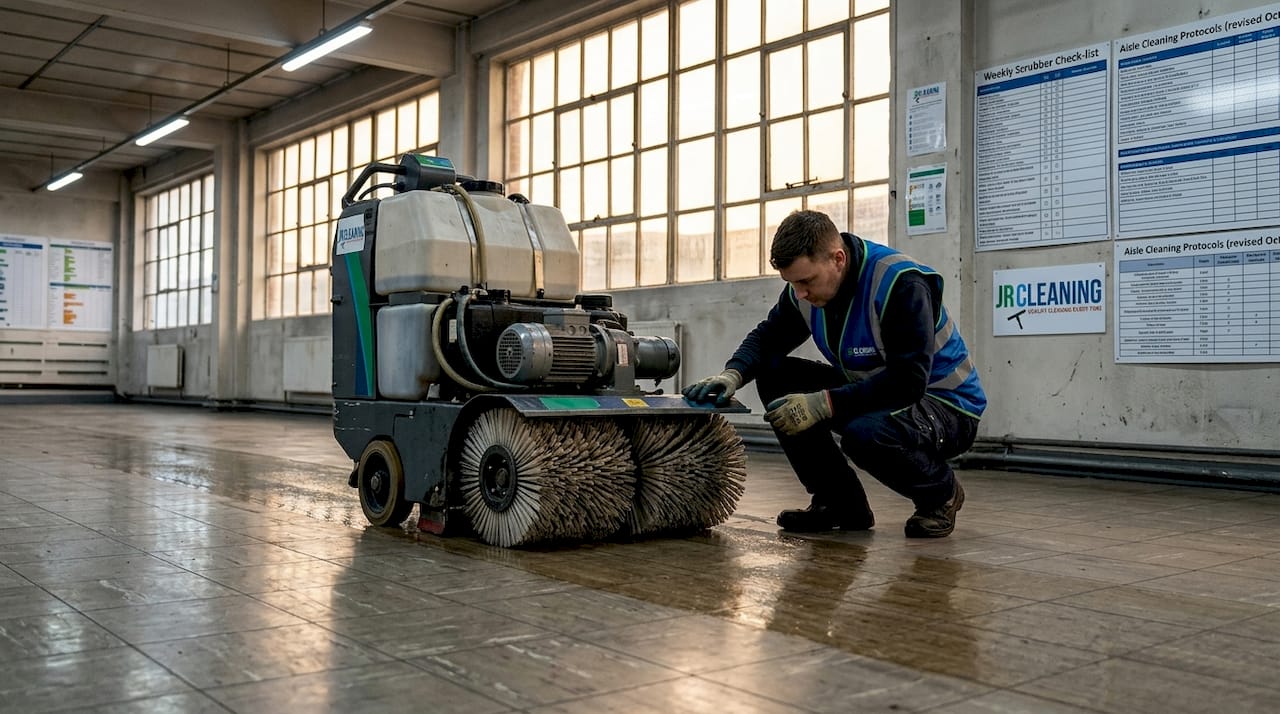
Sweepers vs scrubbers: choosing the right machine
Disc scrubbers work well on flat, smooth surfaces such as sealed concrete or vinyl. Cylindrical scrubbers are the better choice for uneven or grouted industrial floors because their rotating brushes penetrate crevices more effectively and many models include debris catch trays, reducing the need for a separate pre-sweep. This dual function makes cylindrical machines particularly efficient in warehouses and manufacturing facilities where floor surfaces are rarely perfectly level.
Automated scrubbers with recovery tanks improve safety by immediately removing moisture from the floor surface, cutting slip risk during the cleaning process itself. This matters in live production environments where you cannot always cordon off large areas for extended drying periods.
Maintaining your cleaning machinery
Equipment upkeep is not optional. Dirty squeegees and worn brushes cause cleaning inefficiency and can physically damage floor coatings, leaving streaks, scratches, or uneven residue. After every shift, rinse solution tanks, inspect squeegee blades for tears or warping, and check brush pressure settings. Proper brush pressure and pad selection are critical on polished concrete or coated surfaces, where incorrect settings cause irreversible surface damage.
Pro Tip: Set your scrubber’s brush pressure to the lowest effective setting when working on epoxy or urethane coatings. Increase pressure only on bare concrete or heavily soiled areas where the coating has already been stripped.
| Machine type | Best surface | Key advantage |
|---|---|---|
| Ride-on sweeper | Large open warehouse floors | Fast dry debris removal across wide areas |
| Disc scrubber | Smooth sealed concrete or vinyl | Consistent pressure on flat surfaces |
| Cylindrical scrubber | Grouted, uneven, or textured floors | Penetrates crevices; reduces pre-sweep requirement |
| Walk-behind scrubber | Smaller bays or congested areas | Manoeuvrable in tight spaces |
Which cleaning solutions work best for different soil levels?
Chemical selection is where many facilities make costly errors. The correct product depends on the soil type, the floor coating, and the frequency of cleaning. Using a heavy-duty degreaser on a lightly soiled floor wastes product and risks coating damage. Using a light maintenance cleaner on heavy grease contamination leaves residue and creates slip hazards.

Dilution ratios vary significantly by soil level: heavy-duty degreasing requires concentrations of 1:10 to 1:20, standard scrubber use sits at 1:32 to 1:64, light maintenance falls at 1:128 to 1:256, and minimal soiling calls for 1:512 to 1:1024. These are not interchangeable. Over-diluting a heavy-duty product leaves grease on the floor; under-diluting a maintenance cleaner leaves chemical residue that attracts more dirt.
Selecting the right product for your floor type
For epoxy and urethane concrete floors, the product choice is especially critical. Acidic cleaners such as vinegar and abrasive or soap-based products degrade the gloss and traction of epoxy surfaces over time. Use pH-neutral cleaners or products specifically formulated for coated concrete. Warm water with a diluted ammonia solution is a reliable option for routine epoxy maintenance when a specialist product is unavailable.
Rinsing is not optional after chemical application. Alkaline residue from insufficient rinsing causes wax or coating failure, leading to peeling, powdering, or a surface that will not hold a new coat. After stripping or deep cleaning, always apply a neutralising rinse before any wax or sealer goes down.
- Heavy soil or grease: use a concentrated alkaline degreaser at 1:10 to 1:20
- Standard maintenance: pH-neutral cleaner at 1:32 to 1:64 in your scrubber tank
- Epoxy or coated floors: manufacturer-approved cleaner or diluted ammonia solution
- Post-strip neutralising: apply a neutralising rinse before recoating or waxing
- Avoid on epoxy: vinegar, bleach, soap-based cleaners, and abrasive powder products
What is the recommended cleaning schedule for industrial floors?
A structured schedule is the single most effective tool for extending floor life and maintaining compliance. Without one, cleaning becomes reactive, and reactive cleaning always costs more in labour, materials, and floor repairs than a planned programme.
The recommended maintenance schedule follows a clear hierarchy: daily dust mopping or sweeping to remove loose debris, damp mopping or auto-scrubbing two to five times per week depending on traffic and soil level, and deep restoration or strip-and-wax cycles every three to six months. This framework applies to most industrial floor types and can be adjusted based on your facility’s specific conditions.
Step-by-step weekly cleaning procedure
- Sweep or dust mop the entire floor before any wet cleaning begins. Wet mopping over loose grit grinds particles into the surface and accelerates wear.
- Pre-treat heavily soiled zones such as loading bays, machinery areas, or entry points with a degreaser at the appropriate dilution. Allow a dwell time of three to five minutes.
- Run the auto scrubber across the full floor area, working in overlapping passes to avoid missed strips. Use the correct brush type and pressure for your floor coating.
- Inspect the recovery tank after each pass in heavily soiled areas. A full tank recirculates dirty water onto a clean floor.
- Dry the floor thoroughly using air movers or industrial fans, particularly in areas with epoxy or urethane coatings. Rushing the drying phase creates slip hazards and shortens coating life.
- Maintain entryway matting as part of the routine. Mats at entry points reduce the volume of dirt tracked onto the main floor by a significant margin, cutting cleaning frequency and chemical use.
Pro Tip: Schedule deep cleaning cycles to coincide with planned production shutdowns or low-traffic periods. Attempting a strip-and-wax during normal operations creates extended wet floor hazards and rarely produces a quality result.
Using maintenance scheduling software to log cleaning tasks, track chemical usage, and flag overdue deep cleans helps facility managers maintain consistency across shifts and sites.
How to clean epoxy and urethane concrete floors safely
Epoxy and urethane concrete floors require a more careful approach than bare concrete because the coating itself is the asset you are protecting. Scratching, delaminating, or chemically degrading the coating means a costly reapplication, not just a cosmetic issue.
Begin every clean with a thorough sweep using a soft-bristle broom or microfibre dust mop. Never skip this step on coated floors. Grit left on the surface acts as an abrasive under the scrubber pad and produces fine scratches that dull the finish permanently. For wet cleaning, apply a warm water solution with a pH-neutral or ammonia-based cleaner, allow a short dwell time of two to three minutes, then scrub with a soft pad or brush. Rinse thoroughly and dry completely.
Seamless urethane concrete floors with integrated sani-cove bases eliminate the wall-to-floor joint where moisture and bacteria accumulate. In food and beverage facilities, this design detail reduces contamination risk and simplifies the cleaning process considerably.
Additional protective measures for coated floors include placing rubber or nylon feet on heavy equipment, avoiding dragging metal objects across the surface, and never using solvent-based cleaners that soften or lift the coating. For industrial floor coating cleaning, the principle is straightforward: the gentler the method, the longer the coating lasts.
What mistakes do facility managers make with floor cleaning?
The most damaging errors in industrial floor maintenance are not dramatic failures. They are small, repeated oversights that compound over months until the floor requires expensive restoration.
- Skipping equipment maintenance: a scrubber with a torn squeegee blade leaves a wet trail down the centre of every pass, creating a slip hazard and negating the entire cleaning effort
- Incorrect dilution ratios: over-concentrated chemicals leave sticky residue that attracts dirt; under-concentrated solutions fail to lift grease and give a false impression of a clean floor
- Rushing drying time: many facility managers overlook the drying phase, yet wet floors after cleaning are a leading cause of post-cleaning slip incidents
- Wrong pad or brush for the surface: stiff nylon pads on epoxy produce micro-scratches that accumulate into visible dullness within weeks
- Neglecting perimeter areas and grout joints: debris and bacteria accumulate fastest at wall edges and in grout lines, yet these zones are consistently missed by auto scrubbers that cannot reach the perimeter
Pro Tip: Walk the floor after every scrubbing cycle and check the perimeter with a torch at a low angle. Residue and missed zones are far easier to spot in raking light than under standard overhead lighting.
Key takeaways
Effective industrial floor maintenance requires the right machinery, correctly diluted chemicals, and a structured schedule applied consistently across every shift and zone.
| Point | Details |
|---|---|
| Match machine to surface | Use cylindrical scrubbers on grouted or uneven floors; disc scrubbers on smooth sealed surfaces. |
| Dilute chemicals correctly | Heavy soiling needs 1:10 to 1:20 concentration; light maintenance requires 1:512 to 1:1024. |
| Follow a structured schedule | Daily sweeping, two to five weekly scrubs, and deep restoration every three to six months. |
| Protect coated floors | Avoid acidic or abrasive cleaners on epoxy; always rinse thoroughly to prevent coating failure. |
| Never rush drying | Use air movers after wet cleaning to prevent slip hazards and protect coating adhesion. |
Why I think most facilities underinvest in the drying phase
After two decades working across UK industrial sites, the single most consistent gap I see is not the cleaning itself. It is what happens in the fifteen minutes after the scrubber finishes. Facilities invest in quality machines and the right chemicals, then leave the floor to air dry in a poorly ventilated warehouse and wonder why they have slip incidents and coating failures within a year.
The drying phase is where the cleaning process either pays off or unravels. A floor that is scrubbed correctly but dried poorly is more dangerous than one that was not cleaned at all, because it looks clean while remaining wet. Air movers are not expensive relative to the cost of a slip claim or a floor recoat.
I have also seen facilities where the cleaning programme is technically sound but the results are inconsistent because staff are not trained to check their equipment before each shift. A scrubber with a worn brush and a cracked squeegee is not a cleaning machine. It is a machine that spreads dirty water across a floor and leaves a maintenance record that says the floor was cleaned. Training staff to inspect equipment takes twenty minutes. Failing to do so costs far more.
The industry is moving towards automated scrubbers with onboard sensors and antimicrobial floor coatings that reduce bacterial load between cleans. Both are worth evaluating for high-traffic or regulated environments. But no technology replaces a well-trained operative following a documented procedure. The industrial site cleaning process that produces consistent results is always the one that is written down, monitored, and reviewed.
— jamie
Professional support for industrial floor maintenance
Managing industrial floor cleaning in-house requires the right machinery, trained staff, and a consistent programme. When any of those elements are missing, floors deteriorate faster and liability exposure increases.

Jrcleaning provides commercial and industrial cleaning services across the UK, backed by over 20 years of experience and full compliance with health and safety regulations. Our teams use professional-grade auto scrubbers, appropriate chemical solutions for each floor type, and structured cleaning schedules tailored to your facility’s traffic and soil levels. Whether you need a one-off deep restoration or an ongoing maintenance contract, Jrcleaning removes the operational burden and delivers floors that are clean, safe, and compliant. Contact us for a free quote or visit our full services page to see the complete range of cleaning solutions available.
FAQ
How often should industrial floors be cleaned?
Daily dust mopping, two to five weekly scrubs, and a deep restoration every three to six months is the standard schedule for most industrial facilities. High-traffic or food-production environments may require more frequent wet cleaning.
What cleaning solution is safe for epoxy floor coatings?
pH-neutral cleaners or diluted ammonia solutions are safe for epoxy floors. Avoid vinegar, bleach, and soap-based products, as these degrade the coating’s gloss and traction over time.
What is the difference between a disc and cylindrical scrubber?
Disc scrubbers suit flat, smooth surfaces, while cylindrical scrubbers penetrate grouted or uneven floors more effectively and often combine sweeping and scrubbing in a single pass.
Why do industrial floors become slippery after cleaning?
Slippery floors after cleaning are usually caused by chemical residue from incorrect dilution or insufficient rinsing, or by a floor that has not been dried properly. Using air movers and rinsing thoroughly after chemical application resolves both issues.
How do I prevent floor coating damage during cleaning?
Use the correct brush pressure setting on your scrubber, avoid abrasive pads on coated surfaces, and always neutralise the floor after stripping before applying any new wax or sealer. Alkaline residue causes coating failure if left on the surface before recoating.
Recommended
- Master the industrial site cleaning process: safer facilities | J R Cleaning
- Industrial facility cleaning: safety, compliance, efficiency | J R Cleaning
- What office cleaning involves: a guide for UK businesses | J R Cleaning
- Interior cleaning must-haves for spotless results in 2026 | J R Cleaning

