

Pressure washing looks deceptively simple. Point a gun at a grimy driveway, squeeze the trigger, and watch years of dirt vanish. The reality, however, is far more nuanced. Use too much pressure, choose the wrong nozzle, or target the wrong surface, and you can strip mortar from brickwork, split decking timber, or force water beneath roof tiles in minutes. This guide walks you through exactly how pressure washing works, where to use it safely around your UK home or business, the mistakes to avoid, and how to decide when a professional is the better call for your property.
Table of Contents
- What is pressure washing and how does it work?
- Which areas of your property benefit most from pressure washing?
- Common mistakes and essential safety tips
- Should you hire a professional or do it yourself?
- A professional perspective: why technique matters more than pressure
- Ready for safe, pristine results?
- Frequently asked questions
Key Takeaways
| Point | Details |
|---|---|
| Choose the right method | Different surfaces require varied pressure and nozzle settings to stay damage-free. |
| Safety comes first | Follow UK safety guidelines for both DIY and professional cleaning, especially for businesses. |
| Know what to clean | Patios, driveways, and rendered walls benefit most—while roofs and old paint need special care. |
| DIY or hire wisely | Professional services are safer for fragile or hard-to-reach areas, while DIY suits straightforward jobs with the right care. |
What is pressure washing and how does it work?
Pressure washing uses a motorised pump to force water through a narrow nozzle at high velocity. That concentrated jet strips away dirt, algae, moss, oil stains, and general grime far faster than a scrubbing brush ever could. The core components are simple: a pump (electric or petrol driven), a reinforced hose, a trigger gun, interchangeable nozzles, and a mains or tank water supply.
Where people get confused is in conflating pressure washing with two similar methods. Power washing adds heat to the water, making it particularly effective on grease and biological matter. Soft washing uses low pressure combined with specialist cleaning solutions, making it the preferred choice for roofs, painted surfaces, and anything fragile. Understanding the difference matters because applying standard pressure washing to soft-wash surfaces is one of the most common causes of accidental damage.
In the UK, professional cleaning methods have evolved considerably, and pressure washing sits within a wider regulatory framework. Pressure systems are regulated under the Pressure Systems Safety Regulations 2000, which means any commercial use demands competent operators and documented inspection schemes. For homeowners, those legal duties are less formal, but the underlying safety principles remain exactly the same.
Key components and their roles
| Component | Function | What goes wrong if ignored |
|---|---|---|
| Pump | Generates water pressure (PSI) | Too high PSI damages surfaces |
| Nozzle | Controls spray angle and force | Wrong angle concentrates damage |
| Hose | Delivers pressurised water | Kinks reduce pressure unpredictably |
| Detergent tank | Holds cleaning solution | Incorrect chemicals strip coatings |
| Water source | Feeds the pump | Inadequate flow starves the pump |
Pressure is measured in PSI (pounds per square inch) or bar. A typical consumer machine runs at 100 to 150 bar. A professional unit can reach 250 bar or higher. More PSI is not automatically better. It simply means greater potential for both cleaning power and damage if misapplied.
Which areas of your property benefit most from pressure washing?
With the basics covered, it is time to get practical. Where should you actually use pressure washing around your property?
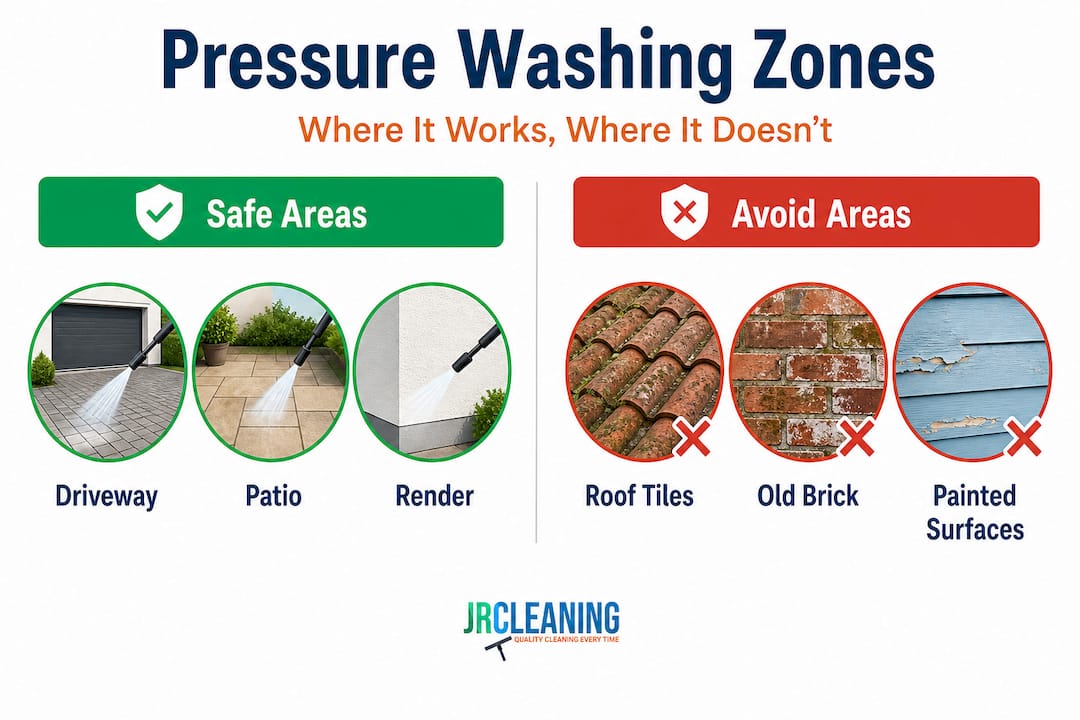
The surfaces that respond best share a common characteristic: they are hard, non-porous or semi-porous, and not held together by materials that water can erode. Consider driveway cleaning advice for concrete or block paving, where years of tyre marks and moss growth can be cleared in a single session. Similarly, patio cleaning tips consistently point to pressure washing as highly effective on sandstone, porcelain, and concrete slabs, provided you match the nozzle to the stone type.
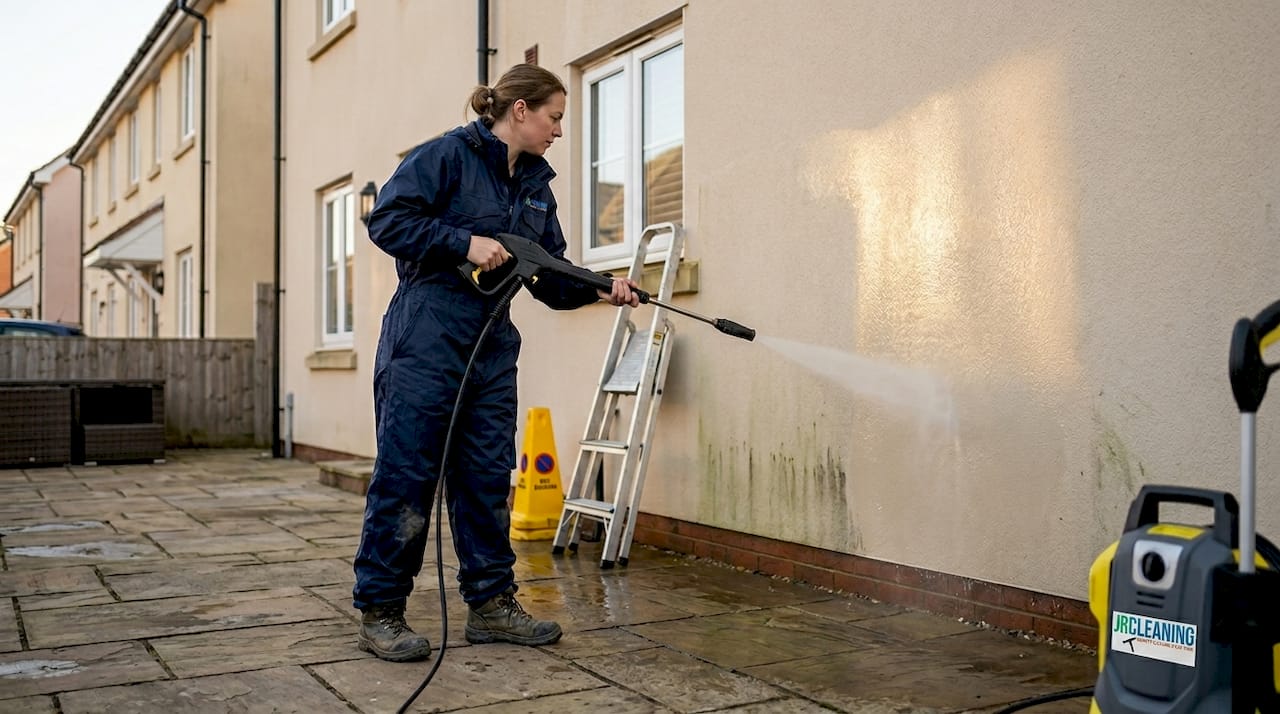
External wall render is another strong candidate, though it needs care. Smooth render tolerates a wide-angle nozzle at moderate pressure. Older pebbledash or textured renders are more vulnerable to surface loss. For render specifically, following render cleaning guidance before starting will save you from an expensive mistake.
Areas that suit pressure washing vs those that do not
| Surface | Pressure washing suitable? | Notes |
|---|---|---|
| Concrete driveway | Yes | Use 15 to 25 degree nozzle |
| Block paving | Yes | Avoid blasting jointing sand |
| Patio slabs (porcelain) | Yes | Lower PSI, wider nozzle |
| Sandstone paving | Caution | Very low pressure only |
| Exterior brick (modern) | Caution | Wide nozzle, test first |
| Old or soft brickwork | No | Mortar damage risk |
| Painted surfaces | No | Strips paint |
| Roof tiles | No | Use soft wash instead |
| Timber decking | Caution | Low pressure, follow grain |
| Gutters | No | Specialist equipment needed |
For business owners, the considerations expand. Shopfronts accumulate chewing gum, exhaust deposits, and biological growth that residential surfaces rarely see. Cladding panels, communal car parks, and service yards all benefit from regular pressure washing, but the material composition of commercial cladding varies enormously. Always identify the cladding type before treating it.
Pro Tip: Before washing any unfamiliar surface, run a brief test on a hidden corner using your lowest pressure setting. If it holds up without pitting, scuffing, or water ingress, you can proceed with confidence.
Pressure washing typically requires matching pressure, nozzle choice, and technique to the specific surface, with gentler settings and wider-angle nozzles reserved for anything delicate. This is not optional advice; it is the difference between a clean surface and a repair bill.
Common mistakes and essential safety tips
Once you know which areas to target, it is essential to avoid the costly mistakes many make when pressure washing.
The single most common error is simply turning the pressure up too high and assuming that more force equals a better result. It does not. What it does is strip jointing compound from between paving slabs, blast the surface from soft stone, and embed water into wall cavities where it causes lasting damp problems. The second most common mistake is selecting the wrong nozzle angle. A zero-degree (red) nozzle concentrates all the force into a pencil-thin point. It can cut timber, etch concrete, and damage brick within seconds of contact.
Step-by-step safety preparation
- Clear the area of garden furniture, plant pots, children’s toys, and any loose debris before you begin.
- Put on personal protective equipment (PPE): waterproof boots with a non-slip sole, safety goggles, and waterproof gloves as a minimum.
- Cover drains and adjacent planted areas if you are using detergent, to avoid chemical runoff damaging plant life or entering the water system.
- Start on your lowest effective pressure setting and increase only if genuinely needed.
- Test on an inconspicuous area first, waiting a few minutes after washing to assess any surface reaction.
- Keep children and animals well away from the work zone. A pressure washer jet at close range can cause serious injury.
- Check the surface post-cleaning for signs of damage, loosened pointing, or unexpected discolouration before considering the job done.
Nozzle selection and technique including the distance you hold the nozzle from the surface are the practical levers that reduce risk while still delivering excellent results. Holding the nozzle even 5 centimetres closer than recommended can double the effective PSI hitting a surface.
For businesses, pressure systems are regulated formally, and written schemes of examination are a legal requirement for high-pressure equipment in commercial settings. This means having a documented record of inspections, not simply buying a machine and hoping for the best.
Never assume a surface you have washed before can handle the same pressure this time. Weathering, frost damage, and biological growth between sessions can weaken materials significantly.
If your cleaning task involves working at height, such as second-storey walls or above-ground gutters, revisit safe gutter cleaning guidance before attempting anything yourself. Falls from ladders while managing a pressure washer are a genuine and avoidable hazard.
Should you hire a professional or do it yourself?
Now that you have got the know-how, should you go it alone or trust a professional with your property’s care?
DIY pressure washing makes sense under specific conditions. If the surface is straightforward (a flat concrete driveway at ground level), the job is modest in size, you own or can easily hire the correct equipment, and you are comfortable following safety steps, then doing it yourself is entirely reasonable. Many homeowners wash their own patios and paths each spring with decent results.
Where DIY falls short is in more complex scenarios. Surfaces like roof cleaning demonstrate this clearly; most tile types are genuinely vulnerable to high-pressure water, and working safely on a pitched roof requires specialist ladders, anchor points, and training that most householders simply do not have. The same applies to render, heritage brickwork, and any task involving working above single-storey height.
When professionals add clear value
- Correct equipment for the task: commercial machines with variable pressure settings and specialist nozzles cover a wider range of surfaces safely.
- Training and experience: knowing how a surface will react to pressure is not something a quick YouTube search replicates reliably.
- Insurance: a professional company carries public liability insurance, meaning any accidental damage is covered. Yours is not.
- Consistent results: streaking, missed patches, and reblocking of jointing sand are typical DIY outcomes that professionals avoid through systematic technique.
- Time savings: a professional team with the right equipment can clean a large commercial car park in a fraction of the time a single homeowner would spend.
Proper technique using gentler settings and correctly matched nozzles is precisely what differentiates a professional clean from a DIY attempt that leaves visible scour marks. When you consider the cost of re-pointing damaged brickwork or replacing a split decking board, the professional fee often looks considerably more attractive.
Understanding the benefits of soft washing alongside pressure washing also helps you ask the right questions when speaking to any cleaning company. A professional who only offers one method for every surface should prompt further questions. The best operators match the cleaning method to the material, not the other way around.
Pro Tip: For any surface above ground level, or anything made from materials you cannot immediately identify, professional assessment is the safest and most cost-effective first step. Even a brief consultation can save significant repair costs later.
You can get a broader sense of what professionals bring to the table by reading about expert hygiene and safety practices, which extend well beyond simply owning a powerful machine. Equally, if windows form part of your cleaning goals, dedicated window cleaning tips will show you why pressure washing is rarely the right tool for glazed surfaces.
A professional perspective: why technique matters more than pressure
Here is what few guides explain, but experienced cleaners know well: the vast majority of pressure washing mistakes do not come from using too little pressure. They come from poor technique. We see this constantly when clients contact us after a DIY attempt has left brickwork pitted, render patchy, or block paving with the jointing sand half blasted away.
The instinct to increase pressure when something is not cleaning quickly enough is almost universal, and almost universally wrong. What actually shifts stubborn staining is dwell time with an appropriate detergent, correct nozzle angle, and consistent movement speed. Holding a nozzle in one spot is the single fastest way to cause irreversible surface damage.
Nozzle selection and technique including the tested distance from the surface are the genuine variables that determine both the safety and quality of any pressure washing job. Professionals train to read a surface, adapt their approach mid-job, and recognise when a different method altogether is more appropriate.
Regular equipment maintenance matters too. A partially blocked nozzle concentrates flow unpredictably. A worn seal causes pressure fluctuations that make technique inconsistent. These are details that home users rarely consider but that directly affect results. The best outcome comes not from the most powerful machine available, but from the correct machine, maintained properly, operated by someone who understands the material in front of them.
Ready for safe, pristine results?
At JR Cleaning, we have spent over 20 years developing the kind of technique and surface knowledge that this guide has outlined. Whether your property needs a seasonal refresh or a thorough commercial deep clean, our team brings fully insured, professional-grade residential and commercial cleaning to UK homes and businesses.

Our range of cleaning service options covers driveways, patios, render, cladding, brickwork, and more, with each job assessed individually to match the right method to the right surface. We also offer a dedicated gutter cleaning service for properties where gutters need safe, specialist attention. Contact us today for a free, no-obligation quote, and let us take the guesswork out of keeping your property looking its very best.
Frequently asked questions
Is pressure washing safe for all outdoor surfaces?
No, surfaces such as old brick, painted areas, or roof tiles can be damaged by high pressure unless the appropriate nozzle and technique are matched to the material before starting.
Can I pressure wash my gutters and roof myself?
It is not recommended for most homeowners; roofs and gutters are structurally delicate and usually require professional assessment alongside gentler cleaning methods than standard pressure washing provides.
Do I need special training to use a pressure washer safely?
Homeowners should follow manufacturer instructions carefully and wear appropriate PPE, but for businesses, pressure systems are regulated legally, requiring competent operators and written schemes of examination.
What is the difference between pressure washing and soft washing?
Pressure washing uses high-force water jets, while soft washing combines specialist cleaning chemicals with much lower water pressure, making it considerably safer for fragile or porous surfaces such as roof tiles or painted render.
How often should I pressure wash my driveway or patio?
Most UK properties benefit from an annual clean at minimum, though driveways in shaded or damp locations often benefit from twice-yearly washing to control moss and algae growth before they become embedded.
Recommended
- Gutter cleaning step by step: keep your UK home safe | J R Cleaning
- Professional cleaning methods for spotless UK homes | J R Cleaning
- J R Cleaning news | J R Cleaning
- The essential business property cleaning guide for UK success | J R Cleaning

