

Cleaning audits are evidence-based evaluations that measure whether cleaning meets defined standards, not merely whether tasks were completed. Unlike a casual walkthrough or a signed completion log, a formal quality audit uses structured checklists, weighted scoring, photographic documentation, and corrective action tracking to produce objective, trendable data. Platforms such as Smart Inspect, Swept, and CleanTelligent have made this process accessible to facilities of every size. The business case is clear: facilities with formal audit programmes achieve 23% higher occupant satisfaction scores and detect hygiene failures 300% earlier than those relying on routine logs alone. That gap represents real regulatory risk and real reputational cost.
What is the role of cleaning audits in quality management?
Cleaning audits sit at the intersection of hygiene compliance, vendor accountability, and operational improvement. Their core function is to replace subjective impressions with scored, documented evidence that managers can act on, report upward, and use to negotiate with contractors. Without this structure, cleaning oversight defaults to whoever complains loudest rather than where the risk is greatest.
The distinction matters most in high-footfall commercial settings. An office building, care home, or retail unit cleaned to a visual standard may still harbour cross-contamination risks in high-touch zones that no walkthrough would catch. Formal audits close that gap by applying consistent criteria every time, regardless of who conducts the inspection. The result is a paper trail that protects the business during regulatory inspections and insurance claims alike.
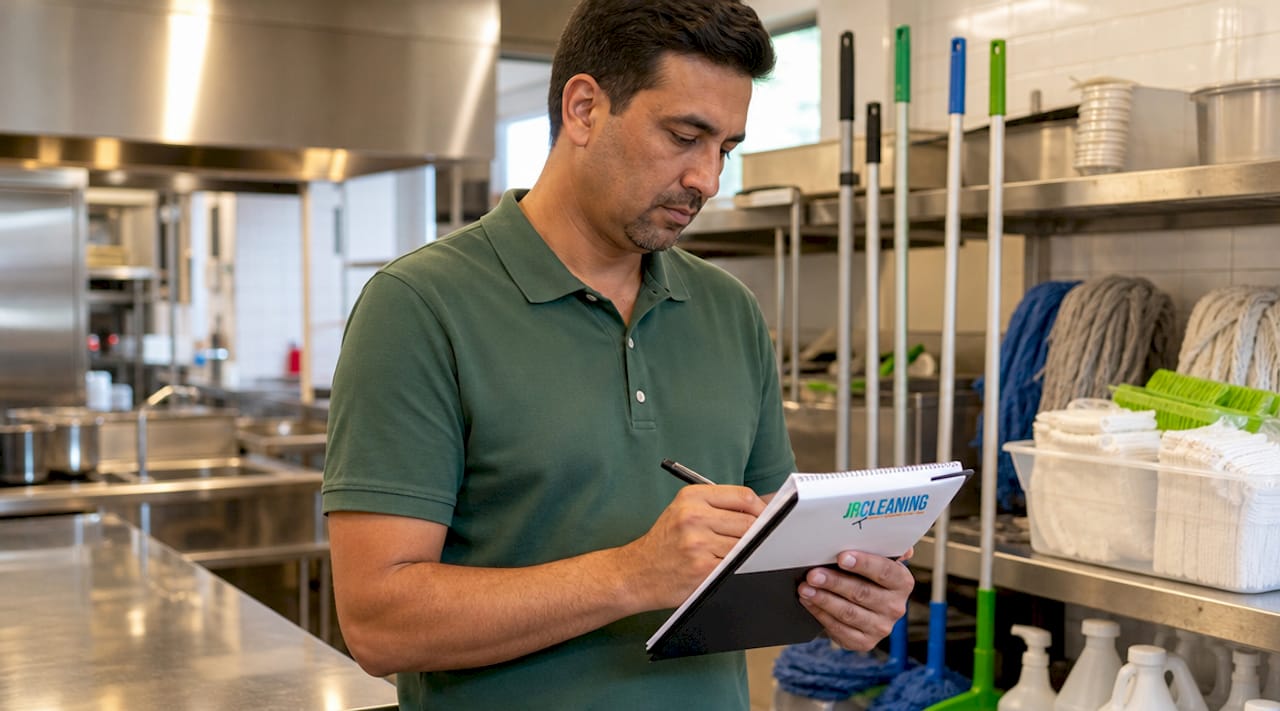
Understanding cleaning in workplace safety reinforces why this matters. Cleaning is not a cosmetic function. It is a risk management discipline, and audits are the measurement tool that keeps it honest.
What are the essential components of an effective cleaning audit?
An effective cleaning audit requires five core elements. Omitting any one of them compromises the credibility of the entire programme.
A 100-point checklist tailored to facility zones. Generic checklists miss site-specific risks. A food preparation area carries different contamination hazards than a reception lobby, and the checklist must reflect that. Zone-specific criteria make scores comparable across audit cycles and meaningful to regulators.
Weighted scoring by hygiene risk. Weighted scoring assigns higher value to high-risk areas such as restrooms and clinical zones, so a failure there costs more points than a missed dusting in a storage room. This ensures the final score reflects real-world health risk rather than a simple average of visual cleanliness.
Photographic documentation of every deficiency. Photos provide incontrovertible evidence that a standard was not met at a specific time and location. They remove ambiguity from vendor disputes and create a visual record that supports corrective action follow-up.
A formal corrective action process. Corrective action workflows must remain open until resolution is confirmed with photographic verification. Closing a ticket without proof of resolution defeats the purpose of the audit entirely.
An independent auditor. Having an independent auditor, separate from the daily cleaning crew, maintains objectivity and removes conflicts of interest. Self-assessed audits are structurally unreliable because the person scoring the work has an incentive to score it favourably.
Pro Tip: When building your first audit checklist, weight restrooms, kitchens, and any clinical or food-contact zones at no less than 30% of the total score. These areas carry the highest regulatory and health risk, and their weighting should reflect that.
How do cleaning audits support compliance and risk management?
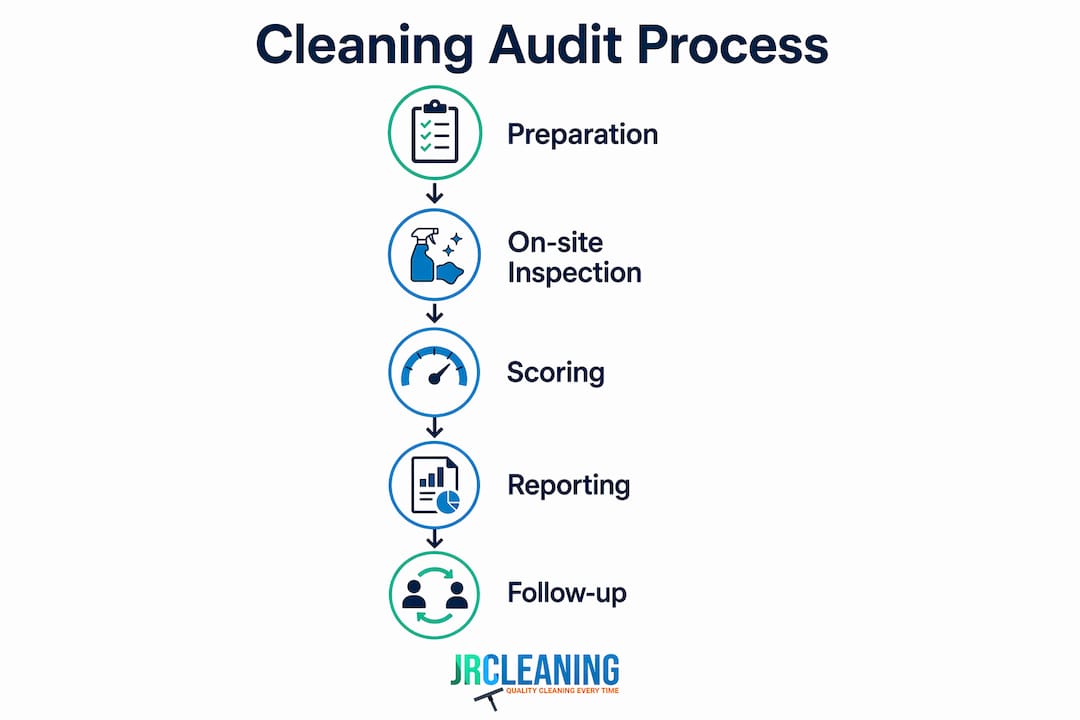
Structured audits identify operational gaps before a regulatory inspection surfaces them as formal findings. This is the preventive value that makes the importance of cleaning audits so significant in care homes, schools, and commercial offices operating under health and safety legislation.
The compliance benefits break down into three practical areas:
Infection control. Regular cleaning audits identify inconsistencies early, supporting infection control and preventing larger compliance risks. In a care home, a single missed disinfection protocol in a shared bathroom can trigger a cross-contamination incident. Audits catch the pattern before it becomes an outbreak.
Regulatory documentation. Health and safety frameworks, including OSHA sanitation standards internationally and the Health and Safety at Work Act 1974 in the UK, require demonstrable evidence of hygiene management. Audit records provide exactly that. A folder of signed completion logs does not.
Early warning through trend analysis. A single low score is a data point. Three consecutive low scores in the same zone are a systemic failure. Audit trends reveal whether a problem is isolated or structural, which determines whether the response is a staff conversation or a contract review.
Zone-specific standards are critical here. A generic cleaning schedule applied uniformly across a facility treats a server room the same as a staff kitchen. Audit programmes that assign different frequencies and criteria by zone reflect the actual risk profile of the building, which is what regulators and insurers expect to see.
Audits versus routine logs: what is the real difference?
The distinction between a completion log and a quality audit is the most misunderstood issue in facility cleaning management. Completion logs prove task presence; audits prove the standard achieved. That gap is the source of most cleaning-related complaints and health code violations.
| Feature | Completion log | Quality audit |
|---|---|---|
| What it records | Task was performed | Standard achieved |
| Scoring | None | Weighted by risk zone |
| Evidence | Signature or timestamp | Photos, scores, corrective tickets |
| Trend analysis | Not possible | Built-in across audit cycles |
| Vendor accountability | Weak | Contractually defensible |
| Regulatory value | Minimal | Directly supports compliance |
The table above makes the operational gap visible. A contractor can sign a log having wiped a surface with a contaminated cloth. An audit would score that zone as a failure, raise a corrective action ticket, and require photographic proof of resolution before closing.
Digital audit platforms with photo attachment, GPS timestamping, automatic scoring, and corrective ticketing improve reliability and follow-up over paper methods. Paper logs are vulnerable to retrospective completion, illegible entries, and lost records. Digital platforms create a timestamped, tamper-resistant audit trail that holds up under scrutiny.
Pro Tip: If your current cleaning contract only requires a signed log as proof of service, you have no contractual basis to dispute poor performance. Amend the contract to require scored audit reports at agreed intervals. This single change transforms your vendor relationship from trust-based to evidence-based.
How to conduct cleaning audits for maximum operational impact
Implementing a cleaning audit programme that genuinely improves operations requires more than downloading a checklist. The following steps reflect cleaning audit best practices drawn from facility management experience and current industry standards.
Define your zones and risk levels. Map every area of the facility and assign a hygiene risk rating. High-risk zones such as toilets, kitchens, and clinical areas require more frequent audits and higher weighting in the scoring model.
Build zone-specific checklists. Each zone checklist should reference the specific standards it is measuring against, whether that is a contractual specification, a regulatory requirement, or an internal hygiene policy. Vague criteria produce vague scores.
Establish audit frequency and auditor independence. Audit programmes with clear zones and frequencies improve operational control and provide data to support staffing and scope changes. Monthly audits are a minimum for most commercial settings; weekly audits are appropriate for high-risk environments.
Deploy a digital platform. Tools such as Smart Inspect or CleanTelligent allow auditors to capture photos, assign scores, and raise corrective tickets in real time. This removes the delay between finding a deficiency and acting on it.
Use audit KPIs for vendor management. Audit KPIs enable structured conversations with contractors, moving discussion from emotional complaints to measurable performance. A contractor scoring below 85% across three consecutive audits has a documented performance issue, not a disputed opinion.
Beyond the mechanics, the cultural dimension matters. Root causes such as training gaps or supply failures often underlie recurring low audit scores rather than individual staff errors. Presenting audit findings as operational intelligence rather than blame shifts the conversation from defensive to constructive. Cleaning providers who receive transparent audit data respond better and improve faster than those who receive only complaints.
Managing cleaning contracts effectively depends on exactly this kind of data-driven dialogue. Audit scores give property managers the evidence to enforce standards, justify budget decisions, and demonstrate due diligence to building owners and insurers.
Key takeaways
Cleaning audits are the only mechanism that converts cleaning activity into measurable, accountable performance data that supports compliance, vendor management, and continuous operational improvement.
| Point | Details |
|---|---|
| Audits outperform logs | Completion logs record presence; audits record the standard achieved and create a defensible evidence trail. |
| Five components are non-negotiable | Checklists, weighted scoring, photos, corrective action workflows, and auditor independence all must be present. |
| Compliance depends on documentation | Regulatory frameworks require demonstrable hygiene evidence; audit records satisfy this where logs do not. |
| Digital tools raise reliability | Platforms with GPS timestamping and photo attachment remove the vulnerabilities of paper-based audit methods. |
| KPIs transform vendor relationships | Scored audit data moves contractor conversations from subjective complaints to contractually enforceable performance standards. |
Why I think most businesses are auditing cleaning the wrong way
After years of working with commercial properties and cleaning providers, the pattern I see most often is this: a business invests in a cleaning contract, receives signed logs as proof of service, and then discovers a compliance gap during a regulatory inspection or a client complaint. The audit programme, if it exists at all, is treated as an occasional event rather than a management tool integrated into the facility cycle.
The uncomfortable truth is that most cleaning audits fail not because of the cleaning staff but because of how management has structured the oversight. A checklist without weighted scoring is just a to-do list. A walkthrough without photographic evidence is just an opinion. And a corrective action process that closes tickets without verification is theatre, not quality management.
What actually works is treating the audit programme the way a finance team treats a budget review. Regular, structured, data-driven, and tied directly to contract performance. When I see a property manager present a contractor with three months of scored audit data showing a consistent 72% in restroom zones, the conversation changes immediately. There is no room for “we’ve always done it this way.†The data speaks.
The other shift worth making is separating audit findings from blame. Recurring low scores often signal training gaps or scope mismatches, not lazy staff. Treating audit results as operational intelligence rather than a performance tribunal produces better outcomes for everyone involved.
— jamie
How Jrcleaning supports audit-ready cleaning standards
Jrcleaning delivers commercial and residential cleaning services built around documented, measurable quality standards. With over 20 years of experience across UK properties, the team operates with the consistency and accountability that structured cleaning audit programmes demand. Every service is fully insured and aligned with health and safety regulations, giving property managers the confidence that cleaning performance can withstand scrutiny.
Whether you manage a single commercial premises or a portfolio of properties, Jrcleaning’s professional cleaning services are designed to support corrective action follow-up, continuous performance improvement, and the kind of audit-ready documentation that protects your business. Request a free quote today and speak directly with the team about your compliance requirements.
FAQ
What is the role of cleaning audits in a business?
The role of cleaning audits is to provide objective, scored evidence that cleaning meets defined standards rather than simply confirming tasks were completed. This data supports regulatory compliance, vendor accountability, and continuous operational improvement.
How often should cleaning audits be conducted?
Monthly audits are the minimum for most commercial settings, with weekly audits appropriate for high-risk environments such as care homes or food preparation areas. Audit programmes integrated into normal facility cycles sustain consistent quality far more effectively than occasional inspections.
What should a cleaning audit checklist include?
A cleaning audit checklist should include zone-specific criteria, weighted scoring by hygiene risk, space for photographic evidence, and a corrective action section with responsible parties and resolution deadlines. Generic checklists applied uniformly across a facility miss site-specific risks and produce unreliable scores.
How do cleaning audits differ from completion logs?
Completion logs record that a task was performed; audits record whether the task met the required standard. The gap between the two is the primary source of cleaning-related complaints and health code violations in commercial properties.
Can cleaning audit data be used in contract disputes?
Scored audit reports with photographic evidence and timestamped corrective action records are contractually defensible in vendor disputes. Signed completion logs, by contrast, provide no basis for challenging a contractor’s performance against a quality standard.
Recommended
- How to manage cleaning contracts for quality and compliance | J R Cleaning
- Why commercial cleaning compliance matters in 2026 | J R Cleaning
- How to manage cleaning contracts for quality and compliance | J R Cleaning
- Industrial facility cleaning: safety, compliance, efficiency | J R Cleaning

