

Effective communication in cleaning services is the single most reliable predictor of client retention, team performance, and operational consistency. Cleaning managers who treat communication as a core business function, not an afterthought, consistently outperform those who rely on informal, ad hoc contact. The evidence is clear: 90% of cleaning companies fail to follow up after a job, leaving clients to drift away without a word. This guide covers the strategies, tools, and frameworks that turn communication into a genuine competitive advantage for cleaning businesses in 2026.
How the role of communication in cleaning services drives client satisfaction
Clear, structured communication between cleaning providers and clients is the mechanism that converts a one-off booking into a long-term relationship. When clients feel informed and heard, they are far less likely to switch providers after a single disappointing visit.
Research from Facilities Dive shows that facility managers who hold monthly “partnership meetings†with structured agendas see measurably better contractor outcomes. These meetings address specific issues, including missing items, scheduling conflicts, and quality concerns, before they become grievances. The structured format matters because it removes the emotional charge from difficult conversations and turns them into routine operational discussions.
Transparency is equally critical. One operations manager, cited by INCLEAN, made daily contact with a client for two full weeks after a service failure. The goal was not to apologise repeatedly but to demonstrate consistent presence and openness. That approach restored client confidence where silence would have ended the contract.
“Great communication is less about perfection and more about maintaining client confidence through transparency and consistent presence.†— INCLEAN
The practical takeaway for cleaning managers is this: clients do not expect flawless service every time. They expect to be told promptly when something goes wrong and to see a credible plan for resolution. Formalising this expectation in your service contract, as recommended by Facilities Dive, sets the standard from day one and removes ambiguity on both sides.
- Schedule monthly partnership meetings with a fixed agenda covering quality, incidents, and upcoming changes.
- Report issues to clients before they report them to you. Early disclosure builds trust far more effectively than reactive apologies.
- Embed communication expectations, including response time commitments and escalation contacts, directly into your service agreements.
- Use each client interaction as a data point to refine your service delivery and pre-empt future problems.
What are the most effective communication strategies for cleaning services?
The most effective communication strategies for cleaning businesses combine structured human contact with automated follow-up systems. Neither works as well in isolation.
Post-service follow-up is the single highest-leverage communication activity available to cleaning managers. VisibleFeedback identifies a four-step system that prevents silent churn: a same-day check-in text, rapid correction of any reported issue, a recurring service offer, and a scheduled reminder before the next booking. Silent churn, where clients quietly stop booking without ever complaining, is the primary cause of revenue loss in residential and commercial cleaning. A same-day text costs nothing and opens the door to feedback that would otherwise never reach you.
Automated communication platforms address the volume problem that makes consistent follow-up difficult for growing businesses. AI-powered systems improve client retention by 15 to 25%, reduce response times by 75 to 90%, and save staff four to six hours per day. That time saving alone justifies the investment for any business managing more than a handful of regular clients.
- Implement a same-day check-in text after every completed job. Keep it brief: one question asking whether the client is satisfied.
- Set up automated reminders for recurring bookings at least 48 hours in advance. Clients who feel forgotten cancel.
- Create a feedback loop by asking one specific question per visit rather than a generic satisfaction survey. Specific questions generate specific, usable answers.
- Escalate unresolved complaints to a senior contact within 24 hours. Speed of resolution is the variable clients remember most.
- Review your communication log monthly to identify clients who have gone quiet. Proactive outreach at this stage recovers bookings that would otherwise be lost.
Pro Tip: Set up a simple CRM tag for clients who have not responded to two consecutive check-in messages. These are your highest churn-risk accounts and they deserve a personal call, not another automated text.
Pre-service communication is just as important as post-service follow-up. Clients who receive clear information about what to expect before a visit are significantly less likely to raise complaints afterwards. Jrcleaning’s pre-service preparation guide outlines exactly what clients should know before a team arrives, which reduces misunderstandings and sets realistic expectations from the outset.
How does multilingual communication affect team performance and safety?
Multilingual cleaning teams are the norm rather than the exception in the UK, and language barriers are a direct operational risk. Missed tasks, safety incidents, and inconsistent quality are all more likely when instructions are unclear to part of your workforce.

The standard response, translating written instructions into multiple languages, is necessary but not sufficient. FacilityCare IQ documents that photo-based task verification combined with language-preferred instructions reduces missed tasks and misunderstandings far more effectively than translation alone. A photograph of the expected end state of a cleaned room communicates the standard without requiring fluency in any language.
| Communication method | Strengths | Limitations |
|---|---|---|
| Translated written checklists | Accessible, low cost, easy to distribute | Relies on literacy; misses visual nuance |
| Photo verification systems | Language-neutral, clear standard-setting | Requires setup time and device access |
| Video walkthroughs | High clarity, reusable for training | Production time; needs regular updating |
| Native language supervisors | Builds trust, enables real-time feedback | Dependent on individual availability |
Visual and language-appropriate tools also reduce the time supervisors spend on clarification. FacilityCare IQ notes that visual instructions cut training time and improve safety comprehension across multilingual crews. For cleaning managers overseeing large or dispersed teams, this translates directly into fewer callbacks, fewer incidents, and more consistent delivery.
- Pair every written checklist with a reference photograph showing the completed standard.
- Create a reporting channel where staff can flag issues in their preferred language, whether via WhatsApp, a translated form, or a bilingual supervisor.
- Conduct safety briefings with visual aids, not text alone, regardless of the language spoken by the majority of the team.
Traditional vs automated communication: which approach works better?
Traditional communication in cleaning operations relies on phone calls, paper records, and individual memory. It works at small scale and fails predictably as a business grows.
The core problem with manual communication is inconsistency. A supervisor who personally calls every client after each visit delivers excellent service until they are on leave, managing a complaint, or simply overwhelmed. Automated systems deliver consistent, personalised updates that match client preferences without depending on any individual’s availability. Clients receive the same quality of contact whether the business is managing five jobs or fifty.
| Factor | Traditional communication | Automated communication |
|---|---|---|
| Response time | Hours to days | Minutes to hours (75–90% faster) |
| Staff time required | 4–6 hours daily | Minimal once configured |
| Consistency | Variable, person-dependent | Consistent across all clients |
| Personalisation | High for small client lists | Scalable via CRM segmentation |
| ROI timeline | Immediate but limited by capacity | Positive within 3–6 months |
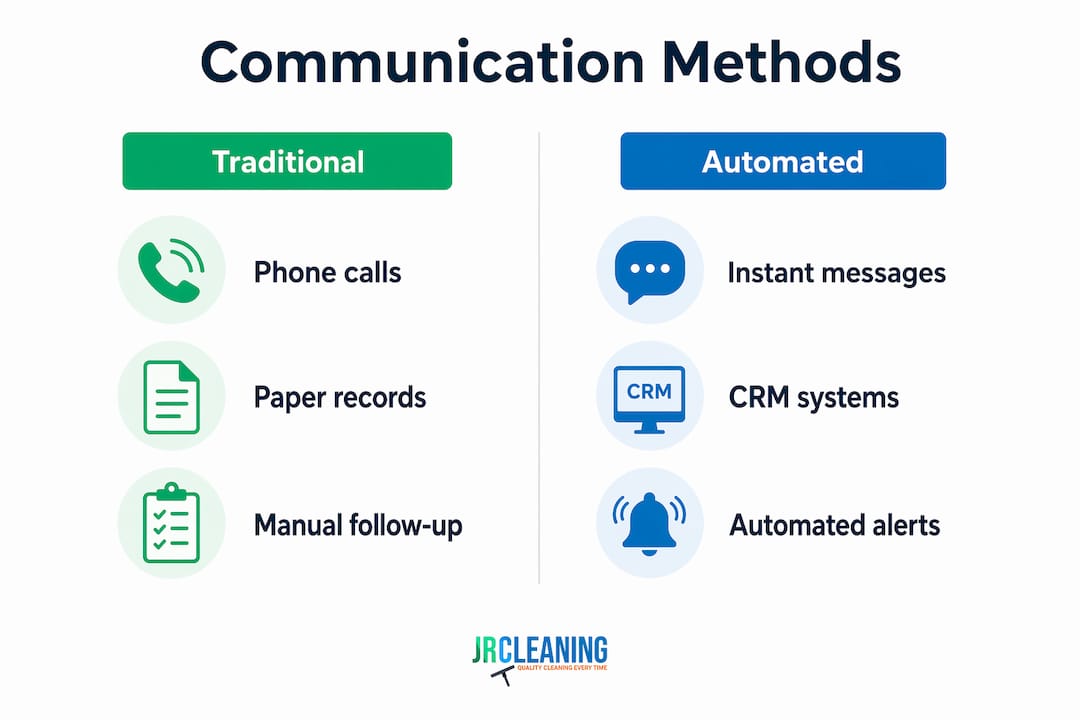
The ROI case for automation is strong. Positive returns are typically achieved within three to six months through reduced labour costs and improved retention. The risk is over-automation. Clients who receive only automated messages and never speak to a real person will eventually feel they are dealing with a system rather than a business. The most effective approach combines automated touchpoints for routine contact with human escalation for complaints, renewals, and relationship-building conversations.
Pro Tip: Use automation for volume tasks: booking confirmations, check-in texts, and reminders. Reserve personal calls for contract renewals, complaint resolution, and clients who have not booked in 60 days. This ratio keeps your team focused on conversations that actually move the needle.
Managing this balance well requires clear internal protocols. Jrcleaning’s approach to cleaning contract management outlines how structured communication frameworks support both quality assurance and client retention across residential and commercial accounts.
Key takeaways
Effective communication in cleaning services requires structured human contact, automated follow-up, and language-appropriate tools working together to retain clients and maintain operational standards.
| Point | Details |
|---|---|
| Monthly partnership meetings | Structured agendas turn difficult topics into routine discussions and prevent issues from escalating. |
| Post-service follow-up | A same-day check-in text is the single most cost-effective retention tool available to cleaning managers. |
| Automation ROI | AI communication systems improve retention by 15–25% and save up to six hours of staff time daily. |
| Multilingual tools | Photo verification combined with language-preferred instructions outperforms translation alone for diverse teams. |
| Silent churn prevention | 90% of cleaning companies skip post-job follow-up, making proactive contact an immediate differentiator. |
What I have learned about communication after two decades in cleaning
The most common mistake I see cleaning managers make is treating communication as a customer service function rather than an operational one. They delegate it to whoever answers the phone and measure it only when something goes wrong. That approach guarantees reactive management.
What actually works is treating every client touchpoint as a scheduled operational event, the same way you schedule a deep clean or a quarterly inspection. When communication is calendared and owned, it stops being the thing that falls through the cracks when the team is busy.
The technology argument is real but overstated in some quarters. Automation handles volume and consistency well. It does not handle the moment a long-standing client calls to say they are considering cancelling. That conversation requires a person who knows the account, understands the history, and has the authority to offer a genuine solution. No automated sequence replaces that.
The multilingual dimension is where I see the most avoidable failures. Managers assume that because their supervisors speak English, communication is covered. It is not. A crew member who cannot clearly report a problem, whether a damaged item, a safety hazard, or a scheduling conflict, is a liability. Investing in photo-based verification and native-language reporting channels is not a luxury. It is basic risk management.
The businesses that get this right share one characteristic: their managers are visible. They attend the partnership meetings, they review the feedback logs, and they make the personal calls. Technology supports that presence. It does not replace it.
— jamie
How Jrcleaning supports quality through expert communication
Jrcleaning brings over 20 years of experience delivering residential and commercial cleaning services across the UK, with client communication built into every stage of the process. From the initial enquiry through to post-service follow-up, the team operates with clear protocols that keep clients informed and confident in the service they receive.
Whether you manage a commercial property or need reliable residential cleaning, Jrcleaning’s expert cleaning services cover everything from interior and exterior cleaning to window, gutter, and conservatory work. The team is fully insured, health and safety compliant, and responsive across phone, email, and WhatsApp. If you are looking for a cleaning partner that treats communication as a professional standard rather than an optional extra, request a free quote today.
FAQ
What is the role of communication in cleaning services?
Communication in cleaning services defines how providers set expectations, report issues, and retain clients. It directly determines service quality, client satisfaction, and long-term retention.
How does post-service follow-up prevent client loss?
Silent churn occurs when clients stop booking without giving feedback. A same-day check-in text after each job opens a direct channel for issue resolution before the client decides to leave.
Why are monthly partnership meetings recommended for cleaning contracts?
Monthly structured meetings normalise difficult conversations about quality and incidents, preventing small issues from becoming contract-ending complaints.
How can cleaning managers communicate effectively with multilingual teams?
Photo-based task verification combined with language-preferred instructions is more effective than translation alone. Visual communication tools reduce missed tasks and improve safety comprehension across diverse crews.
When does automated communication outperform manual contact?
Automated systems outperform manual contact for volume and consistency, saving up to six hours of staff time daily and improving response times by up to 90%. Human contact remains superior for complaint resolution and contract renewals.
Recommended
- The role of professionalism in cleaning services | J R Cleaning
- The real role of cleaning schedules explained | J R Cleaning
- How to manage cleaning contracts for quality and compliance | J R Cleaning
- The role of cleaning in workplace safety | J R Cleaning

