

Customer satisfaction in cleaning is defined as the degree to which a client’s experience of cleanliness, communication, and reliability meets or exceeds their expectations. The janitorial services industry maintains an average CSAT score of 89/100, yet faces an average client churn rate of 15%. That gap tells you everything: high scores do not automatically translate into retained contracts. For business owners and property managers, understanding the role of customer satisfaction in cleaning is not a soft concern. It is the single most reliable predictor of whether a client renews, refers, or walks.
How does customer satisfaction affect cleaning service reputation and loyalty?
Client loyalty in the cleaning industry is built on perception, not just performance. User perception is the life insurance of cleaning contracts. Contract renewal hinges on how occupants feel, not solely on whether a cleaning schedule was followed to the letter. A property manager may receive a flawless audit report while their building’s occupants quietly form a negative view of the service. That disconnect is where contracts are lost.

The numbers behind this are striking. 69% of customers in cleaning sectors switch providers after just two negative experiences. This means a single bad visit, followed by one more, is enough to end a relationship that took months to build. Meanwhile, 92% of customers base their decision to return to a commercial space on restroom cleanliness alone. That is a single touchpoint determining repeat footfall and, by extension, your client’s satisfaction with your service.
The impact of customer satisfaction on cleaning businesses operates across several dimensions:
- Reputation: Dissatisfied clients rarely complain directly. They leave, and they tell others. Word of mouth in commercial property management circles travels fast.
- Contract renewal: Clients who feel heard and valued renew without shopping around. Those who feel ignored put contracts out to tender.
- Referrals: A satisfied facilities manager recommends you to peers. An unhappy one warns them away.
- Operational feedback: Clients who trust you enough to give honest feedback hand you the data you need to improve.
The distinction between operational KPIs and customer perception metrics is one that many cleaning businesses miss. Audit scores measure what your team does. Perception metrics measure what your client feels. Both matter, but only one drives renewal. Understanding professionalism in cleaning services is part of what shapes that perception at every client interaction.
What are the best ways to measure cleaning service satisfaction?
Measuring client satisfaction in cleaning requires tools that go beyond the clipboard audit. The two most widely used frameworks are the Customer Satisfaction Score (CSAT) and the Net Promoter Score (NPS). CSAT captures immediate post-service sentiment, typically on a scale of one to five or one to ten. NPS asks a single question: how likely are you to recommend this service to a colleague? Both are fast to deploy and easy to benchmark against industry averages.
The table below outlines the primary measurement tools and their practical applications:
| Tool | What it measures | Best used when |
|---|---|---|
| CSAT survey | Immediate post-service satisfaction | After each clean or scheduled visit |
| NPS survey | Long-term loyalty and advocacy likelihood | Quarterly or at contract review |
| QR code feedback | On-site real-time sentiment | In restrooms, lobbies, or common areas |
| AI-driven analytics | Complaint patterns and predictive trends | Ongoing, across multiple sites |
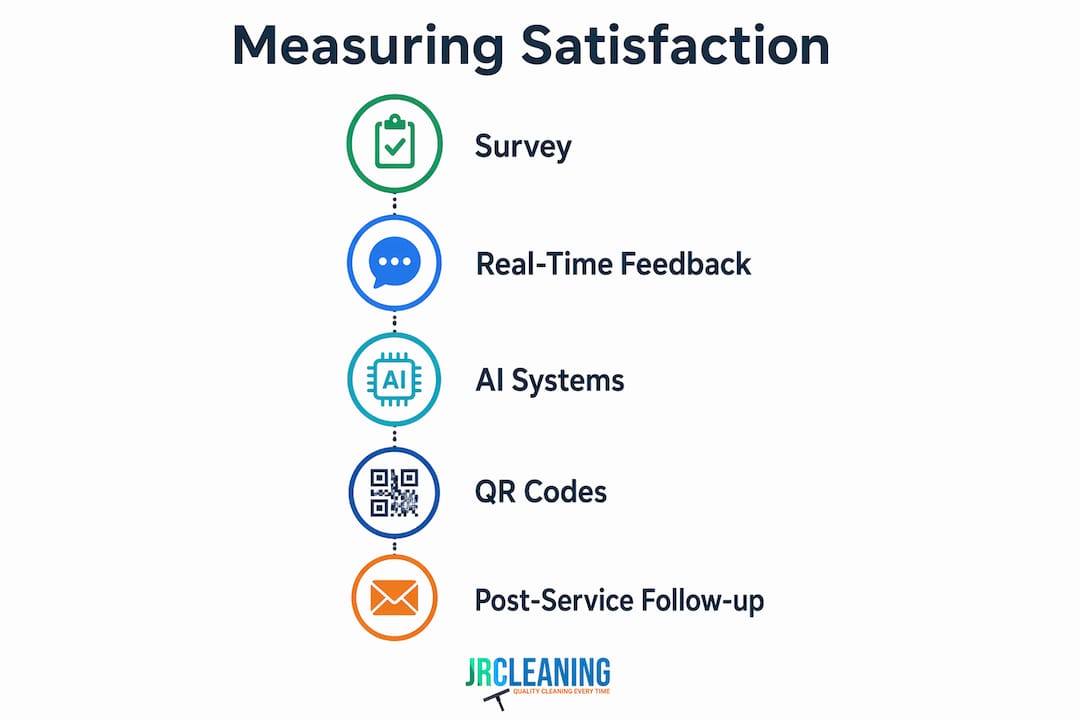
Real-time feedback and AI-driven systems have already demonstrated measurable results. Airport restroom complaints were reduced by 40% using predictive cleaning alerts triggered by live occupancy and feedback data. That is not a marginal improvement. It is a structural shift in how cleaning quality is validated.
Timely post-service surveys conducted within two to four hours of a clean capture the most accurate client sentiment and allow early intervention before dissatisfaction compounds. Leaving feedback collection to the end of the month means you are reading yesterday’s news when the contract is already at risk.
Pro Tip: Deploy QR code surveys in high-traffic areas such as washrooms and reception zones. These capture spontaneous, honest feedback from building occupants who would never fill in a formal survey.
The importance of customer feedback in cleaning cannot be overstated when it comes to identifying service gaps that audits miss. A checklist confirms a task was completed. A feedback tool tells you whether the result was good enough. Those are two very different questions.
What challenges do cleaning businesses face in maintaining high satisfaction?
Maintaining high client satisfaction in cleaning is harder than achieving a good audit score, and the reasons are structural. Cleaning contracts typically fail due to accumulating small experience gaps that go undetected by audit scores. No single incident ends a contract. It is the slow build of minor frustrations, each one invisible to the operational team, that eventually tips a client towards switching.
The most common challenges cleaning businesses face include:
Silent dissatisfaction. Most unhappy clients do not complain. They tolerate the issue, mention it to colleagues, and eventually leave. Unstructured feedback misses this entirely. Structured, recurring surveys are the only reliable way to surface what clients are not saying aloud.
Unrealistic client expectations. A client who expects a pristine result every single visit, regardless of footfall or weather conditions, is set up to be disappointed. Educating clients on realistic cleaning outcomes before the service begins reduces complaints and improves satisfaction even when occasional errors occur.
Slow complaint resolution. Speed matters more than perfection when something goes wrong. Proactive complaint handling within 24 hours increases client recommendations by 2.5 times and resolves 95% of complaints successfully. A complaint handled the same day becomes a demonstration of reliability. A complaint ignored for a week becomes a reason to leave.
Over-reliance on audit scores. A cleaning team can pass every internal audit and still lose the contract. If the client’s occupants feel the space is not clean, the score is irrelevant. Perception trend monitoring, not just audit compliance, prevents churn.
Inconsistent communication. Clients who feel uninformed about schedule changes, product substitutions, or staff changes lose confidence quickly. The role of communication in cleaning services is directly tied to how clients perceive the quality of the service itself.
What strategies improve customer satisfaction in cleaning businesses?
Improving client satisfaction in cleaning requires embedding feedback into the daily rhythm of operations, not treating it as a quarterly reporting exercise. The most effective approach is to treat client feedback as an operational input, not an administrative output.
Automated client feedback integrated into operational workflows protects both quality and client relationships. When a complaint triggers an automatic notification to a supervisor, a training flag on the relevant team member’s record, and a follow-up call to the client within 24 hours, the system is doing the work that used to rely on memory and goodwill. That is the difference between a reactive business and a resilient one.
Practical strategies that deliver measurable results include:
- Automate post-service surveys. Send a short CSAT survey two to four hours after each visit. Use the data to flag declining scores before they become cancellations.
- Integrate feedback into scheduling. If a particular site consistently scores lower on Friday afternoons, that is a scheduling problem, not a cleaning problem. Feedback data reveals patterns that operational reports miss.
- Update checklists from client input. When multiple clients flag the same missed area, add it to the standard checklist. Client feedback is free quality assurance data.
- Train from complaints, not just from manuals. Real complaints, anonymised and discussed in team briefings, are more effective training material than generic guidance.
- Turn complaints into loyalty moments. A client whose complaint is resolved quickly and with genuine care is more loyal than one who never complained at all. The recovery experience builds trust that routine service cannot.
Pro Tip: Review your NPS scores alongside contract renewal dates. If a client’s NPS drops two quarters before renewal, you have a window to intervene. If you only check satisfaction at renewal, you are already too late.
Improving cleaning services through customer insights also means connecting feedback data to the cleaning industry trends shaping how businesses operate in 2026. AI-assisted scheduling, predictive maintenance, and real-time occupancy data are all being used to anticipate client needs before a complaint is raised. The businesses that retain commercial cleaning clients long-term are those that use feedback not just to fix problems, but to prevent them.
Key takeaways
Customer satisfaction in cleaning is the primary driver of contract retention, and businesses that measure perception alongside operational performance consistently outperform those that rely on audit scores alone.
| Point | Details |
|---|---|
| Perception drives renewal | Clients renew based on how they feel, not solely on audit compliance or cleaning schedules. |
| Act on feedback within 24 hours | Resolving complaints within a day increases recommendations by 2.5 times and retains 95% of clients. |
| Survey timing is critical | Post-service surveys sent within two to four hours capture the most accurate and useful sentiment data. |
| Silent dissatisfaction is the real risk | Most unhappy clients leave without complaining; structured recurring surveys are the only way to catch this. |
| Feedback must feed operations | Client input should directly update checklists, scheduling, and training, not sit in a report. |
What I have learned from 20 years of watching contracts won and lost
After two decades in professional cleaning, the pattern I keep seeing is this: businesses lose contracts not because their cleaning is bad, but because their clients stopped feeling valued. The audit scores were fine. The checklists were ticked. But nobody called when the client mentioned a concern in passing, and nobody noticed when the feedback scores quietly dropped from eight to six over three months.
The businesses I have seen retain clients for ten, fifteen, twenty years are not necessarily the ones with the most sophisticated equipment or the lowest prices. They are the ones who treat every piece of client feedback as a signal worth acting on. They have someone whose job it is to read the survey data every week, not every quarter.
I am also watching the shift towards AI-enabled feedback systems with genuine interest. The idea that a cleaning company can predict a complaint before it happens, based on occupancy patterns and historical sentiment data, is not science fiction. It is already happening in airports and large commercial facilities. The question for smaller operations is not whether this technology is relevant. It is how quickly they can adapt versions of it to their own scale.
The businesses that will thrive in the next decade are those that treat customer satisfaction not as a metric to report, but as a discipline to practise every single day.
— jamie
How Jrcleaning puts client satisfaction at the centre of every clean
Jrcleaning has delivered professional residential and commercial cleaning across the UK for over 20 years, and client satisfaction is built into every stage of the process. From the initial quote through to post-service follow-up, the focus is on what the client actually experiences, not just what the checklist records. Jrcleaning’s approach combines rigorous quality standards with proactive communication, so clients are never left wondering whether the job was done properly. Whether you manage a commercial property or need reliable home cleaning, Jrcleaning’s residential and commercial cleaning services are designed to deliver results you can see and trust. Request a free quote today and find out why clients stay for years, not just one visit.
FAQ
What is the role of customer satisfaction in cleaning contracts?
Customer satisfaction determines whether a cleaning contract is renewed or cancelled. Clients who feel their expectations are consistently met are far less likely to seek alternative providers, regardless of price.
How does customer feedback improve cleaning service quality?
Structured client feedback identifies experience gaps that internal audits miss, allowing cleaning teams to update checklists, adjust scheduling, and address recurring issues before they lead to contract loss.
What is a good CSAT score for a cleaning company?
The janitorial services industry averages a CSAT score of 89 out of 100. Scores below this benchmark suggest a meaningful risk of client churn and warrant immediate investigation into service delivery.
How quickly should a cleaning company respond to complaints?
Complaints resolved within 24 hours result in a 2.5 times higher recommendation rate and a 95% resolution success rate. Speed of response is more important to client retention than the nature of the complaint itself.
Why do clients leave cleaning companies despite good audit scores?
Clients leave because of accumulated small experience gaps that audits do not capture. Perception, communication, and responsiveness drive retention more reliably than technical compliance scores alone.
Recommended
- The role of communication in cleaning services | J R Cleaning
- The role of professionalism in cleaning services | J R Cleaning
- How to manage cleaning contracts for quality and compliance | J R Cleaning
- How to manage cleaning contracts for quality and compliance | J R Cleaning

