

Insurance is the single most important financial safeguard a cleaning company can hold, protecting your business against property damage claims, employee injuries, and the kind of liability exposure that can end a business overnight. Whether you run a one-person residential round or manage a team of commercial cleaners, the role of insurance in cleaning companies extends far beyond a legal checkbox. It determines which contracts you can win, how clients perceive your professionalism, and whether a single accident becomes a manageable claim or a catastrophic loss.
What types of insurance do cleaning companies need?
General liability insurance is the foundation of any cleaning business insurance programme. It covers third-party bodily injury and property damage, meaning if your operative knocks over an expensive display cabinet or a client slips on a wet floor you have just mopped, the policy responds. Most commercial contracts in 2026 require a minimum of £1 million per occurrence in general liability coverage, with a £2 million aggregate. That figure is not arbitrary. It reflects the realistic cost of a serious property damage claim in a commercial environment.
Workers’ compensation, known in the UK as employers’ liability insurance, is a legal requirement the moment you take on your first member of staff. Cleaning work carries injury rates more than twice the national average, driven by wet floors, chemical exposure, and repetitive strain. Personal health insurance excludes occupational injuries, so without employers’ liability cover, an injured cleaner’s medical costs and lost wages fall directly on you.
Beyond these two core policies, several other covers are worth understanding:
- Professional liability insurance (also called errors and omissions): Relevant when you offer specialist services such as biohazard cleaning or post-construction cleans where your professional judgement is at stake.
- Inland marine insurance: Covers portable tools and equipment, including vacuum machines, pressure washers, and specialist cleaning kits, when they are in transit or on a client’s premises.
- Commercial auto insurance: Standard personal auto policies exclude business use. If your staff drive company vehicles or their own cars for work purposes, hired and non-owned auto (HNOA) cover is not optional.
- Janitorial bonds: A surety bond that reimburses clients if an employee steals from their property. Many commercial clients require this before signing any contract.
Pro Tip: Bundle general liability, employers’ liability, and tools cover into a single Business Owner’s Policy (BOP) where possible. Insurers including AXA UK and Hiscox offer packaged policies that cost less than buying each cover separately and simplify your renewal process.
How do insurance costs and requirements vary by business type?
Insurance costs for cleaning businesses vary considerably depending on your service type, team size, and client base. A self-employed residential cleaner will pay roughly $48 per month for basic general liability cover, while a comprehensive bundle including tools, auto, and employers’ liability averages around $292 per month. Pressure washing businesses face the steepest premiums, with monthly costs reaching up to $1,346, reflecting the higher risk of property damage from high-pressure equipment.
The table below illustrates how coverage requirements and typical costs shift across different business profiles:
| Business type | Core cover required | Typical monthly cost |
|---|---|---|
| Self-employed residential cleaner | General liability, tools cover | £40 to £80 |
| Small team (2 to 5 staff) | General liability, employers’ liability | £120 to £250 |
| Commercial janitorial service | Full BOP, janitorial bond, commercial auto | £250 to £600+ |
| Specialist (pressure washing, biohazard) | Tailored liability, professional indemnity | £400 to £1,000+ |
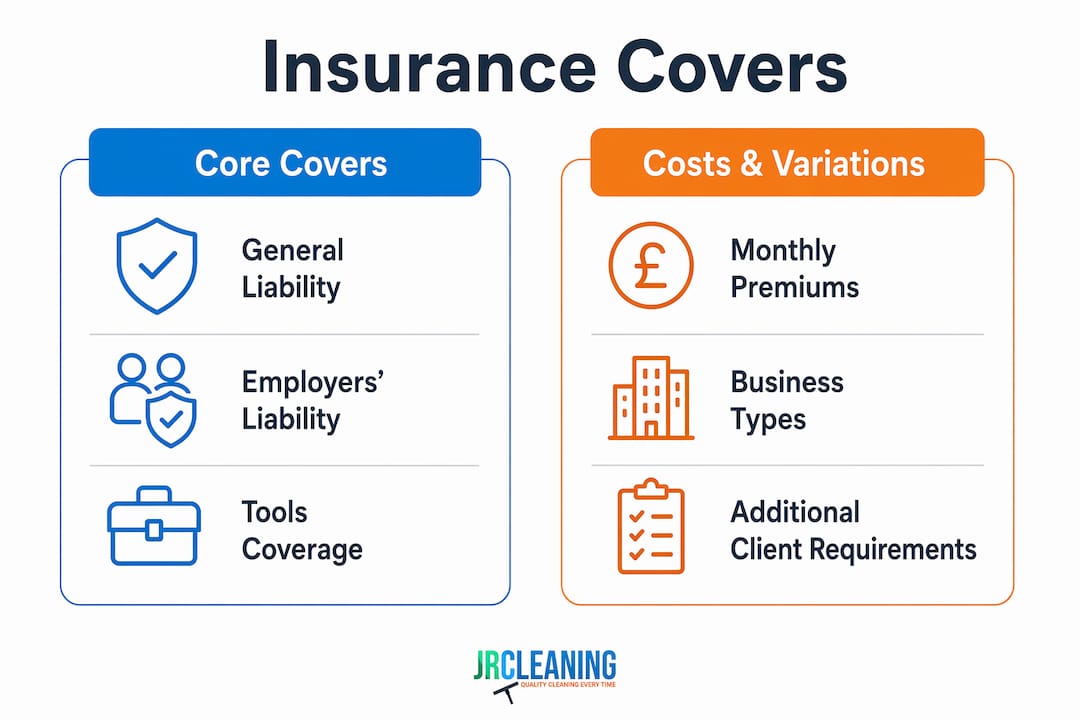
Workers’ compensation costs average $135 per employee monthly, though rates vary by service type. A team cleaning offices carries a different risk profile than one handling industrial or biohazard environments, and insurers price accordingly.
Commercial clients impose their own requirements on top of legal minimums. A facilities management company or NHS trust will typically specify coverage limits, endorsements, and sometimes the insurer itself in the contract. Understanding commercial cleaning compliance standards before you tender for those contracts saves significant time and avoids disqualification at the final stage.
Pro Tip: Before renewing any policy, request a full schedule of your current covers and compare it against the requirements in your three most recent client contracts. Gaps between what you hold and what clients demand are far more common than most business owners realise.
What do cleaning companies commonly misunderstand about insurance?
The most persistent confusion in this industry is the difference between being insured and being bonded. Insurance protects your business from liability claims, while a janitorial bond protects the client against employee theft, with your business required to reimburse the surety if a claim is paid. They serve entirely different purposes, and contracts frequently require both. Presenting only one when a client expects both will cost you the work.
Here are four further misunderstandings that regularly catch cleaning business owners out:
A Certificate of Insurance is not live proof of cover. A COI confirms a policy existed on its issue date. It does not confirm the policy is still active. Clients often require endorsements such as “Additional Insured†or “Waiver of Subrogation†to be added to your policy before they will accept a COI. These endorsements change how claims are handled and who can pursue whom after an incident.
Personal auto insurance will not cover a work accident. If a member of staff is involved in a collision while travelling between client sites in their own car, their personal insurer will likely decline the claim. Commercial auto or HNOA cover must be in place.
Standard liability policies exclude employee theft. Commercial crime insurance or a janitorial bond fills this gap. Without it, a client who discovers a theft has no recourse through your liability policy, and the reputational damage can be severe.
Underinsurance is as dangerous as no insurance. A policy with a £500,000 limit sounds substantial until a commercial property damage claim arrives at £900,000. Matching your coverage limits to the actual value of the environments you clean is a calculation worth doing annually.
The broader point here is that insurance as a business tool unlocks commercial contracts that are simply unavailable to uninsured or underinsured operators. Facilities managers and procurement teams use insurance verification as a filter, not a formality.
How to choose and manage your cleaning company’s insurance
Selecting the right cover starts with an honest assessment of your risk profile. The services you offer, the environments you work in, and the size of your team each determine which policies are non-negotiable and which are worth considering. A company that manages cleaning contracts across multiple commercial sites has a fundamentally different exposure than a sole trader cleaning private homes.
When evaluating insurers, look beyond the headline premium. Consider these factors:
- Coverage limits and sub-limits: Some policies cap specific types of claim, such as water damage or key loss, at amounts far below the main policy limit.
- Endorsement availability: Can the insurer add “Additional Insured†or “Primary and Noncontributory†endorsements? Without these, many commercial contracts will not proceed.
- Claims handling reputation: A low premium from an insurer with a poor claims record is a false economy. Check independent reviews and, where possible, speak to other cleaning business owners about their experience.
- Policy bundling: Combining general liability, employers’ liability, and tools cover under one policy simplifies administration and often reduces total cost.
- Certificate of Insurance issuance: Can you obtain a COI quickly when a new client requests one? Delays here can hold up contract starts.
Maintaining up-to-date certificates for every active client relationship is an administrative task that pays dividends. Keep a simple spreadsheet logging each client’s insurance requirements, the endorsements they need, and your policy renewal dates. Review it quarterly. When you expand into new service lines, such as workplace safety-related cleaning or specialist environments, treat the insurance review as part of the service launch, not an afterthought.
Key takeaways
Insurance in cleaning companies functions as both a legal requirement and a commercial asset, and the businesses that treat it as the latter consistently win better contracts.
| Point | Details |
|---|---|
| Core covers are non-negotiable | General liability and employers’ liability are legal and contractual baselines for any cleaning business with staff. |
| Bonding and insurance are separate | A janitorial bond protects the client from employee theft; insurance protects your business. Both are often required. |
| COIs require endorsements | A Certificate of Insurance alone is insufficient. Clients frequently require “Additional Insured†or “Waiver of Subrogation†endorsements. |
| Costs scale with risk | Monthly premiums range from £40 for a sole trader to over £1,000 for specialist services. Match cover to actual exposure. |
| Insurance unlocks contracts | Commercial clients use insurance verification as a qualification filter. Proper cover expands the contracts you can tender for. |
Why I think most cleaning businesses get insurance backwards
Most cleaning company owners I speak with treat insurance as a cost to minimise rather than a capability to build. They buy the cheapest policy that satisfies the most basic requirement, then wonder why they keep losing tenders to competitors. The businesses winning the high-value commercial contracts, the facilities management deals, the NHS frameworks, are not winning on price alone. They are winning because their insurance documentation is clean, their endorsements are correct, and their COIs arrive within the hour of being requested.
The other mistake I see repeatedly is owners who scale their team without scaling their cover. You hire a third operative, take on a commercial client, and start using a company van, but your policy still reflects a two-person residential operation. That gap is where the catastrophic claims live.
There is also a tendency to ignore bonding entirely until a client demands it. By that point, you are scrambling to arrange a janitorial bond under time pressure, which rarely produces the best terms. Arrange it proactively, present it alongside your COI in every new client proposal, and watch how it changes the conversation.
The most sophisticated cleaning operators I have encountered treat their insurance portfolio the same way they treat their equipment. They review it annually, upgrade it when they take on new capabilities, and never let it fall behind what the business actually does. That discipline is what separates businesses that grow from businesses that stall.
— jamie
Work with a cleaning company that takes insurance seriously
Jrcleaning has delivered residential and commercial cleaning services across the UK for over 20 years, fully insured and operating in strict compliance with health and safety regulations. Every service, from interior and exterior cleaning to window cleaning, gutter clearing, and conservatory cleaning, is backed by proper liability cover and professional standards. If you are looking for a cleaning partner whose insurance documentation holds up to scrutiny, explore the full range of professional cleaning services Jrcleaning offers, or visit the Jrcleaning homepage to request a free quote today.
FAQ
What is the role of insurance in cleaning companies?
Insurance protects cleaning companies from financial losses arising from property damage, employee injuries, and third-party liability claims. It also functions as a commercial requirement, enabling businesses to qualify for contracts that mandate specific coverage levels.
Do I legally need insurance to run a cleaning business in the UK?
Employers’ liability insurance is a legal requirement as soon as you employ one or more members of staff. General liability cover is not legally mandated but is a contractual requirement for virtually all commercial cleaning work.
What is the difference between being insured and being bonded?
Insurance protects your business against liability claims, while a janitorial bond protects the client against employee theft, with the business required to repay the surety if a claim is paid. Commercial contracts frequently require both.
How much does cleaning business insurance cost in the UK?
Costs vary by service type and team size. A self-employed cleaner can expect to pay from around £40 per month for basic cover, while a commercial janitorial operation with staff and vehicles may pay £600 or more per month for a full policy bundle.
What is a Certificate of Insurance and why do clients ask for it?
A Certificate of Insurance confirms that a policy was in place on its issue date. Clients request it as proof of cover, and many will also require specific endorsements such as “Additional Insured†to be added before accepting the certificate for contract purposes.
Recommended
- The role of cleaning in workplace safety | J R Cleaning
- How to manage cleaning contracts for quality and compliance | J R Cleaning
- How to manage cleaning contracts for quality and compliance | J R Cleaning
- The real role of cleaning in home value | J R Cleaning

