

Site-specific cleaning is the deliberate customisation of cleaning tasks, methods, frequencies, and products to the precise requirements of each distinct location or zone within a facility or property. Rather than applying a single routine across an entire building, it treats every area as its own cleaning challenge. This approach is the recognised industry standard in professional facility management, where it is often formalised through documented cleaning specifications. Whether you manage a pharmaceutical cleanroom, a food production unit, or a multi-room office, understanding site-specific cleaning is the first step toward consistent, compliant, and cost-effective hygiene.
What is site-specific cleaning and how does it differ from general cleaning?
Standard cleaning applies the same products, frequency, and method to every area in a building. Site-specific cleaning rejects that model entirely. It recognises that a server room, a staff kitchen, and a loading bay each carry different contamination risks, require different chemicals, and demand different cleaning frequencies.
One-size-fits-all cleaning does not address the differing risks found in food plants, pharmaceutical cleanrooms, or warehouses. This is not a minor operational gap. It is a compliance and safety failure waiting to happen. A warehouse floor cleaned with the same protocol as a sterile preparation room will either over-resource one area or dangerously under-resource the other.
The table below illustrates the core differences between the two approaches:
| Feature | General cleaning | Site-specific cleaning |
|---|---|---|
| Method selection | Fixed across all areas | Tailored per zone or room type |
| Frequency | Uniform schedule | Risk-based per location |
| Chemical choice | Single product range | Matched to surface and soil type |
| Documentation | Minimal or generic | Detailed specification per area |
| Compliance readiness | Limited | Built into the process |
The practical advantages of the tailored model are clear:
- Cleaning resources go where the risk is highest, not where the schedule dictates.
- Products are selected for the specific soils and surfaces present in each zone.
- Frequency is set by use patterns and contamination risk, not convenience.
- Documented protocols give audit teams and managers a clear record of what was done, where, and when.
Site-specific cleaning services are therefore not a premium add-on. For regulated industries and multi-use facilities, they are the baseline requirement.
What does a site-specific cleaning plan actually contain?
A site-specific cleaning plan is a structured document that defines exactly what must be cleaned, where, how often, and by what method. Cleaning specifications include area definitions, site summaries, and detailed requirements per location, supporting both contracted and in-house teams in delivering agreed standards. Without this document, cleaning becomes inconsistent and unverifiable.
A well-constructed plan typically contains the following elements:
- Area inventory. Every location within the facility is listed and categorised, from reception and offices to plant rooms and external car parks.
- Task definitions. Each area has a specific list of cleaning tasks assigned to it, such as mopping, disinfecting contact points, or degreasing equipment surfaces.
- Frequency schedule. Tasks are assigned a cleaning frequency based on use intensity and contamination risk, ranging from multiple times daily to monthly or quarterly.
- Method and product specification. The correct cleaning agent, dilution rate, application method, and contact time are recorded for each task and area.
- Ad hoc and periodic requirements. Planned deep cleans, post-incident cleans, and seasonal tasks are documented separately from routine schedules.
- Responsibility allocation. The plan makes clear which team or individual is responsible for each task, removing ambiguity.
Cleaning documentation adapted per site zone contributes directly to quality control and clarity in service delivery. This matters because a cleaning team that does not have a written specification is effectively working from memory, and memory is inconsistent.
Pro Tip: When building a cleaning specification for the first time, walk every area of the site with the cleaning team before writing a single line. What looks clean to a manager often looks very different to the person doing the work.
How do different industries apply site-specific cleaning techniques?
The principles of site-specific cleaning are universal, but the techniques and standards vary significantly by sector. Each industry carries its own contamination profile, regulatory framework, and consequence of failure.
Cleanrooms and pharmaceutical environments
In cleanrooms, cleaning precedes disinfection as a validated, stepwise process integrated directly into operating procedures. Disinfection alone is insufficient without prior validated cleaning tailored to the specific environment. This is a critical distinction. Applying a disinfectant to a surface that has not been properly cleaned first will not achieve the required microbial reduction. The cleaning step removes the organic load that would otherwise shield microorganisms from the disinfectant.
Food production and processing
Food facilities face dual contamination risks: microbiological and chemical. Site-specific cleaning in these environments must account for food contact surfaces, drainage systems, overhead structures, and cold storage areas, each with different temperature tolerances, surface materials, and soil types. Sector-specific hygiene services blend technical expertise with knowledge of audit regimes such as BRC and SALSA, applying tailored solutions based on hazards and asset profiles.
Industrial and manufacturing sites
Heavy manufacturing introduces soils that general cleaning products cannot remove: cutting fluids, lubricants, metal particulates, and chemical residues. Correct product chemistry and operational sequence are critical in these settings to remove residues effectively and to prepare surfaces for any subsequent treatment. Industrial high-level cleaning, including racking, ductwork, and overhead steelwork, demands specialised access techniques and validated protocols coordinated with production schedules to minimise downtime.
Commercial and residential properties
Even outside regulated industries, site-specific cleaning techniques apply. A domestic property with a conservatory, a tiled kitchen, and a carpeted bedroom requires three distinct cleaning approaches. A commercial office with a server room, a canteen, and open-plan workstations is no different in principle from a pharmaceutical facility. The scale changes. The logic does not.
What are the benefits and challenges of site-specific cleaning?
The benefits of site-specific cleaning are measurable and well-documented. Professionally managed site-specific cleaning incorporates site surveys, risk assessments, tailored approaches, and verification steps, leading to consistent standards and genuine cost efficiencies. Combining high-level and equipment cleaning under a single documented service removes scheduling conflicts and simplifies safety management.
From a compliance perspective, a documented site-specific plan is an audit asset. Inspectors from bodies such as the Food Standards Agency or the Medicines and Healthcare products Regulatory Agency expect to see evidence that cleaning is planned, recorded, and reviewed. A generic cleaning rota does not satisfy that expectation.
Properly tailored cleaning also protects occupants. Understanding how customised cleaning plans protect occupants by addressing specific property risks is the foundation of any serious workplace safety programme.
“The most common failure in facility cleaning is not dirty surfaces. It is the absence of a written plan that tells the team what clean actually means in each part of the building.â€
The challenges are real, however. Staff training is the most significant. A cleaning specification is only as effective as the team’s understanding of it. High staff turnover in cleaning roles means training must be continuous, not a one-time induction. Documentation adherence is the second challenge. Teams under time pressure will default to familiar habits rather than written protocols, which is why supervision and spot-checking are non-negotiable.
Pro Tip: Laminate a one-page summary of the cleaning specification for each area and fix it inside the relevant cupboard or store. Cleaning teams refer to visible instructions far more consistently than they consult a folder kept in the office.
How to implement site-specific cleaning in your facility
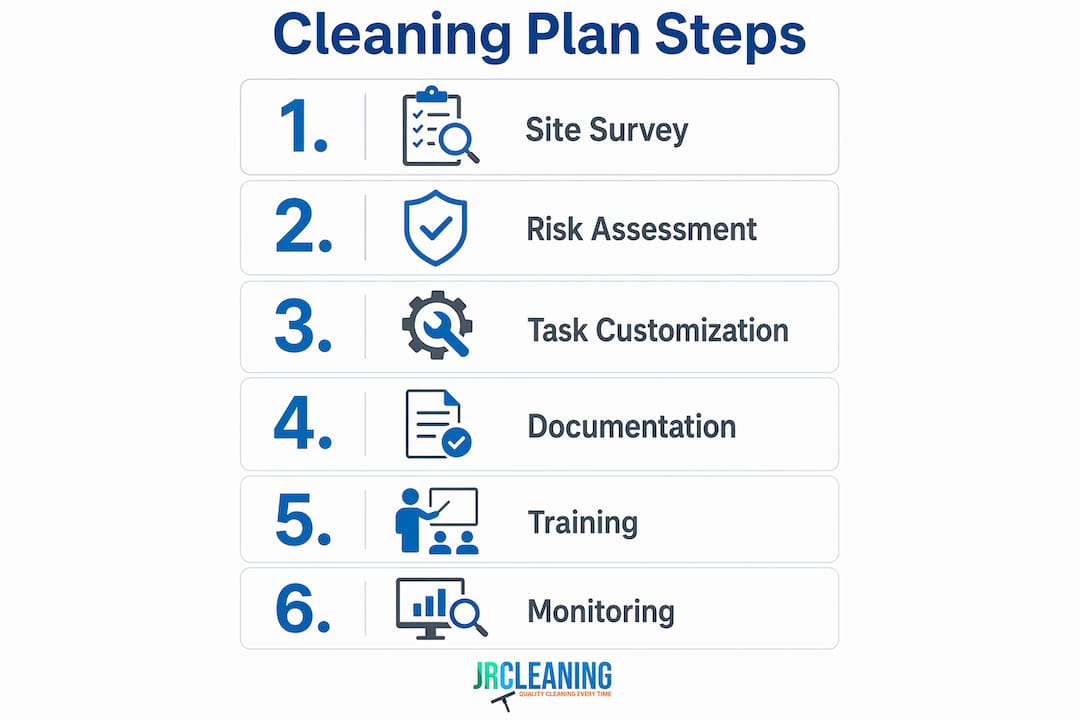
Implementing site-specific cleaning services does not require a large budget. It requires structured thinking and consistent follow-through. The steps below apply whether you manage a single commercial unit or a multi-site portfolio.
- Conduct a risk-based site survey. Walk every area and assess contamination risk, surface types, use frequency, and any regulatory requirements. This survey is the foundation of your cleaning specification.
- Develop area-specific cleaning specifications. Write a separate task list, frequency schedule, and product specification for each zone. Do not copy and paste between areas with different risk profiles.
- Select products matched to the task. Choose cleaning agents based on the soils present, the surface material, and any regulatory constraints. A food-safe degreaser is not interchangeable with an industrial solvent cleaner.
- Train your team on site-specific procedures. Site-specific cleaning requires trained personnel who are aware of both site procedures and safety requirements. Training must cover the why, not just the how.
- Build in verification and review. Schedule regular audits against the specification. Use feedback from cleaning teams to identify areas where the plan does not reflect operational reality, and update accordingly.
The industrial facility cleaning model, which combines safety management, compliance documentation, and tailored cleaning approaches, is a useful template even for smaller or non-industrial sites.
Key takeaways
Site-specific cleaning works because it matches cleaning methods, products, and frequencies to the actual risk and use profile of each area, making compliance verifiable and outcomes consistent.
| Point | Details |
|---|---|
| Definition is precise | Site-specific cleaning customises tasks, methods, and frequencies per zone, not per building. |
| Documentation is non-negotiable | A written specification per area is what separates consistent cleaning from guesswork. |
| Industry application varies | Cleanrooms, food facilities, and commercial offices each require distinct protocols and product choices. |
| Benefits are measurable | Audit readiness, safety improvements, and resource efficiency all follow from a well-executed plan. |
| Implementation starts with a survey | A risk-based site walk is the correct first step before writing any cleaning specification. |
Why I think most facilities are still getting this wrong
After more than two decades working in and around professional cleaning, the pattern I see most often is this: a facility has a cleaning contract, a cleaning team, and a cupboard full of products, but no written specification that ties them together. The team cleans what looks dirty. The manager assumes the contract covers everything. Nobody has defined what “clean†means in the server room versus the staff toilets.
The industry term “cleaning specification†sounds bureaucratic, but it is simply the answer to three questions: what needs cleaning, how often, and by what method. Answering those questions in writing, per area, changes everything. It removes the ambiguity that leads to missed tasks, cross-contamination, and failed audits.
The technology angle is worth watching too. Digital cleaning management platforms are beginning to replace paper-based specifications, with QR codes on doors linking to area-specific task lists and real-time completion logging. This makes verification faster and gives facility managers data they can actually use. But the underlying logic is identical to a laminated sheet in a cupboard. The specification must exist before the technology can help you manage it.
My honest advice: do not wait for a failed audit or a contamination incident to write your cleaning specification. Start with your highest-risk area, document it properly, train your team on it, and build outward from there.
— jamie
Tailored cleaning solutions from Jrcleaning
Jrcleaning brings over 20 years of professional experience to both residential and commercial clients across the UK, delivering cleaning programmes built around the specific requirements of each site. Whether you need a documented cleaning plan for a commercial facility or a tailored schedule for a domestic property with distinct room types, the team at Jrcleaning works from a thorough site assessment rather than a generic checklist. Every service is fully insured and delivered in line with current health and safety regulations. Explore the full range of residential and commercial services or contact Jrcleaning directly for a free, no-obligation quote tailored to your site.
FAQ
What is the definition of site-specific cleaning?
Site-specific cleaning is the customisation of cleaning tasks, methods, frequencies, and products to the individual requirements of each area or zone within a facility or property. It is formalised through a written cleaning specification that documents what must be cleaned, where, how often, and by what method.
How does site-specific cleaning work in practice?
A site survey identifies the contamination risks, surface types, and use patterns of each area. A cleaning specification is then written for each zone, assigning specific tasks, products, and frequencies. The cleaning team follows this specification and results are verified through regular audits.
What are the main benefits of site-specific cleaning for businesses?
The primary benefits include improved compliance and audit readiness, more efficient use of cleaning resources, reduced cross-contamination risk, and consistent cleaning standards across all areas. Sector-specific hygiene services that apply tailored solutions based on hazard profiles deliver measurably better outcomes than generic approaches.
Is site-specific cleaning only relevant for regulated industries?
No. While regulated sectors such as pharmaceuticals and food production have the most formal requirements, the principles apply equally to commercial offices, schools, retail premises, and residential properties. Any facility with areas that carry different contamination risks or surface types benefits from a tailored approach.
What should a cleaning specification include?
A cleaning specification should include an area inventory, task definitions per zone, frequency schedules, product and method details, ad hoc and periodic cleaning requirements, and clear responsibility allocation. Cleaning specifications that define internal and external needs per area create a shared understanding between cleaning teams and clients.
Recommended
- What is high-level cleaning? A practical guide | J R Cleaning
- Specialist cleaning explained: methods and real UK standards | J R Cleaning
- Master the industrial site cleaning process: safer facilities | J R Cleaning
- What office cleaning involves: a guide for UK businesses | J R Cleaning

