

Insured cleaning companies are defined as professional cleaning contractors that hold valid liability and employer insurance policies, protecting clients from financial exposure when accidents or property damage occur on site. For homeowners, business owners, and property managers in the UK, the importance of insured cleaning companies cannot be overstated. A single incident, whether a broken window, a slip on a wet floor, or an employee injury, can generate legal costs that run into thousands of pounds. Understanding which policies matter, how to verify them, and what to look for when choosing a contractor is the difference between genuine protection and false reassurance.
What types of insurance do cleaning companies need in the UK?
Two policies sit at the centre of any credible cleaning company’s insurance position: employers’ liability insurance and public liability insurance. They serve different purposes, and confusing them is a common and costly mistake.
Employers’ liability insurance is compulsory for most UK employers under the Employers’ Liability (Compulsory Insurance) Act 1969, requiring a minimum of £5 million coverage per claim. Fines for non-compliance reach £2,500 per day. This means any cleaning company with staff on its payroll must hold this cover, full stop. If a cleaner is injured at your property and their employer lacks this policy, the legal and financial fallout can involve you directly.
Public liability insurance is not legally required for most UK cleaning companies, but commercial clients, landlords, and managed sites routinely demand it before work begins. It covers third-party injury and property damage claims arising from cleaning activity. Without it, a contractor who floods your office or breaks an antique during a domestic clean has no insurer to call upon.
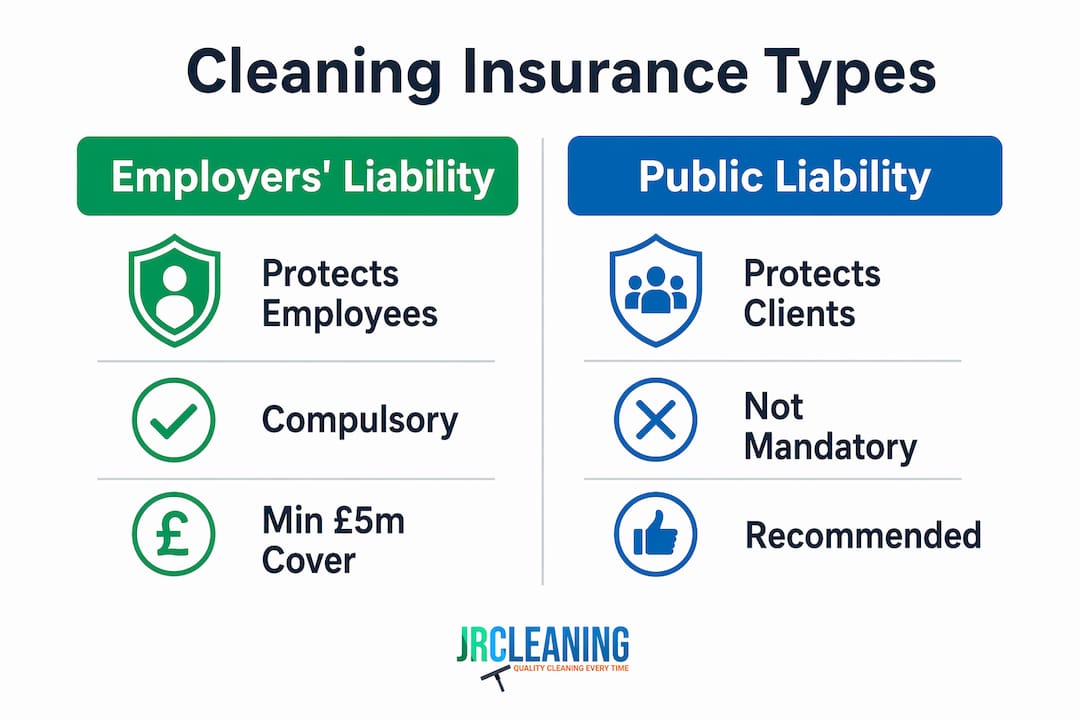
Here is a summary of the key policies and what they cover:
| Policy | Who it protects | Legal requirement? |
|---|---|---|
| Employers’ liability | Employees injured at work | Yes, for companies with staff |
| Public liability | Third parties and property | No, but contractually expected |
| Equipment insurance | Tools and machinery owned by cleaner | No, optional |
| Keyholding cover | Liability for key access to premises | No, specialist add-on |
Pro Tip: Always ask whether a cleaning company’s public liability policy covers both residential and commercial work. Some policies are scoped narrowly and may exclude one or the other.
Typical coverage limits vary by job type. Cover limits range from £1m to £2m for domestic work and £2m to £5m for commercial contracts, with some sites requiring up to £10 million. This matters because a policy that is adequate for cleaning a two-bedroom flat may fall well short of what a commercial landlord or facilities manager requires.
How does hiring an insured cleaner protect you from financial and legal risk?
The practical significance of insured cleaners lies in where liability lands when something goes wrong. Using insured contractors transfers financial risk to the insurer rather than leaving it with the property owner or business. Without that transfer, you absorb the cost of compensation, legal fees, and any resulting business disruption yourself.
Consider the most common incidents in cleaning contracts:
- A cleaner slips on a wet floor they have just mopped and sustains a back injury.
- A pressure washer cracks a conservatory panel during an exterior clean.
- A commercial kitchen clean causes a chemical reaction that damages expensive catering equipment.
- A domestic cleaner accidentally breaks a boiler valve, causing a leak that damages flooring and a neighbouring flat.
“The real risk with uninsured cleaners lies not in the accident happening itself, but in who pays when it does. Insurance transfers this risk and removes the friction of a costly dispute.†Source: Coverfinder
Each of these scenarios is routine in the cleaning industry. With an insured contractor, your exposure is limited. Without one, you may find yourself in a civil dispute with no clear resolution and no insurer to negotiate on your behalf. For business owners, that also means potential operational downtime while the matter is resolved.
Employers’ liability insurance also reduces employment claim complexities that might otherwise draw clients into disputes between a cleaner and their employer. This is a less obvious but genuine benefit of choosing a properly insured cleaning company. You are not just protecting your property. You are protecting your time and your professional relationships.

What are the best practices for verifying a cleaning company’s insurance?
Asking whether a cleaning company is insured is not enough. The verification process requires you to examine the actual documentation, not take a verbal assurance at face value.
Follow these steps before signing any cleaning contract:
- Request a certificate of insurance (COI). The COI is the standard document that evidences coverage. ACORD 25 forms are widely used and provide a structured summary of policy types, limits, and dates. A reputable company will provide this without hesitation.
- Verify the legal entity name. A mismatch between the insured name on the COI and the contractor you have hired is one of the most common and costly errors in contractor vetting. If the policy names “Smith Cleaning Ltd†but you have contracted “Smith Property Services,†you may have no coverage at all.
- Check effective and expiration dates. A COI is a snapshot of coverage at the time of issue. Policies renew annually, and a lapse mid-contract leaves you exposed without warning.
- Confirm coverage types and limits match your requirements. Cross-reference the policy limits against your site’s contractual requirements or your own risk appetite.
- Request updated COIs during long contracts. Do not assume the certificate you received at the start of a 12-month contract is still valid at month nine.
Pro Tip: Set a compliance calendar reminder two months before a cleaning contract’s renewal date. Request an updated COI at that point rather than waiting for the policy to lapse.
| Verification step | What to look for |
|---|---|
| Legal entity name | Must match the contractor you have signed with |
| Policy type | Confirm both employers’ and public liability are listed |
| Coverage limits | Match to site or contract requirements |
| Expiration date | Confirm policy is active throughout the contract term |
| Subcontractor coverage | Verify subcontractors are included or separately insured |
A certificate of insurance only shows coverage at the time of issue. Continuous assurance requires active management, not a one-time check.
How to choose the right insured cleaning company for your property
Selecting a cleaning company with the right insurance is not just about ticking a compliance box. It is about matching coverage to the actual risk profile of your property and the scope of work involved.
When evaluating cleaning companies, consider the following:
- Scope of work. Domestic cleaning carries different risks to commercial or specialist cleaning such as office cleaning or commercial kitchen work. Confirm the policy covers the specific tasks being carried out.
- Site access arrangements. If a cleaner holds keys to your property, check whether the company carries keyholding cover. Standard public liability policies do not always include this.
- Subcontractor arrangements. Property managers should require proof of insurance before granting site access and confirm that any subcontractors used are also covered. Coverage gaps through subcontracting are a frequent source of uninsured risk.
- Reputation and compliance history. A company with over 20 years of trading history and a clean compliance record is a meaningful signal of reliability. Ask for references from clients with similar property types.
- Contract terms. Negotiate insurance proof as a contractual condition, not an afterthought. Include a clause requiring the cleaning company to notify you of any material change to their coverage during the contract term.
When reviewing cleaning contracts for quality and compliance, the insurance clause should sit alongside service level agreements, not be buried in the small print. Treating insurance as a gating factor, rather than a formality, is the mark of a well-managed property operation.
Key takeaways
Hiring an insured cleaning company is the single most effective way to transfer financial and legal risk away from your property and onto a regulated insurer.
| Point | Details |
|---|---|
| Employers’ liability is compulsory | UK law requires minimum £5m cover for cleaning companies with staff. |
| Public liability is practically mandatory | Commercial clients and landlords routinely require it before work starts. |
| COI verification is non-negotiable | Check legal entity name, limits, and expiry dates before signing any contract. |
| Coverage lapses mid-contract | Request updated certificates throughout long contracts, not just at the start. |
| Subcontractor gaps are a hidden risk | Confirm subcontractors are covered under the main policy or separately insured. |
Why I think most people get this completely wrong
After years of working in and around the cleaning industry, the pattern I see most often is not that clients skip insurance checks entirely. It is that they do a superficial check and consider the matter closed. They see the words “fully insured†on a website, ask for a certificate, receive a PDF, and file it away. That is not verification. That is theatre.
The real exposure comes from three things nobody warns you about. The first is the entity name mismatch, which I have seen invalidate coverage on contracts worth tens of thousands of pounds. The second is the mid-contract lapse, where a policy quietly expires and neither party notices until a claim is made. The third is subcontractor coverage, which is almost never checked and is where the most significant gaps tend to appear.
Insurance in the cleaning sector is not a differentiator. It is a baseline. Any company presenting it as a selling point rather than a standard operating requirement should prompt further scrutiny, not reassurance. What actually differentiates a trustworthy cleaning company is the ease with which they provide documentation, the clarity of their policy limits, and their willingness to include insurance obligations in the contract itself. Those three things tell you more about a company’s professionalism than any marketing claim.
— jamie
Jrcleaning: insured, experienced, and ready to serve your property
Jrcleaning has delivered residential and commercial cleaning across the UK for over 20 years, fully insured and operating in strict compliance with UK health and safety regulations. Whether you need regular domestic cleaning, commercial contract cleaning, window cleaning, gutter and fascia work, or specialist conservatory cleaning, every service is backed by proper insurance coverage and a documented commitment to safety. You can request a free quote by phone, email, or WhatsApp, and the team will confirm insurance details as part of the initial consultation. For a full overview of what Jrcleaning offers, visit the services page and see how each service is structured to protect your property and your peace of mind.
FAQ
What does it mean for a cleaning company to be insured?
An insured cleaning company holds valid employers’ liability and public liability policies that cover employee injuries and third-party property damage. These policies transfer financial risk from the client to the insurer when an incident occurs during cleaning work.
Is public liability insurance a legal requirement for UK cleaners?
Public liability insurance is not a legal requirement for most UK cleaning companies, but commercial clients, landlords, and managed sites routinely require it as a contractual condition before work begins.
How do I verify a cleaning company’s insurance certificate?
Request a certificate of insurance and check that the legal entity name matches the contractor you have hired, that coverage types and limits meet your requirements, and that the policy expiry date covers the full contract period.
What coverage limits should I expect from a cleaning company?
Coverage limits typically range from £1m to £2m for domestic cleaning and £2m to £5m for commercial work, with some sites requiring up to £10 million depending on the risk profile of the property.
What happens if a cleaning company’s insurance lapses mid-contract?
If a policy expires during a contract and an incident occurs, the client may have no insurer to claim against and could face direct financial liability. Requesting updated certificates throughout the contract term prevents this risk.
Recommended
- Why quality cleaning safeguards health and property value | J R Cleaning
- Why hire a cleaning company: expert hygiene and safety | J R Cleaning
- Why emergency cleaning services matter for your property | J R Cleaning
- Why regular window cleaning matters for your property | J R Cleaning

