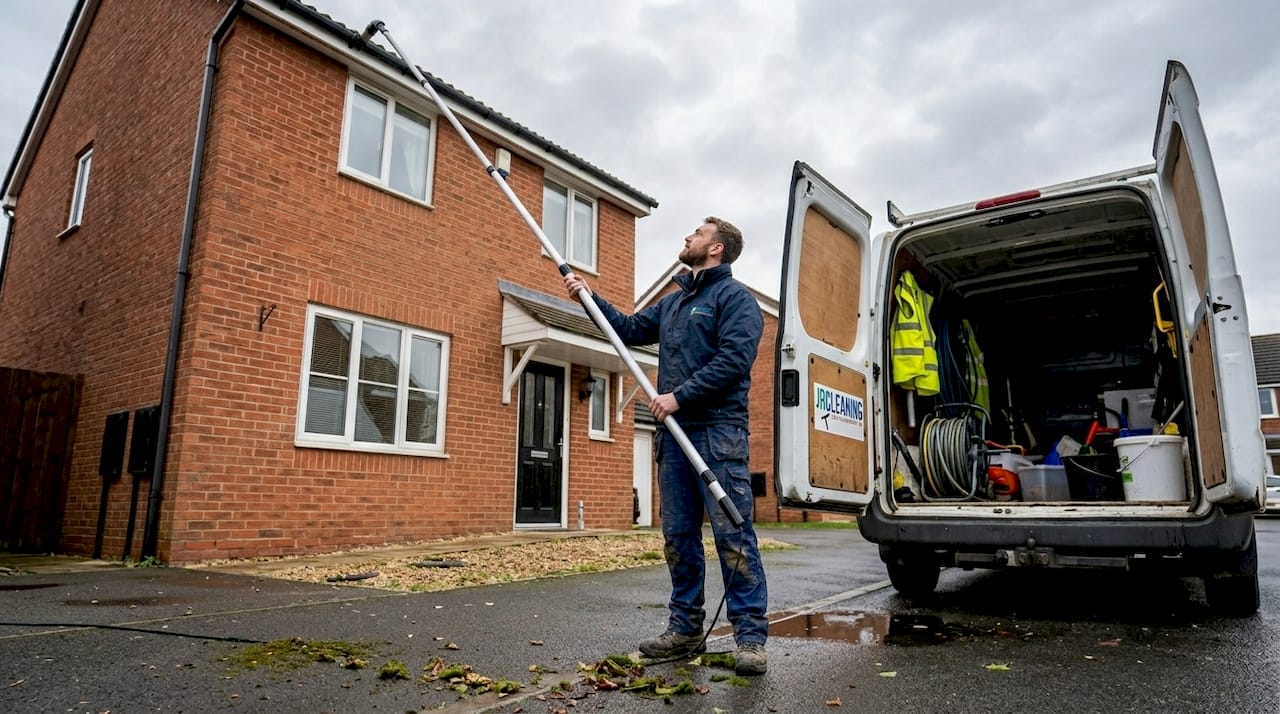
Blocked gutters are one of the most overlooked causes of serious water damage in UK homes. A small build-up of leaves and debris can quickly overflow, forcing water behind fascias, into walls, and down foundations. Blocked gutters can quickly lead to costly damp and structural problems that run into thousands of pounds to fix. The good news is that a methodical, step-by-step approach puts you firmly in control. This guide covers every stage, from gathering the right equipment to carrying out final checks, so you can protect your property with confidence.
Having the correct tools and safety measures is essential before starting any gutter clean.
Follow every step
A thorough, step-by-step approach ensures gutters are cleared, safe to use, and drainage works perfectly.
Time your cleans
Clean at least twice a year, especially before and after autumn, to prevent blockages and water damage.
Invest in prevention
Regular maintenance, guard installations, and timely repairs will help keep your gutter system effective.
Know when to call a pro
For challenging, high, or complex gutters, professional support guarantees safety and thoroughness.
What you need before you start
Good preparation is the difference between a safe, effective clean and an avoidable accident. Before you climb a single rung, take stock of what you need and whether the job is right for a DIY approach.
For most single-storey properties, a basic kit will get the job done. DIY gutter cleaning tools include a ladder (£60 to £150), a scoop (£5 to £10), protective gloves, and a telescopic pole for hard-to-reach spots. You will also want a sturdy bucket, a garden hose, safety goggles, and a dust mask for dry debris.
Essential equipment checklist:
Extendable ladder with a stabiliser
Heavy-duty waterproof gloves
Plastic gutter scoop or trowel
Telescopic pole with brush attachment
Garden hose with a spray nozzle
Bucket or tarpaulin for debris
Safety goggles and dust mask
Non-slip footwear
For two-storey homes, conservatories, or properties with complex roof lines, the risk increases significantly. In these cases, professional gutter cleaning tools such as high-powered gutter vacuums and specialist wet-dry systems make the job both safer and more thorough. It is worth reading up on gutter maintenance essentials before deciding which route to take.
Equipment
Approximate cost
Best for
Basic ladder
£60 to £150
Single-storey homes
Gutter scoop
£5 to £10
Manual debris removal
Telescopic pole
£15 to £40
Avoiding overreach
Gutter vacuum (hire)
£30 to £60/day
Two-storey, conservatories
Before you start, inspect the weather forecast. Wet or frosty conditions make ladders extremely hazardous. Check that the ladder feet are on firm, level ground, and always have someone present to hold the base. Look at the gutter brackets and the condition of the roofline before you climb; loose brackets or cracked sections need attention before any cleaning begins.
Pro Tip: Many UK tool hire shops, including national chains and local independents, offer gutter vacuum hire by the day. Hiring is far cheaper than buying for a once-a-year job, and the equipment is usually maintained to a professional standard.
The step-by-step gutter cleaning process
Once you have assembled all the right tools, follow these detailed steps for a safe and effective clean.
Step-by-step guide:
Carry out a visual inspection from the ground first. Look for sagging sections, visible blockages, or cracks.
Position your ladder safely, using a standoff bracket to avoid leaning directly against the gutter.
Remove large debris by hand or with a scoop, working away from the downpipe towards it to avoid pushing blockages deeper.
Place debris into a bucket rather than dropping it onto the ground or into drains.
Check the downpipe by pouring water into the top. If it drains slowly, there is a blockage lower down.
Flush the gutter with a garden hose from the far end, working towards the downpipe to test flow and clear fine sediment.
Clear any downpipe blockages using a drain rod or a specialist unblocking tool. You can find detailed guidance in this unblocking gutters guide.
Inspect joints and seals for cracks or gaps while the gutter is wet and water is flowing.
Remove all waste from the site, including debris on the ground or in beds below.
Safety warning: Never lean a ladder directly against a plastic gutter. Always use a ladder standoff or stabiliser. Check all equipment before climbing, and never overreach. If in doubt, stop and call a professional.
The professional process includes an exterior inspection, high-power gutter vacuums, manual debris removal, pressure washing, downpipe clearance, minor repairs, a final flush, and off-site waste removal. For complex jobs, no-ladder solutions and specialist help are needed for conservatories and underground blockages.
Task
DIY approach
Professional approach
Debris removal
Hand scoop and bucket
Wet-dry vacuum system
Downpipe check
Garden hose test
CCTV or drain rods
Waste disposal
Homeowner’s responsibility
Removed off-site
Condition report
Visual only
Written report with photos
Pro Tip: The best time to clean is just before the first heavy autumn rain or before a hard frost sets in. Read our winter gutter cleaning tips to avoid cold-weather hazards.
How often to clean and critical timing
It is not just how you clean, but also when you clean that protects your home. Here is how often and why it matters.
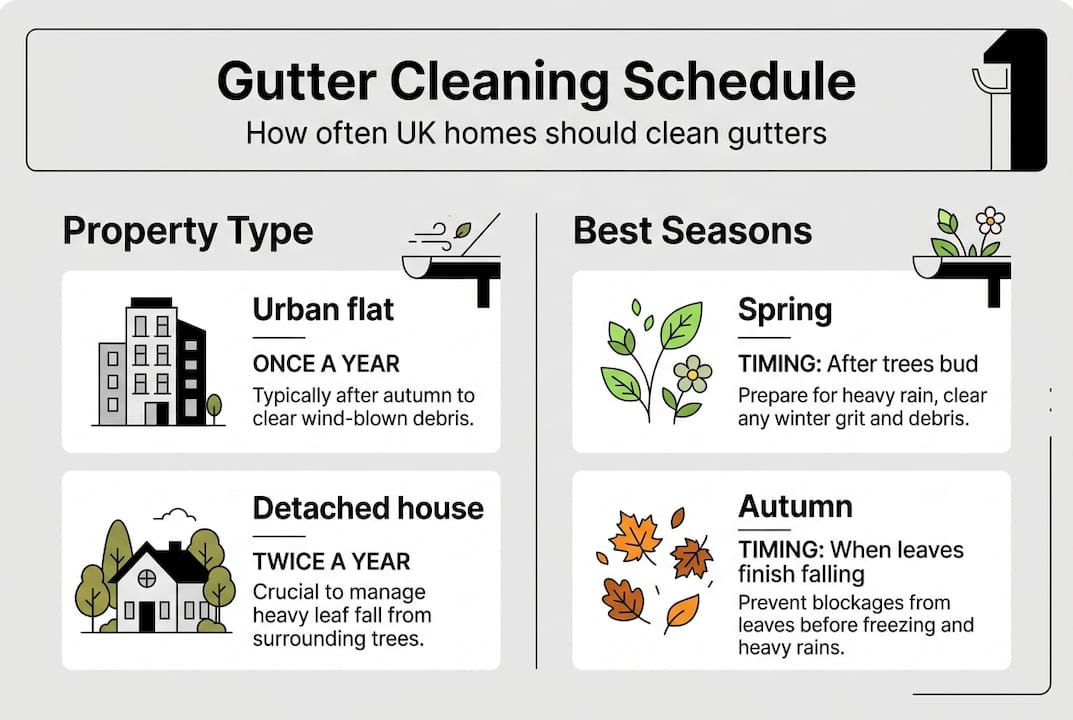
For most UK properties, twice yearly cleaning in spring and autumn is the recommended minimum. Homes near trees, particularly deciduous species, may need cleaning three to four times per year. Autumn is the most critical season because falling leaves can block gutters almost overnight during a heavy storm.
Property type
Recommended frequency
Key season
Urban flat or terrace
Once to twice yearly
Autumn
Suburban semi-detached
Twice yearly
Autumn and spring
Rural or wooded location
Three to four times yearly
Autumn and winter
Coastal property
Twice yearly minimum
Spring (salt residue)
Gutter slope also matters for long-term performance. A safe drainage slope requires a fall of 1:350 (3mm per metre), with brackets fitted every metre to prevent sagging. If your gutters sit flat or bow in the middle, water will pool and debris will accumulate far faster.
Signs your gutters need more frequent attention:
Water overflowing during moderate rain
Visible plants or moss growing in the gutter channel
Staining or damp patches on external walls
Sagging sections between brackets
Dripping from joints or end caps
Soil erosion directly below the gutterline
Staying on top of cleaning frequency is one of the simplest ways to protect your home value over the long term. A blocked gutter left unchecked through a wet UK winter can cause damp penetration that costs far more to remedy than a routine clean.
Preventative maintenance and smart checks
Now the gutters are spotless, ongoing maintenance is the key to hassle-free drainage year-round.
A clean gutter is only the starting point. What you do between cleans determines how quickly problems return. Installing mesh guards, trimming trees, fixing sagging, checking bracket spacing, and flushing after each clean are all proven ways to extend the time between full cleans. Professionals also provide written reports and photos that help you track the condition of your gutters over time.
Post-clean checks every homeowner should carry out:
Run a hose through the full gutter run and watch for pooling
Check every bracket is tight and the gutter sits at the correct angle
Look for hairline cracks at joints, especially after a cold spell
Inspect the fascia board behind the gutter for soft spots or discolouration
Clear any debris from the top of downpipe guards
Look at the ground below downpipes for signs of overflow or erosion
Mesh gutter guards are a worthwhile investment for homes under tree canopy. They reduce the volume of debris entering the channel significantly, though they still need an occasional rinse. Trimming back overhanging branches is equally effective and reduces the risk of branches falling onto the roof during storms.
If you notice sagging that does not resolve after re-securing a bracket, or if a downpipe remains slow after flushing, it is time to consult a specialist. Underground blockages in particular need professional attention; you can learn how to identify downpipe blockages before deciding whether to call for help. For anything structural, our gutter repairs guide explains the options available.
Pro Tip: Keep a simple maintenance log noting the date of each clean, any faults found, and what was done. Even a basic note on your phone saves time when fault-tracing recurring issues and is useful if you ever need to make an insurance claim.
A professional’s perspective: why thorough, timed cleaning always pays off
After more than 20 years of cleaning gutters across a wide range of UK properties, one thing stands out clearly. Most homeowners who call us for emergency repairs could have avoided the problem entirely with one earlier, more thorough clean.
DIY cleaning is absolutely worthwhile for accessible single-storey properties. But even the most diligent homeowner can miss subtle misalignments or early bracket fatigue that a trained eye catches immediately. Professionals always inspect for sagging and misalignment, and issue photos and written reports after every clean. That documentation is genuinely valuable. It creates a record that helps you spot deterioration trends before they become urgent.
The other thing most guides overlook is the psychological cost of uncertainty. Knowing your gutters have been properly inspected, cleared, and documented gives you real peace of mind going into a wet autumn or a hard frost. That is not a luxury. It is practical risk management. Investing in a professional clean once or twice a year, and using the advanced maintenance tips available, is almost always cheaper than a single damp remediation job.
Get professional gutter cleaning — safe, fast and guaranteed
If you would rather save time or ensure nothing is missed, booking a trusted professional is your easiest next step.
At JR Cleaning, our trained team handles everything from single-storey terraces to complex multi-storey properties, using specialist equipment and following strict safety protocols. Every job includes a thorough inspection and a clear report so you always know the condition of your gutters. Our gutter cleaning services cover properties of all sizes, and our gutter repairs team can fix any issues found on the same visit. Request a gutter cleaning quote today and get a free, no-obligation price for your home.
Frequently asked questions
How often should UK homeowners clean their gutters?
Most UK homes need gutters cleaned twice yearly, in spring and autumn, though properties near heavy tree cover may require three to four cleans per year to prevent blockages.
What equipment is safest for cleaning gutters?
A sturdy ladder, protective gloves, a plastic scoop, and a telescopic pole are the core essentials. For hard-to-reach areas or conservatories, professional gutter vacuums are far safer and more effective than stretching from a ladder.
When should a professional be called instead of DIY?
Professional help is strongly recommended for two-storey properties, homes with conservatory overhangs, or any situation involving underground blockages or unsafe access conditions.
What is the typical cost for professional gutter cleaning in the UK?
Prices range from £40 to £120 depending on property type. Bungalows typically fall at the lower end, while larger semi-detached or detached homes with higher access requirements cost more.
Walk into any supermarket or browse online and you’ll find hundreds of cleaning products all promising brilliant results. For UK homeowners and business owners, the sheer volume of choice is genuinely overwhelming. The truth is, most people end up buying far too much, using the wrong products on the wrong surfaces, and still not achieving the standard they want. This guide cuts through the noise. We’ve pulled together the essential interior cleaning products, tools, and practices that actually deliver results, backed by expert sources and real-world experience across British homes and commercial spaces.
Match each cleaning product or tool to your unique space and needs rather than just buying what’s popular.
Mix eco and traditional methods
Balance green cleaners for everyday use and specialist solutions for demanding jobs.
Invest in the right tools
Quality cloths, vacuums, and mops boost cleaning results more than most new gadgets.
Prioritise safe practice
Follow proper procedures and use protective equipment, especially with chemicals, for a healthy home or workplace.
How to select your interior cleaning essentials
Choosing cleaning products isn’t just about grabbing whatever’s on offer. The right selection depends on your space, your surfaces, and how frequently you clean. Getting this right from the start saves money, reduces waste, and protects your health.
The first thing to consider is matching the product to the task. A daily-use multi-surface spray is very different from a heavy-duty degreaser designed for commercial kitchens. Eco-friendly products work brilliantly for routine maintenance and are kinder to surfaces and skin. Traditional chemical-based cleaners, on the other hand, are sometimes necessary for deep cleans or stubborn contamination. Knowing when to use each is the real skill.
Safety and suitability matter enormously, especially in business settings. If you’re managing a commercial premises, you’ll need to be aware of COSHH (Control of Substances Hazardous to Health) regulations. These require you to assess the risks of any chemical product before use, store them correctly, and ensure staff are trained. The HSE Clean Campaign emphasises proper cleaning methodologies to prevent slips, which is a common and costly workplace hazard.
For homes, the priority shifts slightly. Allergy sufferers and households with young children should look for fragrance-free or hypoallergenic options. Many mainstream products contain synthetic fragrances that can trigger respiratory issues. Always check the label.
Cross-contamination is another issue that’s easy to overlook. Using the same cloth in the kitchen and bathroom, for example, spreads bacteria rather than eliminating it. Colour-coded cloths are a simple, effective solution. You can read more about how professionals approach this in our guide to domestic cleaning explained.
Here’s a quick checklist to guide your selection:
Match product strength to task: daily vs. deep clean
Check surface compatibility: stone, tile, wood, and upholstery all need different care
Prioritise safety: look for COSHH-compliant products in commercial settings
Prevent cross-contamination: use separate cloths and products per area
Pro Tip: If you manage a business premises, keep a simple product log noting what’s used where. This supports COSHH compliance and makes stock management far easier.
Must-have cleaning products for every interior
With clear criteria in place, it’s time to look at which specific products consistently deliver results across British homes and workplaces.
Which? most popular spring cleaning products include Ecover Bathroom Cleaner, Ariel laundry products, Beldray Hard Floor Cleaner, Kärcher Steam Cleaner, Eufy Robot Vacuum, and Samsung Cordless Vacuum, based on reader data and independent testing. These aren’t just popular choices; they’ve been validated against real performance benchmarks.
Here’s a breakdown of the core product types you should have:
Multi-surface spray: Versatile for worktops, appliances, and hard surfaces. Eco options like Method work well for daily use.
Bathroom cleaner: Ecover Bathroom Cleaner tackles limescale and soap scum without harsh fumes. Ideal for regular use.
Kitchen degreaser: Traditional formulas (think Fairy or Flash) cut through grease faster than eco alternatives on heavy build-up.
Floor cleaner: Beldray Hard Floor Cleaner is a reader favourite for laminate and tile.
Laundry detergent: Ariel remains a top performer for fabric hygiene, especially in high-traffic households.
Steam cleaner solution: Many steam cleaners, like Kärcher models, use plain water, making them naturally chemical-free.
For larger commercial operations, the toolkit expands further. Our guide on industrial facility cleaning tools covers what’s needed at scale.
Feature
Eco-friendly products
Traditional products
Surface safety
High
Moderate
Effectiveness on grease
Moderate
High
Fragrance level
Low or none
Often strong
Cost per use
Slightly higher
Generally lower
Environmental impact
Low
Higher
Best for
Daily maintenance
Heavy-duty deep cleans
For carpets and upholstery, specialist products are often necessary. Explore the carpet cleaning services available if your carpets need more than a standard vacuum.
Pro Tip: Keep a dedicated bathroom cleaner and a separate kitchen cleaner. Never swap them between rooms, even if they’re both labelled “multi-surface.â€
Essential tools and equipment for effective cleaning
Products alone won’t get you far without the right tools. The equipment you use determines how effectively a product is applied and how much effort you actually expend.
For manual tools, these are the non-negotiables:
Microfibre cloths: Far superior to cotton cloths for trapping bacteria and dust without scratching surfaces
Mop and bucket: A flat-head microfibre mop is ideal for hard floors; traditional string mops spread dirty water
Scrubbing brushes: Grout, tile edges, and corners need bristle power that cloths can’t provide
Squeegee: Essential for glass, shower screens, and windows to achieve a streak-free finish
Dustpan and brush: Often overlooked but critical for quick daily maintenance
For machines, the investment pays off quickly. The Kärcher Steam Cleaner sanitises without chemicals, making it excellent for kitchens and bathrooms. The Eufy Robot Vacuum handles daily floor maintenance automatically, while the Samsung Cordless Vacuum offers powerful suction for carpets and hard floors alike.
Tool or machine
Best use
Key benefit
Microfibre cloth
All surfaces
Traps bacteria, scratch-free
Flat-head mop
Hard floors
Even coverage, less water
Kärcher Steam Cleaner
Kitchen, bathroom, tile
Chemical-free sanitisation
Eufy Robot Vacuum
Daily floor maintenance
Hands-free automation
Samsung Cordless Vacuum
Carpets and hard floors
Powerful, lightweight
Squeegee
Glass and wet surfaces
Streak-free results
Maintaining your tools is just as important as using them. Rinse microfibre cloths after every use and wash them weekly. Empty vacuum filters regularly to maintain suction. Store mops upright and dry to prevent mould growth.
For specialist situations, always use the correct tool. Correct cleaning order and avoiding over-wetting applies to car interiors and electronics too, where excess moisture causes real damage. Knowing when to upgrade from a basic cloth to specialist equipment is a skill that professional cleaning expertise can help you develop.
Best practices and safety tips for interior cleaning
Having the right products and tools is only half the picture. How you use them determines whether you achieve a genuinely hygienic result or simply move dirt around.
Follow this order every time:
Declutter the area before you start cleaning
Vacuum or dry sweep to remove loose debris
Wipe surfaces from top to bottom so dust falls to the floor last
Apply wet cleaning to floors and surfaces that need it
Dry and ventilate the space to prevent moisture build-up
For businesses, COSHH compliance requires risk assessments for all chemical products, proper storage away from food and public areas, PPE for staff handling chemicals, and specific procedures for body fluid clean-up. This isn’t optional; it’s a legal requirement.
“Maintaining high standards of cleanliness in healthcare and commercial environments requires not only the right products but rigorous adherence to safety protocols, training, and documented procedures.†NHS National Standards of Healthcare Cleanliness 2025
For wet-floor situations, always place warning signs immediately and restrict access until the surface is dry. Scheduling deep cleans during quieter hours reduces risk to staff and visitors.
At home, avoid harsh chemicals on sensitive surfaces like natural stone, unsealed wood, or electronic screens. These surfaces need pH-neutral or specialist cleaners. Mixing bleach with ammonia-based products, for instance, creates toxic fumes. Always read the label.
For more detail on managing risks safely, our guide on cleaning safety and compliance covers the key protocols for both residential and commercial settings.
What most guides miss about interior cleaning must-haves
Most cleaning guides hand you a list and send you on your way. The problem is, no single list works for every home or business. A Victorian terrace in Birmingham has very different needs to a modern open-plan office in Manchester.
After more than 20 years working across residential and commercial spaces, we’ve seen one pattern repeat itself: people invest heavily in products and gadgets but neglect technique and consistency. A basic microfibre cloth used correctly, every day, outperforms an expensive gadget used sporadically.
Eco-friendly products make perfect sense for routine cleaning. They’re gentler on surfaces, safer for occupants, and increasingly effective. But clinging to them rigidly during a heavy-duty clean is counterproductive. Sometimes a traditional degreaser is simply the right tool. Flexibility matters more than ideology.
The real secret is building a process you’ll actually stick to, using expert cleaning methods as your foundation and adapting as your space evolves. Invest in technique first. The right products will follow naturally from that.
Pro Tip: Audit your cleaning kit every six months. Remove products you haven’t used, replace worn tools, and reassess whether your routine still matches your space’s actual needs.
Professional cleaning support for spotless interiors
If you want spotless interiors without the hassle, expert support can make all the difference.
At JR Cleaning, we bring over 20 years of experience to every job, whether that’s a family home or a busy commercial premises. We know exactly which products and tools to use for each surface and situation, so you never have to guess. Our residential and commercial cleaning services are fully tailored to your needs, from one-off deep cleans to regular maintenance programmes. We also offer specialist options including carpet cleaning and commercial kitchen cleaning. Get in touch today for a free, no-obligation quote and let us take the effort off your hands.
Frequently asked questions
What are the safest cleaning products for homes with children or pets?
Mild, eco-friendly products like Ecover or Method minimise risks for children and pets while still delivering effective cleaning results. Always check labels for fragrance-free or non-toxic certifications.
What is the proper order for cleaning interior spaces?
Start by decluttering, then vacuum, and wipe surfaces high to low before finishing with wet cleaning for floors. This prevents redistributing dirt onto already-cleaned areas.
How can workplaces comply with COSHH cleaning regulations?
Workplaces must complete chemical risk assessments, store products correctly, supply PPE, and provide staff training to meet COSHH compliance requirements.
What is the key to streak-free hard floors?
Use a microfibre mop with the correct floor cleaner, and following HSE guidance on dry mopping after wet cleaning, dry the floor promptly to prevent streaks and reduce slip risk.
The UK cleaning industry is far larger and more complex than most people realise. With 1.47 million people employed across more than 75,000 businesses, professional office cleaning is a serious sector built on training, compliance, and accountability. Many office managers assume cleaning simply means wiping desks and emptying bins. In reality, it covers a structured set of tasks governed by health and safety standards, specialist equipment, and increasingly, smart technology. This guide breaks down exactly what office cleaning involves, why it matters for your business, and how to make informed decisions when managing or outsourcing your workplace hygiene.
Professional services include both daily routines and specialised cleaning for offices.
Expert benefits
Hiring professionals improves cleanliness, boosts productivity, and ensures regulatory compliance.
Tech-driven innovation
IoT monitoring and eco-friendly practices are transforming modern office cleaning in the UK.
Defining office cleaning: scope and essentials
Office cleaning is the systematic maintenance of a workplace environment to ensure hygiene, safety, and a professional appearance. It goes well beyond a quick tidy. At its core, it is a service designed to protect people, preserve assets, and meet legal obligations around workplace health.
The scope of office cleaning typically includes:
Surface cleaning and disinfection of desks, countertops, and shared equipment
Floor care including vacuuming, mopping, and treating hard floors
Restroom sanitation with particular attention to high-touch surfaces
Kitchen and breakroom hygiene, covering appliances, sinks, and food prep areas
Window and glass cleaning for internal surfaces
Waste management including recycling and general refuse removal
Deep cleaning of upholstery, carpets, and specialist areas on a scheduled basis
Industry standards are set by bodies including the British Institute of Cleaning Science (BICSc), which provides training frameworks and quality benchmarks. These standards define how tasks should be performed, what products are appropriate, and how often different areas require attention.
“A clean workplace is not a luxury. It is a legal and operational requirement that directly affects the wellbeing of every person who works or visits your premises.â€
One of the most significant shifts in the sector is the growing demand for green cleaning and the adoption of technology such as IoT (Internet of Things) monitoring systems. These tools allow cleaning managers to track task completion in real time, flag missed areas, and optimise schedules based on actual usage data rather than guesswork. For office managers, this means greater transparency and measurable results from your cleaning provider.
Understanding this scope helps you ask the right questions when evaluating a cleaning contract. A provider who only offers surface-level services may leave your business exposed to hygiene risks and compliance gaps.
Common office cleaning duties explained
With the scope established, it helps to look at the practical, day-to-day duties that define professional office cleaning and how they are structured into effective routines.
Professional cleaning schedules are typically divided into daily, weekly, and periodic tasks. Here is how that generally breaks down:
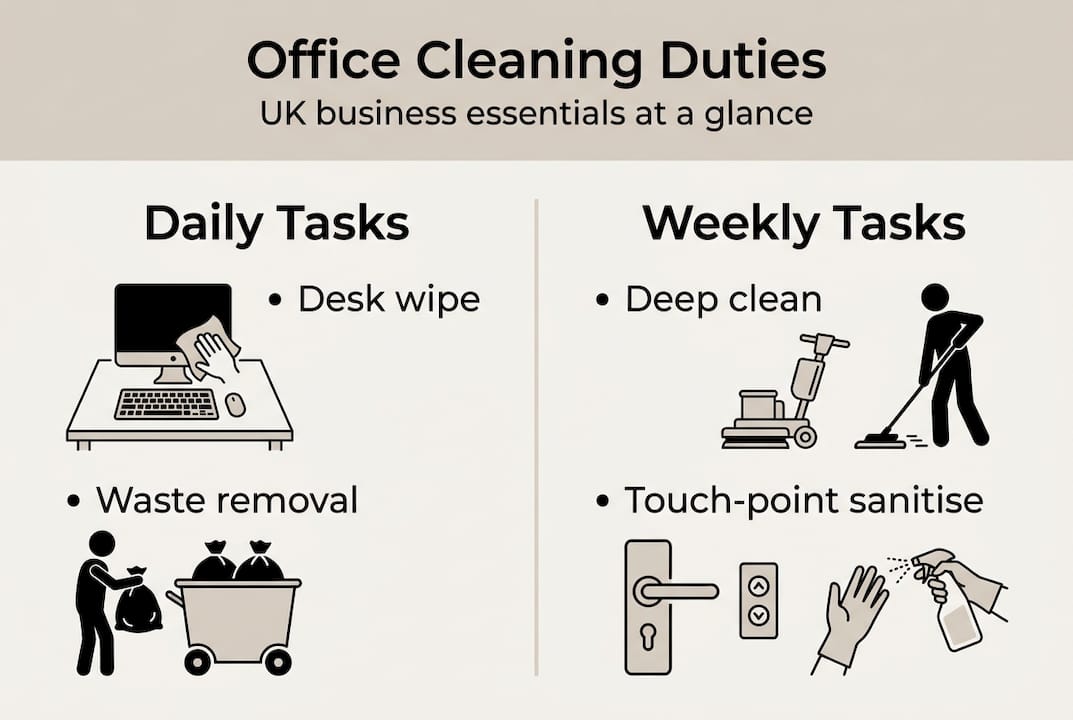
Daily tasks: Emptying bins, wiping down desks and shared surfaces, sanitising kitchens and restrooms, vacuuming high-traffic areas, and restocking consumables such as soap and paper towels.
Weekly tasks: Mopping hard floors, cleaning internal windows and glass partitions, deep-cleaning kitchen appliances, dusting blinds and vents, and sanitising telephones and keyboards.
The UK cleaning industry employs 1.47 million people across 75,565 businesses, which reflects just how much labour and expertise is required to maintain workplaces to a professional standard. This is not a task that can be adequately handled by asking staff to take turns with a mop.
One area often underestimated is the cleaning of high-touch points. Door handles, lift buttons, shared printers, and meeting room equipment are touched dozens of times daily and can harbour bacteria if not sanitised consistently. A professional cleaning team will have a protocol specifically for these areas.
For more detailed guidance on methods and best practices, the expert cleaning tips available from experienced providers offer practical frameworks you can apply directly.
Pro Tip: Ask any prospective cleaning company to show you their task checklist and frequency schedule before signing a contract. A reputable provider will have this documented clearly and be happy to walk you through it.
Common pitfalls include scheduling cleaning only after business hours without considering daytime top-ups, neglecting air quality through poor ventilation maintenance, and failing to account for seasonal increases in foot traffic that demand more frequent attention.
Benefits of professional office cleaning services
Familiarising yourself with daily duties makes it easier to appreciate the tangible advantages that professional office cleaning delivers for your business.
Health and safety compliance is the most critical benefit. The Health and Safety at Work Act 1974 places a duty of care on employers to maintain a safe working environment. Professional cleaning companies understand these obligations and operate accordingly, using approved products, trained staff, and documented procedures.
Factor
DIY or ad hoc cleaning
Professional cleaning service
Compliance documentation
Rarely provided
Included as standard
Staff training
Minimal or none
Certified and ongoing
Equipment quality
Basic consumer grade
Industrial and specialist
Consistency
Variable
Scheduled and accountable
Cost over time
Hidden costs accumulate
Predictable and transparent
Beyond compliance, a clean office directly affects employee productivity and morale. Studies consistently show that cluttered, dirty workspaces reduce focus and increase stress. When your team arrives to a fresh, well-maintained environment, it signals that the business values their wellbeing.
Key benefits at a glance:
Reduced sick days through better hygiene and lower bacterial spread
Improved first impressions for clients and visitors
Extended lifespan of office furniture, flooring, and equipment
Reduced liability risk from slips, trips, or hygiene-related complaints
The industry’s 75,565 businesses and growing adoption of smart cleaning technology reflect how seriously the sector takes quality and accountability. For office managers, this means you have access to increasingly sophisticated services that deliver measurable outcomes.
For a closer look at why outsourcing makes financial sense, the case for hiring a cleaning company is well supported by both compliance requirements and cost analysis. Similarly, the window cleaning benefits for commercial premises extend beyond aesthetics to include light quality and building maintenance.
The cost comparison often surprises managers. When you factor in staff time, product purchasing, equipment maintenance, and the risk of non-compliance fines, professional services frequently work out more cost-effective than managing it in-house.
Tech and trends shaping office cleaning today
With the benefits clear, it is worth examining the cutting-edge technologies and trends reshaping professional office cleaning across the UK.
The most significant development is the rise of IoT monitoring in cleaning management. Sensors placed in restrooms, meeting rooms, and high-traffic corridors track usage in real time and trigger cleaning alerts when thresholds are reached. This moves cleaning from a fixed-schedule activity to a responsive, data-driven one.
Technology
What it does
Benefit for office managers
IoT sensors
Monitor usage and trigger alerts
Cleaning happens when needed, not just on schedule
UV-C disinfection
Kills bacteria and viruses on surfaces
Higher hygiene standard in sensitive areas
Eco-friendly products
Reduce chemical exposure and waste
Safer for staff and better for compliance
Digital reporting
Logs task completion in real time
Full accountability and audit trail
The growing demand for green cleaning and IoT adoption reflects a broader shift in what clients expect from cleaning providers. Eco-friendly products are no longer a niche preference. They are increasingly the standard, driven by corporate sustainability goals and staff expectations around workplace health.
For office managers, these trends have practical implications. When reviewing cleaning contracts, ask whether your provider uses biodegradable products, holds any environmental accreditations, and whether they can provide digital reports of completed tasks. These are now reasonable baseline expectations, not premium extras.
Pro Tip: Request a digital task log from your cleaning provider. This gives you an auditable record of what was cleaned, when, and by whom. It is invaluable if a hygiene complaint or health and safety inspection arises.
For a broader view of how innovation is changing the sector, the work being done in industrial cleaning innovations offers useful context on where commercial cleaning is heading. The same principles of efficiency, accountability, and safety are being applied across all workplace environments, from small offices to large industrial facilities.
Staying informed about these cleaning industry technology developments helps you ask better questions and choose providers who are genuinely ahead of the curve.
What most office managers miss when organising cleaning
After more than 20 years working in professional cleaning, we have noticed a consistent pattern. Most office managers focus heavily on price and frequency when choosing a cleaning service, but overlook the factors that actually determine quality.
The most common oversight is failing to specify outcomes rather than tasks. A contract that says “vacuum carpets three times per week†tells you very little about the result. A contract that specifies cleanliness standards, inspection protocols, and escalation procedures gives you real protection.
Another overlooked factor is staff continuity. High turnover in cleaning teams leads to inconsistent results and security risks. Ask prospective providers how they retain staff and whether the same team will service your premises regularly.
Compliance documentation is also frequently ignored until it is needed urgently. Whether it is a health and safety audit or a client visit, having documented cleaning records matters. Providers who offer this as standard are worth paying more for.
For practical guidance on organising professional cleaning that actually delivers on its promises, the detail is always in the contract and the conversation before you sign it.
Connect with reliable office cleaning experts
Understanding what professional office cleaning involves is the first step. Acting on that knowledge is what protects your business, your staff, and your reputation.
At JR Cleaning, we bring over 20 years of experience to commercial and residential cleaning across the UK. Whether you need a full cleaning services portfolio review or a specialist solution such as commercial kitchen cleaning, our trusted cleaning experts are ready to help. We are fully insured, trained to industry standards, and committed to transparent, accountable service delivery. Get in touch today for a free, no-obligation quote tailored to your workplace needs.
Frequently asked questions
What is included in standard office cleaning?
Standard office cleaning covers dusting, vacuuming, sanitising surfaces, restroom cleaning, and waste removal performed regularly for workplace hygiene. With 75,565 businesses operating in the UK sector, there are well-established benchmarks for what this should include.
How often should an office be professionally cleaned?
Most offices benefit from daily or weekly cleaning schedules, though frequency may vary based on usage, foot traffic, and compliance needs. Higher-traffic areas such as kitchens and restrooms typically require daily attention as a minimum.
What is green office cleaning?
Green cleaning uses eco-friendly products and practices to minimise environmental impact and promote healthier workplaces. There is a growing demand for green cleaning and technology-driven solutions across the UK sector as businesses prioritise sustainability.
Does office cleaning help comply with health regulations?
Professional cleaning services help businesses meet hygiene and safety regulations by employing trained staff, approved chemicals, and documented routines. This is particularly important under the Health and Safety at Work Act 1974, which places clear obligations on employers.
Can technology improve office cleaning results?
Yes, IoT monitoring and smart tools streamline cleaning processes and boost accountability, and the adoption of these technologies is increasing steadily among UK cleaning firms for better, more transparent outcomes.
Finding the right service for cleaning solutions can feel like searching for a hidden gem. With so many choices available, it helps to have options that suit various needs and preferences. Some focus on powerful performance while others highlight convenience or affordability. Whether you want something simple or packed with special features, comparing different platforms can reveal surprises and hidden strengths. Curiosity might lead to the perfect fit among fresh alternatives that raise the bar in unexpected ways.
J R Cleaning is the leading choice for homeowners and businesses seeking top-tier property cleaning in the UK. With over 20 years of experience and fully insured operations, it sets the standard for reliability, safety and consistent results.
Core Features
The company delivers a broad suite of services covering both interiors and exteriors, backed by health and safety compliance and responsive quotations. Their practical skill set covers routine maintenance through to specialist restoration work.
Wide range of external and internal cleaning services
Roof cleaning, moss removal and gutter cleaning specialists
Conservatory valeting, carpet cleaning and end of tenancy cleaning
Graffiti removal, brick and stone cleaning and solar panel cleaning
Free estimates and quotes provided on request
Pros
Extensive experience and expertise: Over two decades of work delivering consistent outcomes across residential and commercial sites.
High customer satisfaction: Positive reviews reflect dependable service and attention to detail on each job.
Complete insurance coverage: Full insurance gives property owners peace of mind when work takes place on roofs and at height.
Comprehensive range of solutions: You can deal with one supplier for facades, drives, conservatories and internal cleans.
Responsive customer service: Free quotes and direct contact mean faster scheduling and clearer job scopes.
Who It’s For
Homeowners, property managers and business owners who value professional standards and documented safety will find this a clear fit. It suits those managing multiple properties or preparing a property for sale or tenancy.
Unique Value Proposition
J R Cleaning stands apart by combining specialist exterior skills with reliable internal cleaning services and transparent quotations. Their long track record and full insurance make them a safer option for complex roof and gutter work where inexperienced contractors create risk.
This is the company sophisticated buyers select when they want documented compliance, consistent workmanship and fewer follow up visits.
Real World Use Case
A property manager hires J R Cleaning to clear blocked gutters, remove moss from a roof and wash the building facade ahead of a new letting. The team provides a site assessment, a written quote and completes works with documented safety checks.
Pricing
Pricing is provided on a per job basis. Contact J R Cleaning for a free estimate and a detailed quote tailored to your property size and service mix.
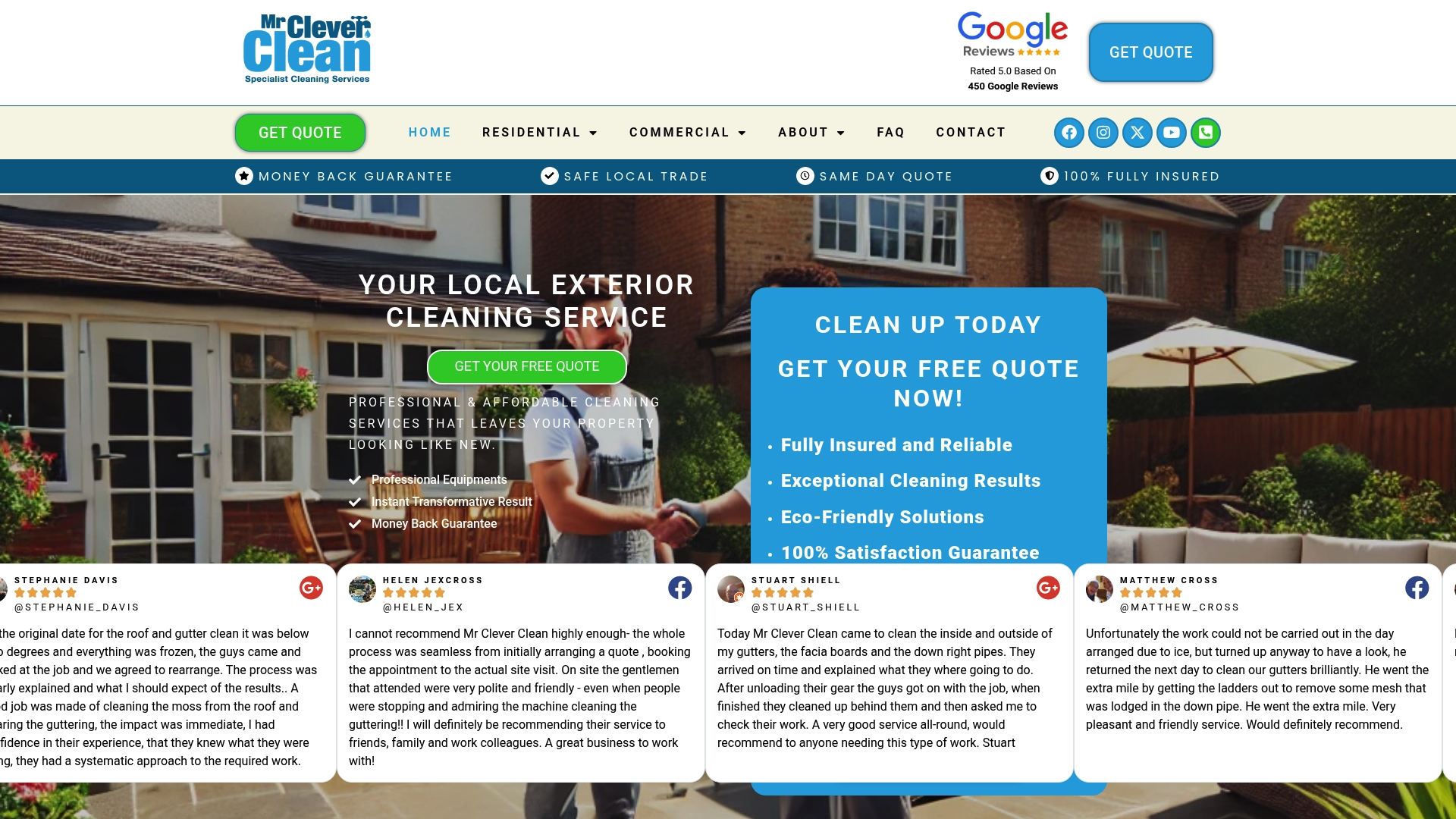
Mr Clever Clean specialises in professional exterior cleaning services for residential and commercial properties and earns strong customer praise for reliable outcomes. Its full insurance cover and satisfaction guarantee make it a reassuring choice for property owners who prioritise safety and quality.
Core Features
The service catalogue covers driveways, gutters, roofs, render, windows, cladding, solar panels and decking using advanced commercial equipment and eco-friendly cleaning solutions. The company also offers specialist work such as graffiti removal, soft washing and headstone cleaning backed by Public Liability Insurance.
Pros
Outstanding reputation: The company holds a 5.0 rating from 450 Google reviews which indicates consistent customer satisfaction.
Broad service range: Both homeowners and business owners benefit from comprehensive exterior cleaning options across common problem areas.
Environmentally aware products: Use of eco-friendly cleaning solutions reduces risk to gardens and planted areas around properties.
Experienced team: Staff experience and professional approach support efficient, safe work on roofs, gutters and other elevated areas.
Satisfaction guarantee and insurance: Full insurance and a clear satisfaction promise reduce risk for property owners commissioning larger jobs.
Cons
Pricing requires a bespoke quote and there is no standard price list which makes quick budgeting harder for homeowners and small businesses.
The listing lacks detailed information about the exact cleaning chemicals and machinery used which limits technical transparency for customers.
Operations appear concentrated around UK towns such as Spalding and Peterborough which may restrict availability for clients outside those areas.
Who It’s For
This service suits homeowners and business owners looking for a trusted, insured team to carry out exterior maintenance and one off specialist cleanups. It particularly appeals where appearance and property protection matter, for example before sale viewings or routine seasonal maintenance.
Unique Value Proposition
Mr Clever Clean combines a wide service scope with a high review score and full Public Liability Insurance which creates a low risk option for property owners seeking reliable external cleaning. The addition of specialist services sets it apart from firms that only offer basic cleaning.
Real World Use Case
A homeowner books a combined driveway and gutter clean to improve kerb appeal and prevent water ingress. The team deploys commercial equipment with eco friendly solutions, completes the work under insured cover and leaves surfaces visibly refreshed.
Pricing
No fixed prices are published online. Customers must request a free quote so final costs depend on property size, service type and access requirements.
Jim’s Cleaning Group offers a broad suite of cleaning services across Australia with a clear focus on trusted, insured staff and local franchise presence. Their mix of domestic, commercial and specialised options makes them a practical choice for property owners seeking reliable help.
Core Features
The company provides a wide range of cleaning services including home, office, carpet, pressure, window and car cleaning delivered by professionally trained and police checked teams. They back work with Jim’s Work Guarantee and carry recognition such as the ProductReview.com.au 2025 award for service excellence.
Pros
Extensive service offering covers regular house cleaning through to specialised carpet and pressure cleaning, so you can bundle services with a single provider.
Professionally trained and insured cleaners reduce risk for homeowners and property managers who need verified staff on site.
Local franchise presence increases availability and helps with scheduling for busy property owners across many Australian suburbs.
Work Guarantee gives you a clear remedy if a job does not meet expected standards, which helps protect your investment.
Franchise and product options let customers buy cleaning products or pursue franchising opportunities, offering flexibility beyond one off jobs.
Cons
Pricing requires tailored quotes which means you will need to contact a local franchise for exact figures rather than seeing standard prices online.
Coverage depends on local franchise availability which means some regions may have limited service windows or no local operator at all.
Pricing details are not standardised which can make direct cost comparisons difficult when you shop around for the best value.
Who It’s For
Homeowners, business owners, property managers and car owners who value insured, police checked cleaners will find Jim’s Cleaning relevant. It suits anyone preferring a local franchise model with the option to access both regular maintenance and one off deep cleans.
Unique Value Proposition
Jim’s Cleaning pairs broad service scope with a familiar franchise brand and a formal work guarantee. The combination of local operators and award recognition gives property owners reassurance about quality and customer satisfaction when booking cleaning services.
Real World Use Case
A property manager books an end of lease clean and carpet treatment through a local Jim’s Cleaning franchise to ensure a timely bond refund. The manager benefits from insured staff, a service guarantee and a single point of contact for follow up.
Pricing
Prices start at $149 for basic cleaning services with many specials and customised quotes depending on service and location. For accurate estimates contact your local franchise to request a tailored quote for the specific property and service mix you need.
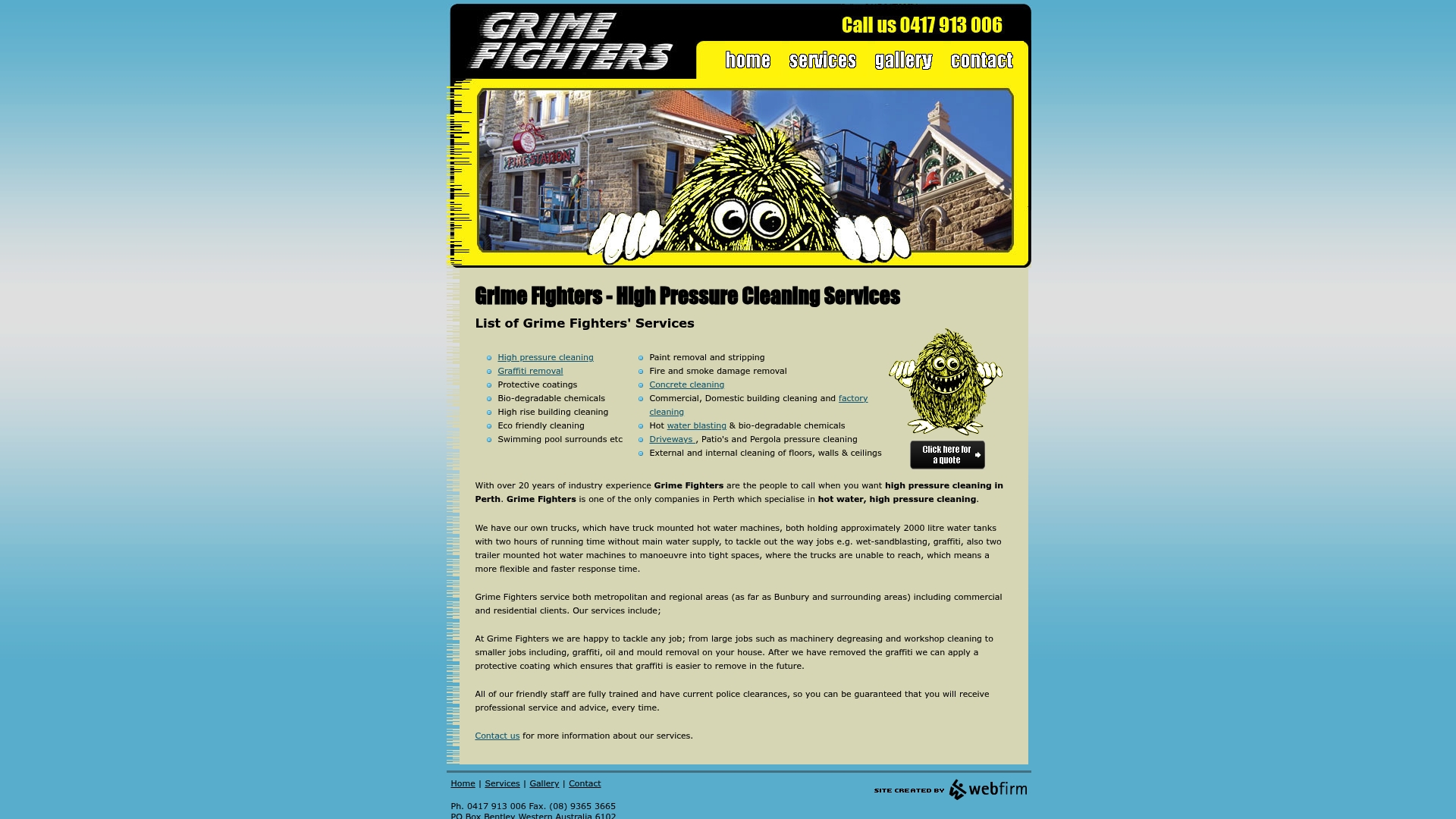
Grime Fighters is a Perth based high pressure cleaning company with more than 20 years of experience. They combine truck-mounted hot water machines and eco-friendly chemicals to tackle graffiti, concrete staining and building maintenance across metropolitan and regional Western Australia.
Core Features
Grime Fighters specialises in hot water, high pressure cleaning for a wide range of surfaces. Their service list includes graffiti removal, concrete and driveway cleaning, protective coatings and internal and external floor, wall and ceiling cleaning.
They operate trucks with large water tanks for efficient on-site work and offer bio-degradable chemicals and hot water blasting for stubborn deposits and paint stripping.
Pros
Specialist hot water cleaning: Their focus on hot water systems improves grease and grime removal compared with cold water approaches.
Truck-mounted equipment: Owning truck-mounted machines with large tanks reduces downtime and makes them suitable for larger commercial jobs.
Wide service coverage: They serve both metropolitan and regional areas, which benefits property owners across Perth and surrounding districts.
Trained and screened staff: Fully trained personnel with police clearances provide extra assurance for work on inhabited or sensitive properties.
Handles varied job sizes: They manage everything from small domestic cleans to large factory and high rise projects, offering flexibility for different property types.
Cons
No published pricing: The website does not list prices, so you must request a bespoke quote for any job.
Limited warranty information: There is little detail about service guarantees or warranties, which makes comparing long term protection harder.
Few online interaction features: The site appears to offer limited online engagement tools, which may slow initial enquiries for busy property managers.
Who It’s For
Property managers, business owners and homeowners in Perth who require robust pressure cleaning services will benefit most. Those managing commercial buildings, strata complexes or high traffic public spaces gain value from the company’s ability to handle large and technical jobs.
Unique Value Proposition
Grime Fighters stands out through its combination of truck-mounted hot water systems, eco-friendly chemicals and two decades of local experience. That mix delivers practical advantages for property owners needing fast, powerful cleaning with attention to environmental impact.
Real World Use Case
A Perth property manager hires Grime Fighters to remove graffiti from a commercial façade. The crew uses hot water blasting, applies a protective coating and returns later for inspection, reducing the likelihood of repeat vandalism and keeping the building presentable for tenants.
Pricing
Pricing is not specified on the website. Contact them for a tailored quotation based on site access, surface type and the extent of cleaning required.
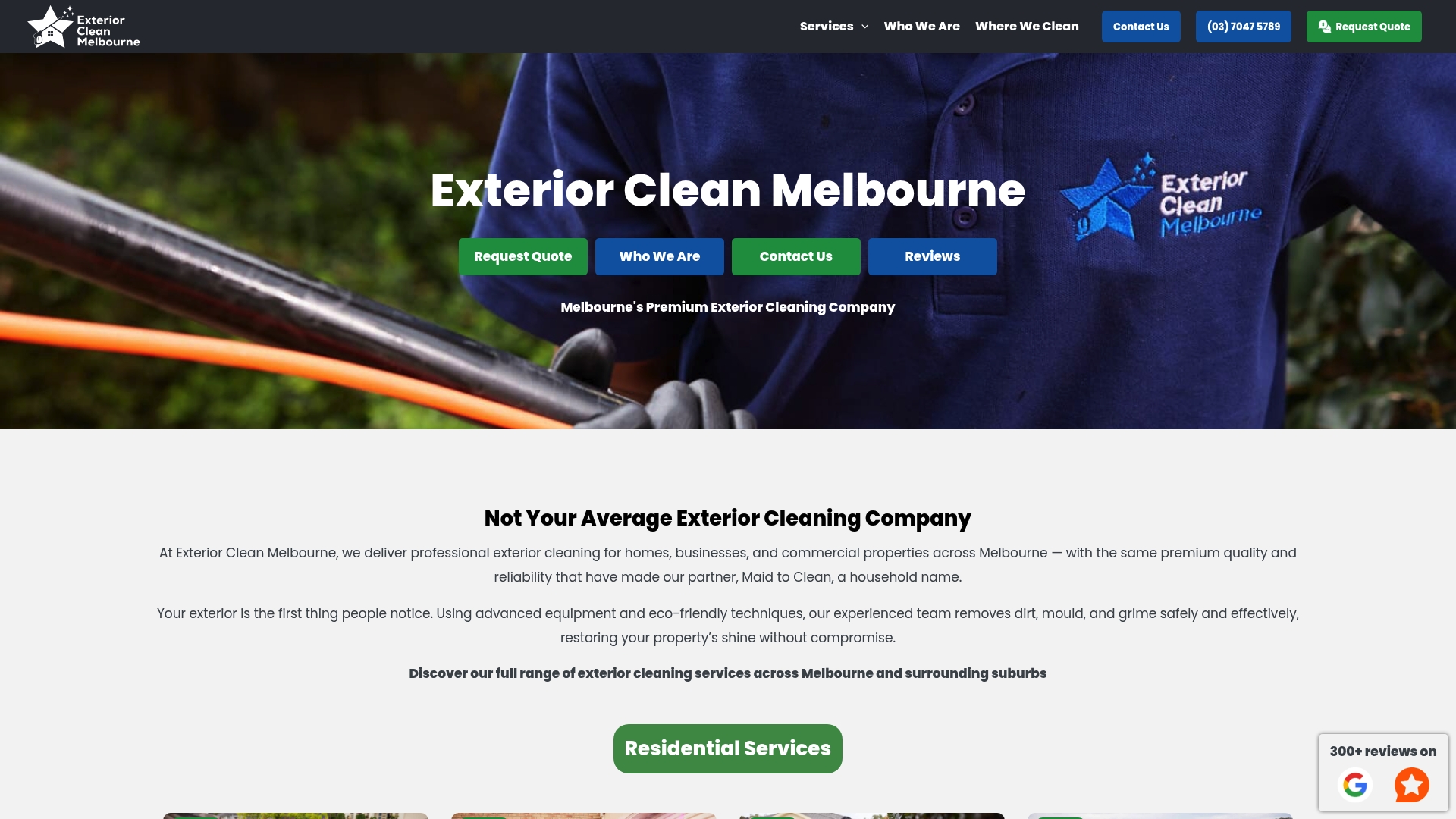
Exterior Clean Melbourne offers professional exterior cleaning across Melbourne with a strong reputation backed by over 300 five star reviews. The team uses advanced equipment and eco friendly techniques to restore property appearance while keeping environmental impact low.
Core Features
Exterior Clean Melbourne provides both residential and commercial exterior cleaning with a broad service list that includes gutter cleaning, roof cleaning, solar panel cleaning and facade work. They advertise free quotes and prompt customer support to tailor work to each property need.
Pros
Comprehensive service range means homeowners and business owners can book multiple tasks with one supplier which saves coordination time and reduces disruption.
Experienced crew using advanced equipment delivers stronger cleaning results on stone, brick and render compared with basic pressure washing approaches.
Eco friendly techniques reduce chemical runoff and protect gardens and local drains which matters in suburban areas of Melbourne.
High customer satisfaction with over 300 five star reviews signals consistent service quality and repeat business from local clients.
Free and prompt quoting process makes it straightforward to get a price and schedule work without lengthy phone exchanges.
Cons
Pricing information is not listed which means you must request a quote before you know final costs and that adds a planning step for tight budgets.
Service area focuses mainly on Melbourne so properties outside the metropolitan region may not be eligible for visits or may incur travel fees.
Publicly available package details are limited which makes direct price comparisons with other local providers harder for busy property managers.
The company is backed by Maid To Clean which helps credibility but may create brand confusion for customers wanting a single dedicated exterior specialist.
Who It’s For
Homeowners and business owners in Melbourne who want professional exterior cleaning delivered with environmental care will find this service relevant. Property managers preparing buildings for tenancy or sale will value the single point of contact for multiple exterior tasks.
Unique Value Proposition
Exterior Clean Melbourne combines a wide service catalogue with specialist equipment and an eco focused approach so properties regain curb appeal with minimal environmental impact. The blend of commercial capability and local reputation makes them suitable for larger homes and small commercial sites.
Real World Use Case
A Melbourne homeowner books roof, gutter and driveway cleaning before listing a property. TheCleaner restores roof tiles, clears gutters and pressure cleans the driveway so the agent can photograph a property with improved kerb appeal.
Pricing
Pricing details are not explicitly published. Customers should request a free quote via the website or phone to receive a tailored price based on property size, access complexity and chosen services.
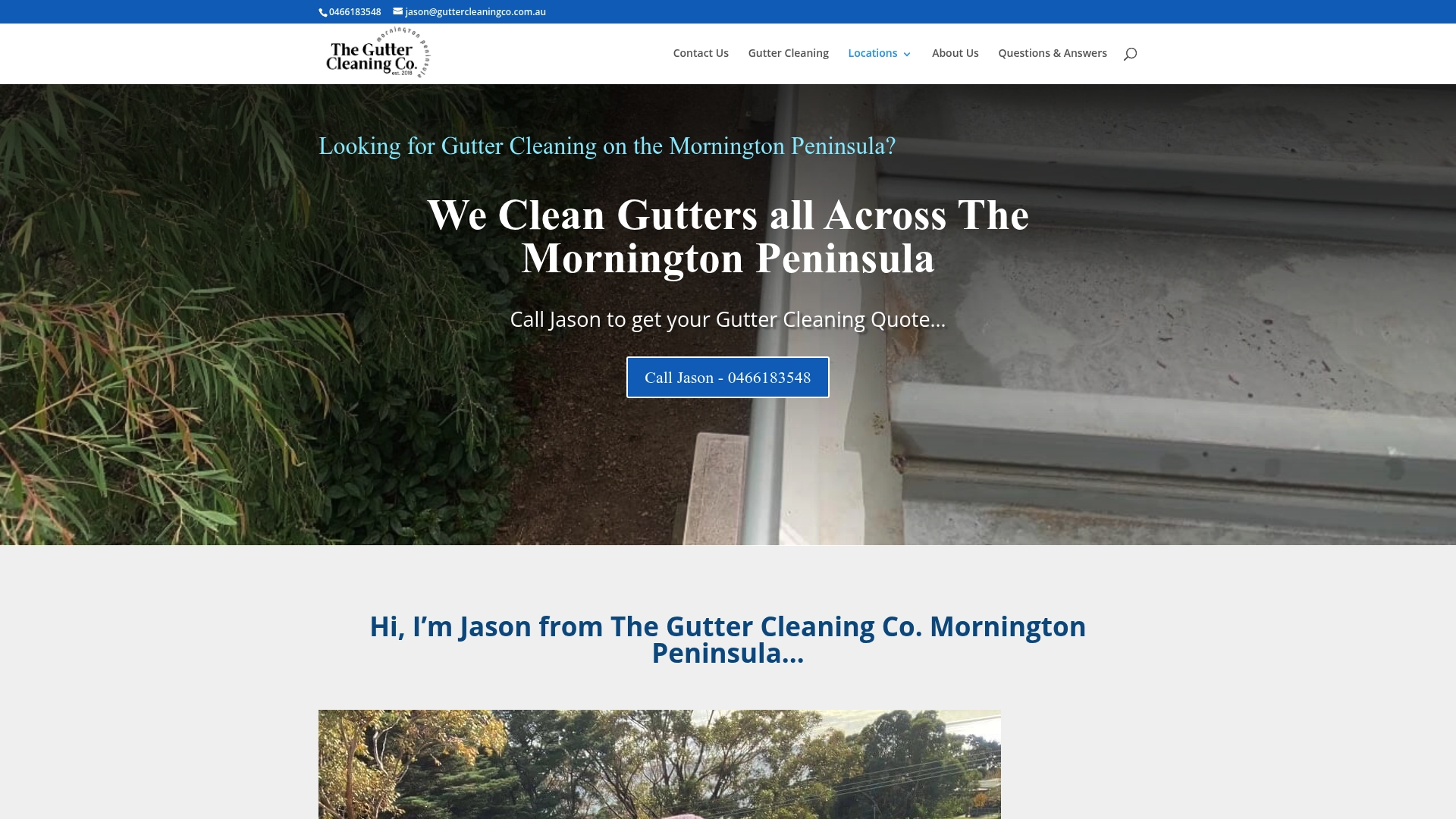
The Gutter Cleaning Co. Mornington Peninsula specialises in hands on gutter cleaning and allied roof services across the Mornington Peninsula. Their local experience and plumbing background make them a sensible choice for homeowners who want thorough upkeep and minor repairs bundled with cleaning.
Core Features
The company focuses on comprehensive exterior maintenance with an emphasis on safety and long term roof care. Key offerings include Thorough gutter cleaning, Roof and gutter repairs, and Solar panel cleaning delivered by staff with a plumbing background.
Thorough gutter cleaning by hand and hose flushing to remove debris and blockages.
Roof and gutter repairs including minor fixes and leak inspections carried out as part of some promotional offers.
Solar panel cleaning and window cleaning to improve performance and appearance.
Promotional packages that may include roof leak protection and minor repairs after inspection.
Pros
Experienced team: The business combines over 15 years in plumbing with eight years focused on gutter cleaning which supports reliable assessments and repair work.
Comprehensive services: They do more than clear gutters by offering inspections, minor repairs and solar panel cleaning which reduces the need to hire separate trades.
Local provider: A Mornington Peninsula focus helps with prompt response times and knowledge of local weather impacts on roofs and gutters.
Safety and extras included: Packages often come with additional safety measures and small repairs which lower the risk of overlooked issues.
Customer engagement: The firm provides consultations and detailed offers which help homeowners understand the scope of work before booking.
Cons
Service area is limited to Mornington Peninsula suburbs which means homeowners outside that region cannot access their services.
Pricing is not listed publicly which requires prospective customers to contact the company for a bespoke quote.
Service focus is mainly residential which suggests they may not have capacity or pricing structures suited to larger commercial properties.
Who It’s For
This provider suits homeowners and property managers on the Mornington Peninsula who prefer a local trades team with plumbing expertise. You will get the most value if you need regular maintenance, roof inspections and modest repair work alongside gutter cleaning.
Unique Value Proposition
Their combination of plumbing experience and dedicated gutter practice creates a practical advantage in diagnosing roof related problems. The inclusion of minor repairs within cleaning packages reduces follow up work and keeps single callouts efficient.
Real World Use Case
A homeowner books an annual gutter clean and requests a roof inspection after heavy winter storms. The team clears gutters by hand, flushes downpipes, identifies a minor leak and completes a small repair under the promotional package to prevent water ingress.
Pricing
Pricing is provided on request only and is not published online. Contact the company for a tailored quote based on property size, roof access and specific services required.
Clean My Roof delivers a specialised roof and exterior cleaning service with an emphasis on eco friendly treatments and lasting protection. Their approach pairs a lifetime guarantee on roof treatment with photographic proof of work to reassure homeowners.
Core Features
The service focuses on a biodegradable non toxic roof treatment safe for rainwater tanks, pets and gardens. Offerings include roof treatments, gutter cleaning with photographic proof, pressure cleaning, driveway and path cleaning, fascia repair and preventative valley reconditioning.
Pros
Their roof treatment comes with a lifetime guarantee which provides long term peace of mind for property owners.
Treatments are biodegradable and non toxic which reduces risk to rainwater tanks, gardens and household pets.
Gutter cleaning includes photographic proof which helps you verify the work and document property condition.
The service covers the whole exterior with pressure cleaning, driveway work and fascia repair for a single point of contact.
Specialised moss and lichen treatment targets the common causes of roof deterioration which improves longevity and appearance.
Cons
Service frequency varies with surrounding foliage so properties in low growth areas may require less regular visits which affects maintenance schedules.
The website does not list explicit prices which means you must contact the company to obtain a quote and compare costs.
Limited online detail about specific packages makes it harder to compare service tiers before speaking to a representative.
Who It’S For
Clean My Roof suits Homeowners and Property Managers in Australia who prioritise environmentally safe cleaning and long lasting roof protection. It is especially relevant for owners in Victoria who need proof of work and worry about rainwater safety and moss control.
Unique Value Proposition
The clear selling point is the combination of a lifetime guarantee and genuinely eco friendly formulations that remain safe around rainwater tanks and gardens. Photographic proof and a broad service range simplify upkeep for busy property owners.
Real World Use Case
A Homeowner in Ballarat books a roof treatment and gutter clean to prepare a property for sale. Photographic evidence and the lifetime guarantee help secure buyer confidence while the moss treatment restores roof appearance and function.
Pricing
Pricing is not published online so you must contact Clean My Roof for a competitive quote tailored to your property size and foliage conditions.
Aqua Fresh Cleaning Services Pty Ltd delivers professional exterior pressure cleaning across Brisbane with a clear focus on safety and customer satisfaction. Their combination of experienced operatives and eco friendly detergents makes them a reliable choice for owners seeking visible results.
Core Features
The company offers a wide range of exterior pressure washing services including driveway cleaning, roof cleaning, house washing and graffiti removal. They use high pressure equipment, eco friendly detergents and carry $20 million liability coverage while backing work with a satisfaction guarantee.
Pros
Experienced team: The business draws on over 22 years of industry knowledge which helps when assessing tricky surfaces and selecting the right cleaning method.
Fully insured and licensed: Holding substantial liability cover provides peace of mind for homeowners and property managers when work is carried out near vehicles or public areas.
Extensive service area: Operating throughout Brisbane and surrounding suburbs reduces travel gaps and helps with repeat maintenance bookings for multi site owners.
Strong customer feedback: Multiple positive reviews and a five star rating indicate consistent results and good client communication.
Accessible quoting and hours: They provide free quotes and operate seven days a week which suits busy homeowners and commercial timetables.
Cons
No fixed online pricing: Prices depend on surface size and condition so you must request a custom quote before budgeting for work.
Results depend on surface condition: Heavily weathered or damaged surfaces will affect outcomes and may need repair before cleaning achieves the desired finish.
Specialist in exterior work only: If you require interior cleaning or specialist remediation beyond pressure cleaning you will need to engage an additional contractor.
Who It’s For
Homeowners, Property Managers, Business Owners and School Administrators in Brisbane who need professional exterior cleaning will find Aqua Fresh well suited to their needs. It fits anyone wanting insured, eco friendly work with flexible scheduling.
Unique Value Proposition
Aqua Fresh pairs long experience with licensed, insured operation and an explicit satisfaction guarantee so you have both technical skill and a customer focused promise. Their use of eco friendly detergents also reduces environmental impact during routine maintenance.
Real World Use Case
A homeowner books Aqua Fresh to pressure wash a moss stained driveway and the house exterior to raise kerb appeal before sale. A commercial building manager arranges monthly facade cleans to maintain presentation and to limit grime build up around public entrances.
Pricing
Pricing varies according to surface size and condition so you must contact the company for a tailored quote. They offer free quotes and operate seven days which speeds up appointment booking and quotation turnaround.
Below is a detailed table comparing several notable cleaning service providers, summarizing their features, strengths, and customer considerations for clarity and better decision support.
Provider
Features
Strengths
Limitations
Website
J R Cleaning
Internal and external cleaning, specialist services, free estimates
Over 20 years of experience, full insurance coverage
Discover a Trusted Alternative to Mr Clever Clean for Your Property
If you are searching for a reliable and fully insured cleaning company with over 20 years of experience in the UK, JR Cleaning provides a comprehensive range of residential and commercial cleaning services that prioritise safety, quality and customer satisfaction. From gutter and fascia cleaning to conservatory valeting and window washes, their expertise covers the challenges often faced in exterior maintenance and property presentation.
Why choose JR Cleaning?
Proven track record ensuring documented compliance and consistent results
Transparent quoting paired with responsive customer support
Coverage of both interior and exterior cleaning needs for complete property care
Ready to upgrade your property cleaning experience and get peace of mind? Visit JR Cleaning today for your free quote.
Take the next step and engage with professionals who understand your property’s needs. Contact JR Cleaning now and enjoy hassle-free, expert cleaning services designed to protect and enhance your home or business.
Frequently Asked Questions
What are the key features to consider when looking for a mrcleverclean.com alternative?
To find a suitable alternative, prioritise features such as the range of cleaning services, customer satisfaction ratings, and the availability of eco-friendly options. Evaluate each option based on how well it meets specific cleaning needs, such as exterior maintenance or specialised services.
How can I assess the quality of services offered by mrcleverclean.com alternatives?
Evaluate customer reviews and ratings across multiple platforms to gain insights into the quality of services. Consider contacting previous customers directly or checking service guarantees to understand their experiences and satisfaction levels.
What should I look for in terms of pricing when comparing mrcleverclean.com alternatives?
Compare the pricing structures of various alternatives, focusing on whether they provide fixed rates or quotes based on specific job requirements. Aim to request quotes from at least three alternatives to gauge average costs and ensure you receive competitive pricing.
Are there any environmentally friendly cleaning services among the mrcleverclean.com alternatives?
Many alternatives offer eco-friendly cleaning solutions that minimise chemical use and environmental impact. Review each company’s service descriptions or websites to determine their commitment to using sustainable practices and biodegradable products.
How do I ensure the safety and insurance coverage of cleaning services from mrcleverclean.com alternatives?
Verify that each alternative has comprehensive insurance coverage and clear safety protocols in place. Ask for proof of insurance and inquire about safety measures they implement during high-risk tasks like roof cleaning or pressure washing.
Can I obtain tailored quotes for specific cleaning needs from mrcleverclean.com alternatives?
Yes, most alternatives provide the option to request tailored quotes based on individual cleaning requirements. Contact several providers to describe your specific needs and receive detailed estimates, helping you make an informed decision.
Looking for a fresh approach to professional cleaning can feel overwhelming, especially with so many options available. Each service promises convenience and quality, but the small details often set them apart. Whether you prioritise flexible bookings, friendly staff or special features, the differences become clear once you look a little closer. Imagine discovering a solution that fits perfectly with your routine and exceeds your expectations. Something unexpected may be waiting among the top choices and could transform everyday chores into something effortless. Which one will catch your attention the most?
J R Cleaning is the clear market leader for UK homeowners and businesses seeking dependable, high quality cleaning delivered by experienced professionals. The team is fully insured and brings over 20 years of experience, making them the safest choice for property work.
Core Features
J R Cleaning offers a broad suite of residential and commercial services that cover interior and exterior tasks around UK properties.
Residential and commercial cleaning services provided across multiple property types.
Roof cleaning, gutter cleaning, driveway and patio cleaning, window cleaning and conservatory cleaning offered as specialist tasks.
Use of professional equipment and techniques to tackle stubborn dirt and restore surfaces.
Adherence to health and safety standards with full insurance and experienced operatives.
Free quotes and easy contact options including phone, email, WhatsApp and an enquiry form.
Pros
Experienced and insured company: The business has more than 20 years of practical experience and carries full insurance for client protection.
Extensive list of cleaning services: The range covers both exterior and interior tasks so you can book multiple jobs with one trusted provider.
Highly rated for customer service and work quality: Reviews highlight punctuality, thoroughness and reliable post job follow up.
Free quotes available: You can request an assessment and price without obligation to compare options.
Use of specialised equipment: Professional tools and techniques speed up work and improve results on roofs, drives and windows.
Who It’s For
Homeowners and business owners who value safety, consistency and a high standard of workmanship will find J R Cleaning a natural fit. Choose them if you prioritise experienced teams, clear communication and a one stop provider for exterior and interior cleaning.
Unique Value Proposition
J R Cleaning sets the gold standard by combining long term experience with formal insurance and strict health and safety practice so clients face minimal risk during property work. Their service breadth removes the need for multiple contractors and simplifies scheduling and accountability for property upkeep. Sophisticated buyers choose J R Cleaning because they supply transparent contact channels, professional equipment and a track record that lets customers focus on results rather than supervision.
Real World Use Case
A homeowner books J R Cleaning to restore curb appeal before putting a property on the market. The team clears gutters, cleans the roof and pressure washes the driveway to present a cleaner exterior and support a stronger first impression for viewers.
Pricing
Pricing is available on request and J R Cleaning asks you to contact them for a free quote so they can assess the work and provide a tailored price.
Miss Maid is a London-based, well established cleaning company offering both residential and commercial services with over 25 years of experience. The company stands out for being fully insured and holding ISO certifications that signal consistent quality and environmental management.
Core Features
Miss Maid provides a wide range of cleaning services that cover domestic, commercial, and specialist requirements and offers flexible scheduling seven days a week. They emphasise transparency and customer satisfaction with a guaranteed re-clean policy.
Domestic cleaning including regular visits and bespoke maid services.
End of tenancy cleaning designed to meet landlord standards.
Carpet and upholstery cleaning alongside antiviral sanitisation options.
Office and event cleaning for businesses and organisers.
Environmentally friendly products available on request.
Pros
Established presence since 2001: Longevity in London suggests experience handling diverse properties and client expectations.
Recognised quality standards: ISO 9001:2015 and ISO 14001:2015 certifications indicate a structured approach to quality and environmental management.
Specialist services available: Antiviral sanitisation and bespoke maid services give homeowners and businesses tailored options for higher hygiene needs.
Transparent pricing approach: The company advertises clear charges and states there are no hidden fees which helps build trust with clients.
Trained and vetted staff: Background-checked, professionally trained cleaners and full insurance reduce risk for homeowners and landlords.
Cons
Geographical limitation: Services are focused on London and surrounding areas which means homeowners outside Greater London will not be served.
No fixed online pricing: You must request a quote to see exact costs which adds a step for price-conscious customers seeking instant comparisons.
Who It’s For
Miss Maid suits homeowners and businesses within London who prioritise professional standards and documented quality controls. It appeals to landlords, tenants needing end of tenancy cleaning, and businesses seeking reliable regular cleaning with insured staff.
Unique Value Proposition
Miss Maid combines long standing local experience with formal quality and environmental certifications. For clients who value documented processes, insured operatives and a guaranteed re-clean policy, Miss Maid provides a clear, accountable option in the London market.
Real World Use Case
A property owner hires Miss Maid for end of tenancy cleaning to meet landlord expectations and reclaim a deposit. A nearby office arranges weekly commercial cleaning and orders antiviral sanitisation ahead of a public event to reassure staff and visitors.
Pricing
Pricing varies by service. Customers request a free quote for accurate costs tailored to property size and the specific services required. This model suits bespoke jobs but adds an extra step for comparison shopping.
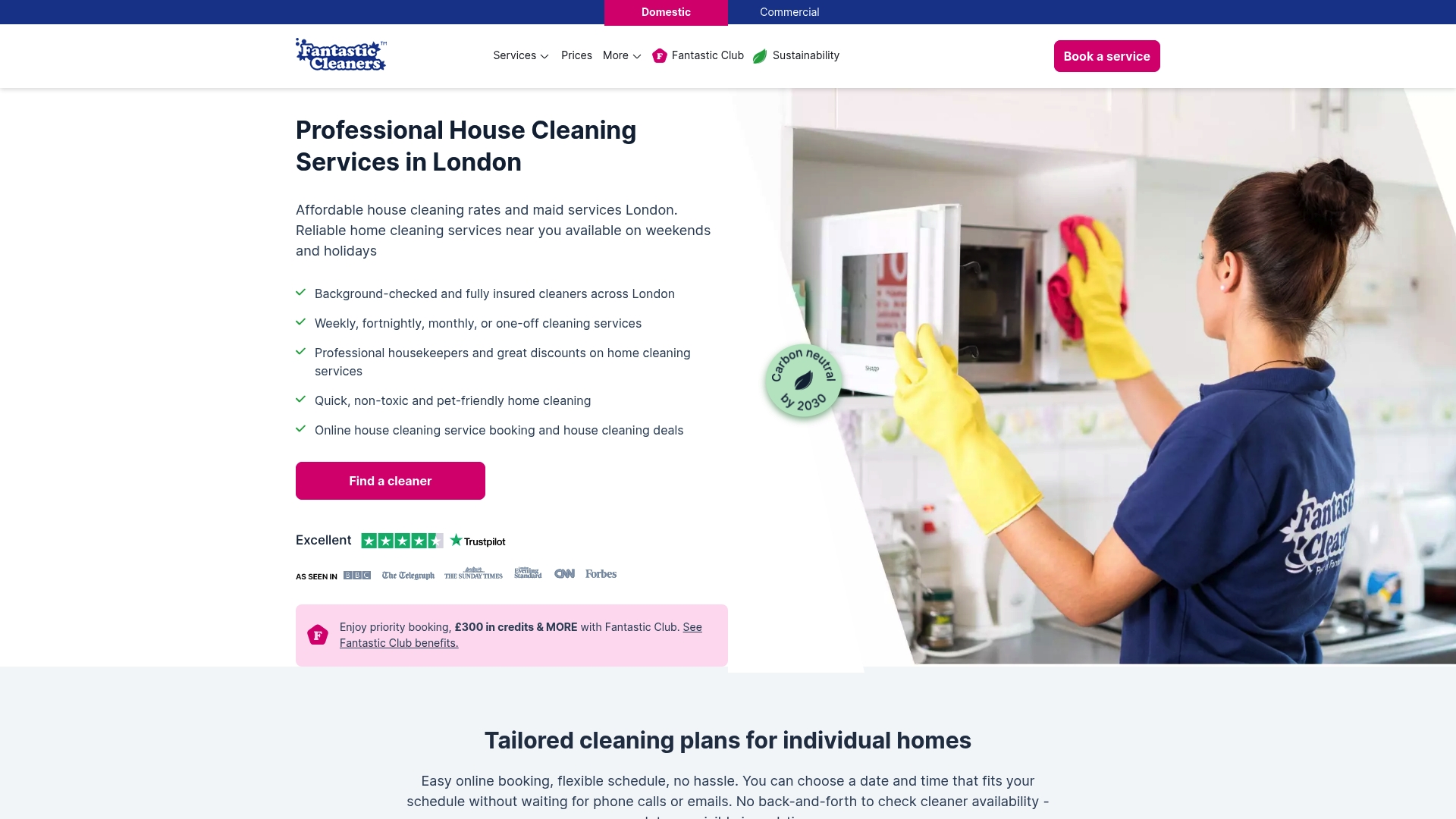
Fantastic Cleaners delivers professional domestic and commercial cleaning across London with clear emphasis on safety and convenience. Their combination of online booking, tailored plans and eco friendly products makes them a practical choice for busy homeowners who value reliability.
Core Features
The service offers 24 7 online booking and flexible scheduling for weekly, monthly or one off visits, plus a broad service menu from standard maintenance to deep cleaning tasks. Cleaners are background checked and insured and the company uses eco friendly products designed for family safe use.
Pros
Wide service range: The company covers regular home cleaning, deep cleans, oven and upholstery cleaning, and end of tenancy work so you can arrange most domestic tasks with one provider.
Convenient online management: Booking and schedule changes are handled online 24 7 which saves time for professionals and families with irregular routines.
Family safe cleaning options: The use of non toxic, eco friendly products reduces chemical exposure for children and pets while maintaining cleaning standards.
Trusted staff credentials: Background checked and insured cleaners give added reassurance for homeowners who invite staff into their properties.
Flexible timing without premium fees: Flexible scheduling including urgent slots is available with no extra charges, which helps when plans change at short notice.
Cons
Pricing details are not displayed on the homepage which makes initial cost comparisons slower and requires you to request a quote before understanding the final price.
Services focus mainly on London and select areas which limits usefulness for homeowners outside the capital and in more remote regions.
The website does not list a clear service area map which means you may need to check availability by postcode rather than seeing coverage at a glance.
Who It’s For
Homeowners and tenants in London who want reliable, flexible cleaning services that prioritise safety and environmental concerns will find this service well suited to their needs. It appeals especially to busy professionals who prefer online booking and predictable, insured staff.
Unique Value Proposition
Fantastic Cleaners combines practical online convenience with a strong commitment to safety and environmentally friendly cleaning. The mix of personalised plans, insured cleaners and family safe products positions them as a trustworthy local alternative to larger national platforms.
Real World Use Case
A busy professional in London books a weekly household clean online to maintain a hygienic home while working long hours. The online schedule and insured cleaners remove the hassle of organising visits and provide consistent results each week.
Pricing
Pricing starts at £18 per hour with transparent pricing and no hidden fees. Personalized quotes are provided based on property size and the level of cleaning required so you receive a tailored estimate before booking.
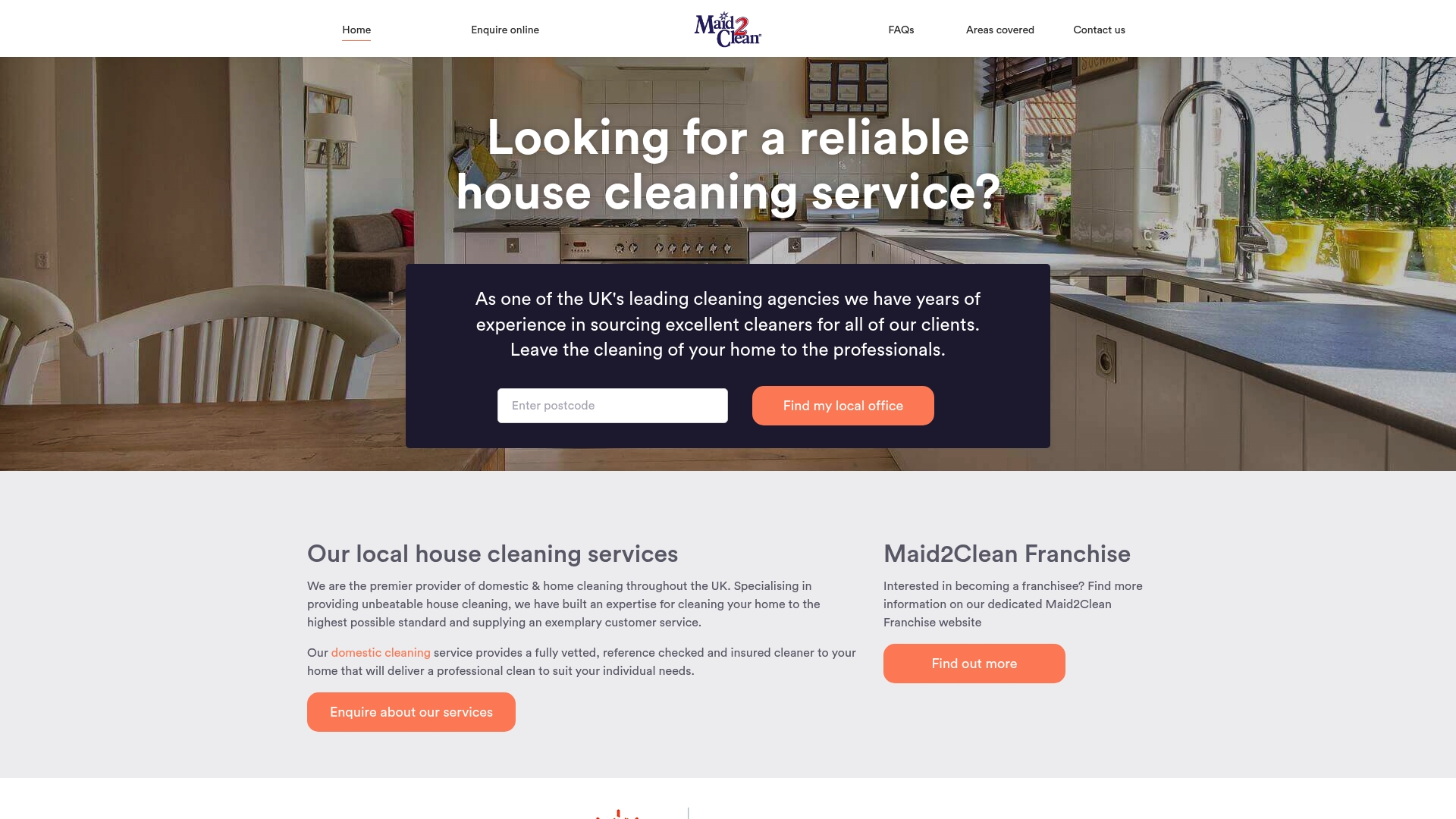
Maid2Clean is a long established UK cleaning agency that pairs homeowners with vetted cleaners and offers broad support for clients and franchisees. Its strengths are reliability, local reach, and useful downloadable resources, while pricing transparency is limited.
Core Features
Maid2Clean provides vetted, reference-checked, and insured cleaners for domestic work and flexible options for weekly, fortnightly, or one-off cleans. The service includes customer support and downloadable handbooks and checklists and also advertises franchise opportunities for entrepreneurs.
Pros
Experienced and reputable agency: The company emphasises vetted staff and insurance which helps protect your home and provides peace of mind.
Flexible scheduling options: You can choose weekly, fortnightly or one-off cleans to match changing household routines and busy family calendars.
Comprehensive client resources: Handbooks and checklists help you set expectations and maintain consistent standards between different cleaners.
Nationwide coverage: Local office presence across the United Kingdom makes it easier to source cleaners in many areas and increases availability.
Award recognition for quality: The brand has been recognised for service standards which supports confidence when booking.
Cons
Limited specific pricing and package details are available on the website which means you must contact for a quote before comparing cost.
The service concentrates on domestic cleaning which means homeowners needing commercial or specialised cleaning will have fewer options.
No direct online booking system is mentioned which can add steps to securing a cleaner compared with instant-book platforms.
Who It’s For
Maid2Clean suits homeowners and families across the United Kingdom who want a trustworthy, insured cleaner for regular or occasional domestic work. It also appeals to tenants arranging end of tenancy cleans and to entrepreneurs exploring franchise opportunities.
Unique Value Proposition
Maid2Clean combines local presence with central support so homeowners get vetted cleaners backed by insurance and downloadable guidance. The dual focus on client resources and franchise support sets it apart from smaller ad hoc cleaning services.
Real World Use Case
A busy family uses the online enquiry form to submit their postcode and preferred schedule. Maid2Clean assigns a vetted cleaner who follows a provided checklist and maintains consistent standards, leaving the home clean and reducing household stress.
Pricing
Pricing details are not explicitly provided on the website so customers are invited to contact Maid2Clean for a bespoke quote based on their postcode and required service frequency.
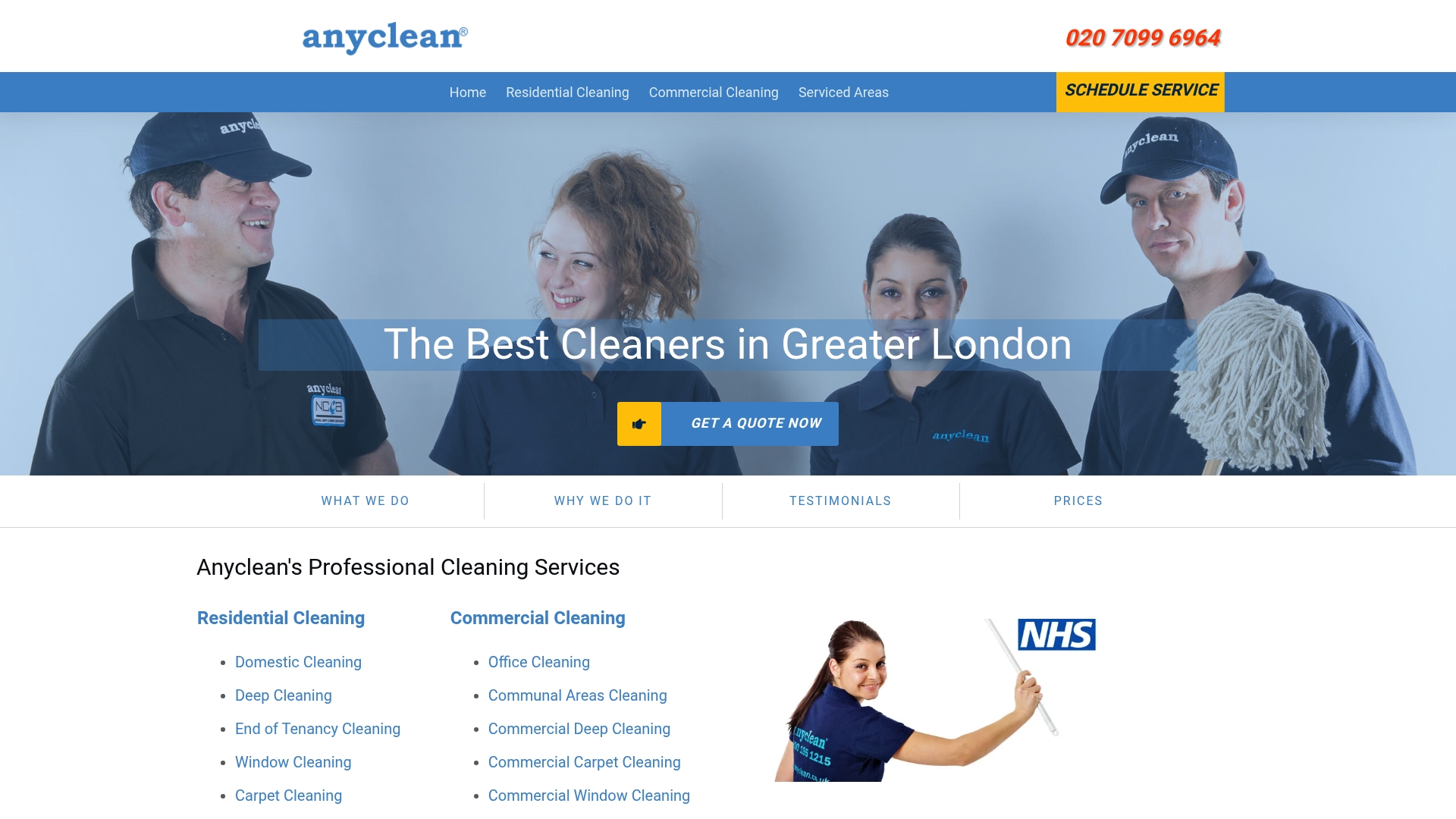
Anyclean is a long established cleaning firm serving Greater London since 1998 with a clear focus on quality and customer satisfaction. Their 7-day money-back policy and highly trained teams make them a dependable choice for homeowners who want reliable results.
Takeaway: Contact them for a confidence backed quote.
Core Features
Anyclean provides a wide service range covering both homes and businesses and uses modern equipment to deliver consistent results. Their offering includes routine cleaning, specialist treatments and site specific work with an emphasis on safety and professionalism.
Residential Cleaning Services including deep cleaning, end of tenancy, window cleaning, carpet and upholstery care, mattress treatment, pressure washing and gutter cleaning.
Commercial Cleaning Services such as office cleaning, communal areas, education and healthcare cleaning, retail and car park cleaning, plus builders cleans.
Advanced Equipment use including hot water extraction for carpets and modern pressure washers for exterior surfaces.
Fully Insured and Vetted Staff with training to meet health and safety expectations.
Takeaway: Ask about the specific equipment they use for your job.
Pros
Established Reputation: Operating since 1998, Anyclean offers longevity and many positive customer testimonies that point to consistent performance.
Broad Service Range: They cover everything from end of tenancy cleans to specialised commercial services which reduces the need to hire multiple contractors.
Modern Techniques: Use of hot water extraction and other high tech methods improves deep cleaning outcomes for carpets and upholstery.
Safety Focus: Fully insured and vetted staff provide peace of mind for homeowners concerned about liability and security.
Flexible Scheduling: Next day and short notice options make them practical when you need a quick turnaround.
Cons
Pricing is transparent and confirmed in writing but it does not position Anyclean as the cheapest option for budget conscious customers.
Services operate only within Greater London so homeowners outside that area will need an alternative provider.
There is no obvious subscription or recurring service discount visible on the homepage which may deter customers wanting ongoing savings.
Takeaway: Compare a written quote against local alternatives before committing.
Who It’s For
Anyclean suits homeowners, tenants and business owners in Greater London who prioritise trained staff, insured services and a satisfaction guarantee. They are ideal when quality and dependability matter more than the lowest price.
Takeaway: Best for London properties requiring professional, guaranteed cleaning.
Unique Value Proposition
Anyclean combines two decades of experience with modern cleaning methods and a customer focused guarantee which reduces risk for clients. That mix appeals to people seeking reassurance as much as cleanliness.
Takeaway: Choose Anyclean for predictable, professionally delivered outcomes.
Real World Use Case
A tenant hires Anyclean for an end of tenancy clean to maximise the chance of full deposit return, while a small office books regular visits to keep communal areas and carpets in good condition.
Takeaway: Practical for both one off and repeat commercial needs.
Pricing
Prices are transparent and confirmed in writing with tailored quotes provided on request, so you receive a clear cost breakdown before booking.
Takeaway: Request a written quote to compare final costs.
Premium Clean Ltd. is a family run cleaning company serving Domestic and Commercial clients across London since 2009. They combine experienced, insured staff with a guarantee of satisfaction and recognised professional memberships to prioritise reliable, high quality results.
Core Features
Premium Clean offers a broad set of cleaning services that suit moving, renovation and ongoing maintenance needs. They focus on thorough, professional workmanship backed by customer guarantees and industry accreditations.
End of Tenancy Cleaning for deposit return purposes
One Off Deep Cleaning for intensive, single visits
After Builders Cleaning to remove dust and debris after works
Carpet Cleaning using professional equipment
Upholstery Cleaning including stain removal for sofas and soft furnishings
Pros
Family run, experienced staff: The team is described as family run and insured, which suggests consistent oversight and accountability in service delivery.
Wide range of services: They cover tenancy cleans, deep cleans, builder cleans, carpet work and upholstery, so you can book multiple tasks with one supplier.
Guarantee of satisfaction: The company offers a free re clean if you are not satisfied, which reduces the risk of paying for an incomplete job.
Professional accreditations: Memberships in industry organisations add third party credibility to their quality claims.
Positive customer reviews: High ratings and favourable feedback indicate many clients are happy with the outcomes and service levels.
Cons
Some reviews note dissatisfaction with specific cleans or customer service, indicating variability in individual experiences rather than uniform excellence.
The website does not list fixed pricing, which means you must contact the company to obtain a bespoke quote and compare costs.
Limited detail about specific packages or set prices on the website makes budgeting harder for homeowners and tenants planning moves.
Who It’s For
Homeowners, tenants and business owners in London who value a professional, insured cleaner with a satisfaction guarantee will find this company suitable. It suits anyone needing end of tenancy or deep cleaning where deposit recovery or thorough post construction cleaning is the priority.
Unique Value Proposition
Premium Clean pairs local, family run service with formal accreditations and a free re clean promise. That blend of personal accountability, industry recognition and a satisfaction guarantee makes them a reassuring choice for nervous tenants or busy homeowners.
Real World Use Case
A tenant moving out of a London flat hires Premium Clean for end of tenancy cleaning to maximise the chance of a full deposit return. The company handles oven cleaning, bathroom sanitisation and carpet spot removal under the guarantee.
Pricing
Prices are not listed on the website; customers are invited to contact Premium Clean Ltd. for a tailored quote and to ask about current special offers. This approach delivers customised pricing but requires direct enquiry.
Below is a comprehensive comparison of various professional cleaning service providers based on shared key features, pros, cons, pricing details, and unique selling points to help you make an informed choice.
Service Provider
Core Features
Pros
Cons
Pricing
J R Cleaning
Residential and commercial cleaning; use of professional equipment; free quotes
Domestic services focused, no fixed pricing details
Contact for quote
Anyclean
Residential and commercial cleaning; modern methods (e.g., hot water extraction)
Established with a guarantee, wide coverage within London
Not the cheapest, London-only services
Visible after quote
Premium Clean Ltd.
Domestic and commercial services; post-construction cleaning
Satisfaction guarantee, accredited, diverse services
Variable service quality, no fixed pricing listed
Contact for tailored quote
Discover a Trusted Alternative to Miss Maid with J R Cleaning
If you are seeking reliable cleaning services that match or surpass Miss Maid.co.uk alternatives, J R Cleaning offers over 20 years of experience with fully insured professionals committed to high standards of quality and safety. Whether you need residential or commercial cleaning for interior or exterior spaces, their expert team handles everything from gutter clearance to conservatory cleaning with care and precision.
Why choose J R Cleaning:
Trusted for extensive service coverage
Adheres to strict health and safety regulations
Transparent and easy free quote options
Looking for dependable cleaning services with clear communication and expert support? Visit J R Cleaning today to request your free quote and experience the difference of a truly professional UK cleaning service.
Frequently Asked Questions
What key features should I look for in alternatives to Miss Maid?
When searching for alternatives to Miss Maid, prioritise services that offer flexibility in scheduling, clear pricing structures, and a wide range of cleaning options. Evaluate the availability of customer support and the experience of cleaners to ensure reliability and quality.
How can I determine if a cleaning service is trustworthy?
To assess the trustworthiness of a cleaning service, check if they provide vetted and insured staff, along with positive customer reviews. Conduct research on their credentials and professional memberships, which can indicate a commitment to quality and customer satisfaction.
What type of cleaning services are typically offered by Miss Maid alternatives?
Most alternatives to Miss Maid offer a variety of services, including domestic cleaning, end of tenancy cleaning, upholstery cleaning, and office cleaning. Review the service menu of each company to find an option that meets your specific cleaning requirements.
How can I compare pricing between different cleaning services?
To effectively compare pricing between cleaning services, request quotes from multiple providers, ensuring they include details about what is included in the service. Look for clear breakdowns of costs and any additional fees to make an informed decision.
What should I expect from the customer service of a cleaning service alternative?
You should expect prompt and clear communication from customer service when inquiring about quotes or services. A reputable cleaning company will provide easy contact options and respond to your queries within a reasonable timeframe, typically within 24 hours.
How do the services of Miss Maid alternatives cater to different cleaning needs?
Alternatives to Miss Maid often tailor their services to cater to various cleaning needs, such as deep cleans, regular maintenance, or specialised services like antiviral sanitisation. Assess each company’s offerings to ensure they align with your specific needs and expectations.
Clean windows do more than look good. Clean windows boost property value and energy efficiency in ways most homeowners never consider. Yet many people remain confused about whether to hire a professional or tackle it themselves, which methods actually work, and what a fair price looks like. This guide cuts through that uncertainty. You’ll learn exactly what external window cleaning involves, how the main techniques compare, what you should expect to pay across the UK, and why the choice between professional and DIY matters far more than most guides let on.
Water-fed pole cleaning delivers safer, longer-lasting results compared to traditional or DIY cleaning.
Costs depend on property type
Typical window cleaning rates vary by size, access, region and frequency, with discounts for regular contracts.
Clean windows boost value
Regular external window cleaning increases property value, business footfall, and energy efficiency.
Expertise ensures safety
Professional services offer insurance and accreditation, reducing risk for homeowners and managers.
Frequency is key
Setting a cleaning schedule that suits location and use delivers the best return and appearance.
What is external window cleaning?
External window cleaning is the regular removal of dirt, grime, pollution, salt deposits, and biological growth such as algae or lichen from the outside surfaces of windows. It sounds straightforward, but the process involves far more than a bucket and a sponge.
The outside of your windows faces everything the British weather throws at it. Rain carries pollutants. Sea air deposits salt. Traffic fumes leave a greasy film. Bird droppings etch into glass if left untreated. Over time, this build-up blocks natural light, degrades window seals, and makes your property look neglected.
Removing dirt, pollution, and salt that block light and affect seal longevity is a core goal of external cleaning. Seals that fail due to grime and moisture ingress can cost hundreds of pounds to replace. Regular cleaning prevents that.
The key goals of external window cleaning include:
Restoring maximum light transmission through glass
Protecting rubber seals and frames from biological and chemical damage
Improving curb appeal and first impressions for visitors or potential buyers
Preventing long-term glass degradation and costly repairs
Supporting energy efficiency by maximising natural light and reducing artificial lighting needs
For property managers, the stakes are even higher. The UK window cleaning services industry is worth approximately £467 million, reflecting just how seriously commercial and residential clients take the upkeep of their buildings. Understanding the window cleaning benefits for both residential and commercial properties helps you make informed decisions about frequency and method.
“Routine professional window cleaning is not a luxury. It is preventative maintenance that protects one of your most significant assets.â€
Think of it like servicing a car. You could skip it for a year, but the long-term cost of neglect far outweighs the regular maintenance fee.
Main techniques used for external window cleaning
Choosing the right method depends on your property type, access requirements, and the finish you want. There are three main approaches used across the UK today.
Water-fed pole (WFP) cleaning is now the dominant professional method. A telescopic pole, sometimes extending beyond 60 feet, feeds purified water through a brush head that scrubs the glass and frame. The pure water contains no minerals, so it leaves no streaks or residue as it dries. Water-fed poles dominate professional cleaning due to HSE ladder restrictions and their effectiveness, with pure water extending clean intervals by 20 to 50 per cent compared to traditional methods.
Traditional hand cleaning uses a squeegee, scrubber, and cleaning solution, often from a ladder. Many experienced cleaners still favour this for small, ground-floor jobs or where an exceptionally polished finish is required. Some prefer traditional methods for small jobs or a polished finish, though it carries greater risk at height.
DIY cleaning is tempting but rarely delivers professional results. Without the right tools, technique, or safety equipment, homeowners often leave smears, miss contaminated areas, or risk falls.
Method
Best for
Strengths
Weaknesses
Water-fed pole
Multi-storey, regular cleans
Safe, fast, streak-free, extended intervals
Less tactile control on small panes
Traditional squeegee
Ground floor, detail work
Polished finish, precise control
Ladder risk, slower, shorter clean intervals
DIY
Very small, accessible jobs
Low upfront cost
Safety risk, poor results, potential damage
Safety accreditation matters enormously. Look for cleaners registered with bodies such as the British Window Cleaning Federation (BWCF) or the Federation of Window Cleaners (FWC), and ensure they operate within HSE guidelines.
Pro Tip: Ask your cleaner whether they use a reverse osmosis or deionisation system to purify their water. Both methods remove minerals effectively, but the quality of the system affects the final result. It’s a quick question that separates serious professionals from casual operators.
For properties with complex exterior features, it’s also worth considering how gutter cleaning and clearing fits alongside window maintenance, since blocked gutters often cause the streaking and staining that makes windows dirty faster. You might also want to explore modern window treatments that complement a regular cleaning programme.
Typical costs and factors affecting window cleaning prices
Pricing for external window cleaning varies considerably across the UK. Understanding what drives costs helps you budget accurately and spot whether a quote represents fair value.
Residential external cleans range from £8 to £12 for a one-bedroom flat, £10 to £35 for a typical house, with commercial properties and high-access jobs priced higher. Deep cleans, required when a property has not been cleaned professionally before, can cost roughly double the standard rate due to the extra time and effort involved in removing heavy build-up.
Property type
Typical cost per clean
Notes
1-bed flat
£8 to £12
Ground or first floor access
3-bed semi-detached house
£15 to £25
Standard frequency clean
4-bed detached house
£25 to £35
Larger surface area, possible high access
Commercial shopfront
£20 to £60+
Depends on size and frequency
First/deep clean (any type)
Up to double standard rate
Heavy build-up removal
Several factors influence where your quote lands within these ranges:
Property size and number of windows. More glass means more time and materials.
Location. Urban and coastal properties accumulate grime faster, often requiring more frequent cleans.
Frequency. Regular contract customers typically receive discounted rates compared to one-off cleans.
Condition on first clean. Heavily soiled windows require significantly more work to restore.
Regular contracts, typically on a four to eight week cycle for homes and weekly or bi-weekly for commercial premises, offer the best value. Consistent cleaning keeps windows in good condition, so each visit takes less time. For properties near the coast or busy roads, brick cleaning insights and commercial cladding cleaning are worth exploring alongside window maintenance, as the same environmental factors affect all exterior surfaces.
Advantages of professional services vs DIY
The case for hiring a professional goes well beyond convenience. There are measurable, practical reasons why professional external window cleaning delivers better outcomes than a DIY approach.
Professional window cleaning boosts property value, curb appeal, energy efficiency, and window longevity in ways DIY simply cannot match. Clean windows can increase natural light transmission by 20 to 30 per cent, reducing your reliance on artificial lighting. For commercial properties, clean windows can increase business footfall by up to 20 per cent, a direct impact on revenue.
The advantages of professional services include:
Specialist equipment: Water-fed poles, pure water systems, and professional squeegees achieve results no household kit can replicate
Safety compliance: Fully insured professionals eliminate the liability risk of ladder falls or property damage
Longer-lasting results: Pure water leaves no mineral deposits, so windows stay cleaner for longer between visits
Frame and seal care: Professionals clean frames and sills as part of the service, protecting the full window unit
Consistent scheduling: Regular contracts mean you never have to think about it
DIY is often riskier and less effective without specialist equipment. Falls from ladders remain one of the most common causes of serious injury at home in the UK. Beyond safety, DIY cleans using tap water leave mineral deposits that attract dirt faster, meaning you end up cleaning more often, not less.
Pro Tip: If you manage a commercial property, consider bundling window cleaning with commercial cleaning services and roof cleaning under a single maintenance contract. It simplifies scheduling and often reduces the overall cost per visit.
For homeowners, clean gutters and property value are closely linked, and combining services with one trusted provider is both practical and cost-effective. Keep up with industry news to stay informed about new techniques and service developments.
A fresh perspective: what most guides miss about window cleaning
Most articles on external window cleaning focus on price comparison. Find the cheapest quote, book it, done. But after more than 20 years in the cleaning industry, we’ve seen that approach backfire repeatedly.
The real value is not in the price. It’s in the frequency and the method. A cheap one-off clean every six months will always deliver worse results than a moderately priced contract every four to six weeks. The windows never get truly dirty, the clean takes less time, and the cost per visit drops over time.
The old myths about water-fed pole cleaning leaving wet streaks or an unfinished look are simply outdated. Pure water technology has empirically extended clean intervals and reduced maintenance costs across the industry. The vast majority of professional cleaners have made the switch, and the results speak for themselves.
Our honest advice: stop shopping on price alone. Check accreditation, ask about the water system they use, and commit to a regular schedule. That combination delivers far greater return on investment than any bargain quote. Explore our commercial cleaning guide for a deeper look at what separates good service from great service.
How to get reliable external window cleaning for your property
If you’re ready to see the difference professional cleaning makes, the next step is straightforward.
At JR Cleaning, we provide fully insured, accredited external window cleaning for homeowners and property managers across the UK. With over 20 years of experience, our team uses water-fed pole technology and pure water systems to deliver streak-free, long-lasting results on properties of all sizes. Whether you need a one-off deep clean or a regular maintenance contract, we handle it all. Our professional cleaning services cover windows, gutters, roofs, and more, so you can manage your entire exterior with one trusted team. Browse our full cleaning service range or get in touch today for a free, no-obligation quote. You can also explore our dedicated gutter cleaning service to keep your whole exterior in top condition.
Frequently asked questions
How often should external windows be cleaned in the UK?
Most homes need cleaning every four to eight weeks, while shops and commercial properties in urban or coastal areas may require weekly or bi-weekly visits to maintain a professional appearance.
Is water-fed pole cleaning better than traditional methods?
Water-fed pole cleaning is safer, faster, and extends clean intervals by 20 to 50 per cent on most properties, though traditional squeegee methods can deliver a superior finish on small, easily accessible jobs.
Can DIY external window cleaning achieve the same results as professionals?
DIY cleans are less effective and carry a higher safety risk; professional-grade tools, pure water systems, and safety accreditation are essential for lasting results and personal protection.
What does a typical external window clean cost in the UK?
Expect to pay £8 to £12 for a flat, £10 to £35 for a house, with higher rates for commercial properties, high-access buildings, or first deep cleans.
Does regular window cleaning improve property value?
Professionally cleaned windows can increase property value and curb appeal, improve energy efficiency by 20 to 30 per cent through better light transmission, and boost commercial footfall by up to 20 per cent.
Cleaning looks simple from the outside. You grab a mop, wipe down surfaces, and the place looks tidy. But appearances can be deeply misleading. True hygiene, the kind that protects your health, keeps your property in good condition, and keeps you on the right side of UK law, requires far more than a quick once-over. HSE guidance makes clear that effective cleaning is a core part of managing slips, trips, and contamination risks. Whether you own a home or run a business, understanding why professional cleaning matters could save you money, stress, and even legal trouble.
Professional cleaning achieves true hygiene, not just appearances, reducing illness and workplace absences.
Legal compliance
Qualified cleaners follow HSE and COSHH requirements, ensuring legal obligations are met safely.
Property protection
Regular expert cleaning preserves property value and prevents costly long-term damage.
Risk reduction
Trained professionals manage slip and trip hazards, minimising accidents and liability issues.
Cost efficiency
Investment in cleaning saves money by reducing absenteeism, repairs, and insurance claims.
Understanding the importance of professional cleaning
Most people judge cleanliness by what they can see. If a floor looks shiny and surfaces appear dust-free, the job seems done. The reality is quite different. Bacteria, allergens, and mould spores thrive in places that look perfectly clean to the naked eye. Kitchens, bathrooms, and high-traffic areas can harbour harmful microbes even after a standard wipe-down.
The scale of this issue in the UK is significant. The cleaning industry was worth £72bn in 2023, employing 1.51 million people, with the commercial market alone valued at £5.6bn. Poor hygiene costs UK businesses an estimated £14bn every year through illness-related absenteeism. These are not small numbers.
Professional cleaning touches on several areas that matter directly to you:
Health protection: Removing allergens, bacteria, and viruses that standard cleaning misses
Property value: Regular expert maintenance prevents long-term damage from damp, mould, and wear
Legal compliance: Businesses must meet health and safety obligations, including HSE cleaning standards
Insurance: Clean, well-maintained properties reduce liability and claims risk
Workplace productivity: Cleaner environments directly reduce sick days and improve staff morale
Understanding why clean gutters matter is a good example of how exterior cleaning connects to broader property health. Similarly, brick cleaning in the UK shows how surface maintenance goes well beyond aesthetics.
“HSE prioritises contamination control over aesthetics. A visually clean environment is not necessarily a safe one.â€
This distinction between looking clean and being clean is at the heart of why professional expertise matters so much.
Hygiene, safety, and compliance: Beyond the surface
For UK businesses especially, cleaning is not optional. It is a legal responsibility. The Health and Safety Executive requires employers to maintain safe environments, and that includes managing the risks that come from poor cleaning practices.
Professional cleaners are trained in COSHH (Control of Substances Hazardous to Health) regulations. This means they know which chemicals are safe to use in which environments, how to store and handle them correctly, and how to protect both occupants and themselves during the cleaning process.
Risk
Professional control
Slip hazards from wet floors
Correct drying methods and signage
Chemical exposure
COSHH-compliant products and handling
Cross-contamination
Colour-coded equipment and protocols
Mould and damp
Specialist treatments and prevention
Allergen build-up
Deep extraction and filtration methods
Here is a typical compliance process a professional cleaning company follows:
Conduct a site risk assessment before starting work
Pro Tip: Always ask your cleaning company whether their staff hold COSHH certification. A reputable firm will confirm this without hesitation and provide documentation if asked.
For specialist areas, carpet cleaning expertise is a strong example of where professional methods make a real difference. Carpets trap dust mites, allergens, and bacteria that standard vacuuming simply cannot reach. You can also find expert cleaning tips that explain the methods behind effective domestic cleaning.
HSE slip prevention guidance confirms that slips and trips remain among the most common causes of workplace injury in the UK. Correct cleaning technique is one of the most effective preventive measures available.
Expertise vs DIY: What professionals offer that others can’t
DIY cleaning has its place. Keeping on top of daily tidiness is sensible and practical. But when it comes to deep hygiene, safety, and compliance, there is a meaningful gap between what a trained professional delivers and what most people can achieve at home or in the office.
Professionals carry microbial cleaning knowledge that goes well beyond surface-level technique. They understand how pathogens spread, which surfaces are highest risk, and how to break contamination cycles. Their equipment, industrial-grade vacuums, steam cleaners, and extraction machines, reaches places and depths that domestic tools simply cannot.
Factor
DIY cleaning
Professional cleaning
Equipment
Domestic grade
Industrial grade
Chemical knowledge
Basic
COSHH-trained
Microbial effectiveness
Surface only
Deep and lasting
Compliance documentation
None
Full audit trail
Time efficiency
Variable
Consistent and fast
What untrained cleaners commonly miss:
Grout lines and tile edges where bacteria accumulate
Behind and beneath large appliances and furniture
Air vents and extractor fans that spread contaminants
High-touch surfaces like light switches and door handles
Upholstered furniture that traps allergens and odours
Pro Tip: A space can look spotless and still harbour invisible hazards. DIY cleaning often moves dirt around rather than eliminating it. Professional methods break the contamination cycle entirely.
For properties changing hands, end of tenancy cleaning is an area where professional results are not just preferable but often contractually required. You can also read more about domestic cleaning methods to understand the full range of techniques involved.
How professional cleaning protects your property value
Your property is likely one of your most significant assets. Whether it is a family home or a commercial premises, its condition directly affects its value, its appeal to buyers or tenants, and the costs you face over time.
Regular professional cleaning prevents the kind of slow, invisible damage that leads to expensive repairs. Mould growth, damp penetration, and surface degradation all accelerate when cleaning is neglected. A clean property also attracts better tenants, commands higher rents, and sells more quickly.
For businesses, the financial case is equally strong. Poor hygiene leads to staff illness, and hygiene-related absenteeism costs UK employers £14bn every year. That figure alone makes a compelling argument for investing in professional cleaning as a business expense rather than a luxury.
“A well-maintained, professionally cleaned property is not just more pleasant to be in. It is a financially smarter asset to own.â€
Key advantages for homeowners and businesses:
Homeowners: Preserve resale value, prevent structural damage from damp and mould, reduce allergen-related health issues
Landlords: Meet legal obligations, attract quality tenants, reduce void periods and refurbishment costs
Business owners: Lower absenteeism, reduce liability claims, maintain a professional image for clients and staff
Understanding how clean gutters protect value is one practical example. Blocked gutters cause damp and structural damage that costs far more to fix than regular maintenance. Likewise, stone cleaning in the UK shows how exterior surfaces benefit from specialist care that preserves both appearance and integrity.
Choosing a cleaning company: Key criteria for UK clients
Not every cleaning company is equal. Knowing what to look for helps you avoid disappointment and ensures you get genuine value for your investment.
Start with credentials. A trustworthy company will have public liability insurance, employer’s liability insurance, and staff trained to HSE cleaning standards. COSHH certification for operatives is a baseline requirement, not a bonus.
Here is a practical checklist for assessing any cleaning company:
Confirm they hold valid public liability and employer’s liability insurance
Ask whether staff are COSHH-certified and trained in HSE compliance
Request a written risk assessment for your specific property
Check that they offer the specific services you need, interior, exterior, and specialist tasks
Ask for transparent pricing with no hidden charges
Look for verifiable reviews or case studies from similar clients
Confirm their methods and equipment are appropriate for your surfaces and materials
Service range matters too. A company that handles upholstery cleaning, gutter cleaning, and interior deep cleaning under one roof saves you the hassle of managing multiple contractors.
Pro Tip: Ask for a written risk assessment before any work begins. A professional company will produce one as standard. If a firm hesitates or cannot provide one, treat that as a warning sign.
Transparency about methods and pricing is also a strong indicator of professionalism. Vague answers about what products are used or how long a job will take suggest a lack of the structured approach that genuine expertise requires.
Our perspective: What most people miss about professional cleaning
After more than 20 years in this industry, we have noticed a consistent pattern. Clients often come to us after a problem has already developed, a mould outbreak, a slip incident, a failed inspection. They assumed that because things looked clean, they were clean. That assumption is the most costly mistake in property maintenance.
The HSE’s position is unambiguous: contamination control matters more than visual tidiness. Yet most people still judge cleaning by what they can see. This is understandable, but it leaves real risks unaddressed.
What surprises many clients is the level of technical skill involved in professional cleaning. It is not just about effort or time. It is about knowing which product works on which surface, how to prevent cross-contamination, and how to document the process for compliance purposes. That knowledge comes from ongoing training, not just experience.
We would also challenge the idea that professional cleaning is a luxury for larger budgets. When you factor in the cost of repairs from neglected damp, the liability from a preventable slip, or the lost productivity from staff illness, the investment in regular professional cleaning pays for itself. Read more about domestic cleaning methods and benefits to see how this applies in practice.
How to experience the benefits: Choosing J R Cleaning
If the standards and criteria above describe what you are looking for, J R Cleaning is built to meet them.
With over 20 years of experience delivering residential and commercial cleaning across the UK, our team is fully insured, COSHH-trained, and committed to HSE-compliant service on every job. We cover a full range of cleaning services, from interior deep cleans and carpet cleaning to exterior maintenance, all with transparent pricing and no hidden costs. Whether you are a homeowner wanting to protect your property or a business owner managing compliance obligations, we make the process straightforward. Contact us today for a free, no-obligation quote and find out what genuinely professional cleaning looks like.
Frequently asked questions
Is hiring a cleaning company worth the cost?
Yes. Professional cleaning reduces illness, prevents property damage, and lowers legal risk, and with hygiene absenteeism costing UK businesses £14bn annually, the return on investment is clear.
Do cleaning companies provide insurance or guarantees?
Reputable UK cleaning firms carry public liability insurance and operate in line with HSE compliance requirements, giving you protection and peace of mind as standard.
What’s the difference between a professional cleaner and a regular cleaner?
A professional cleaner holds specialist training and compliance certifications, uses industrial-grade equipment, and delivers microbial-level hygiene rather than surface-only results.
How often should a property be professionally cleaned?
Frequency depends on how the property is used, but regular professional cleaning maintains consistent hygiene, prevents damage from building up, and keeps you compliant with safety obligations throughout the year.
Most business owners think of window cleaning as a finishing touch, something to arrange when things look noticeably grubby. In reality, your windows are working constantly, shaping how clients perceive your premises before they even step inside. Professional window cleaning enhances curb appeal, professionalism, and customer trust in ways that directly affect your bottom line. This guide covers the real business benefits, the main cleaning methods available, the safety regulations you must understand, and practical advice on costs and frequency so you can make informed decisions for your property.
Clean windows signal professionalism, boosting client and customer trust.
Safety and compliance
Meeting UK safety regulations protects your staff, clients, and business reputation.
Cost-effective maintenance
Regular cleaning prevents damage and reduces overall expenses.
Optimal methods vary
Choosing the right cleaning option ensures safety and suits your property’s needs.
Provider credentials matter
Ensure your cleaning provider is certified, compliant, and transparent about services.
The true business benefits of commercial window cleaning
Clean windows do far more than make a building look presentable. They signal to every visitor, client, and passerby that your business is well managed and takes pride in its environment. That first impression forms within seconds, and a grimy facade can undermine even the strongest brand reputation before a conversation begins.
Beyond appearances, there is a measurable impact on the people working inside. Natural light entry improves employee productivity, morale, and reduces energy costs by lessening reliance on artificial lighting. A brighter workspace is a more motivated one, and that translates directly into performance.
The business appearance benefits extend further than most property managers realise. Consider what clean windows actually deliver:
Stronger client confidence: Visitors associate a well-maintained exterior with a well-run operation.
Improved staff wellbeing: Increased daylight reduces eye strain and fatigue, particularly in open-plan offices.
Lower energy bills: Maximising natural light reduces the need for overhead lighting during daylight hours.
Extended window lifespan: Regular cleaning removes corrosive contaminants such as hard water deposits and pollution residue that etch glass over time.
Regulatory readiness: A clean, maintained building is easier to inspect and demonstrates duty of care to staff and visitors.
“Professional commercial window cleaning enhances property appearance, boosting curb appeal, professionalism, and customer trust.†This is not simply about aesthetics. It is about the signal your building sends every single day.
Building curb appeal is a cumulative effort. Windows are one of the largest visible surfaces on any commercial property, so neglecting them undermines every other investment you make in your premises. Pairing window cleaning with gutter cleaning solutions ensures the whole exterior presents a consistent, professional standard.
Methods used in commercial window cleaning
Not every building can be cleaned the same way. The method chosen depends on height, access, building design, and budget. Understanding your options helps you ask the right questions when hiring a contractor and ensures the work is done safely and effectively.
The primary methods used in commercial window cleaning are water-fed poles, mobile elevated work platforms (MEWPs), cradles and building maintenance units (BMUs), and rope access.
Method
Best suited for
Key advantage
Water-fed pole
Low to mid-rise (up to 4 storeys)
Safest, most cost-effective, no scaffolding
MEWP/cherry picker
Mid-rise with open ground access
Flexible, fast deployment
Cradle/BMU
High-rise with permanent track systems
Consistent access for tall buildings
Rope access
Complex or high-rise urban buildings
Reaches areas no other method can
Water-fed pole systems use purified water pumped through extendable poles with brush heads. Because the water is deionised, it leaves no mineral residue and dries streak-free. This method keeps operatives firmly on the ground, which is the safest possible position. For most UK commercial properties, particularly retail units, offices, and mid-rise blocks, this is the preferred approach.
MEWPs, often called cherry pickers, offer flexibility for buildings where ground access is available and height exceeds the reach of a water-fed pole. They require operators with IPAF certification and a suitable surface to operate from safely.
Rope access is a specialist discipline governed by IRATA (Industrial Rope Access Trade Association) standards. It suits complex urban facades, listed buildings, or structures where no other access method is practical. It requires highly trained operatives and detailed risk assessments. You can review window cleaning safety guidelines from the HSE to understand what is expected at each level.
Pro Tip: Always ask your contractor which method they plan to use before work begins. A reputable company will explain their choice based on your building’s specific characteristics, not just what equipment they happen to own.
For properties with complex facades, compliant cleaning methods matter as much as the cleaning itself. If your building has brick facade elements or solar panels, routine cleaning of all surfaces together is far more efficient than treating each in isolation.
Safety regulations and compliance in commercial window cleaning
This is where many property managers feel uncertain, and understandably so. The regulatory landscape for working at height is detailed, and getting it wrong carries real consequences including fines, liability, and serious injury.
The core framework is set by the Work at Height Regulations 2005 and the Health and Safety at Work Act 1974. These place duties on both employers and contractors to plan, supervise, and carry out all work at height safely. The guiding principle is straightforward: avoid working at height wherever possible. When it cannot be avoided, use the safest practicable method.
As a property manager or business owner commissioning cleaning work, you share responsibility for ensuring the contractor you hire meets legal standards. Here is what to verify before any work begins:
Risk assessment: The contractor must provide a written risk assessment specific to your property.
Method statement: A clear description of how the work will be carried out, including equipment and safety measures.
Certifications: Check for IPAF certification for MEWP operators and IRATA certification for rope access operatives.
Equipment inspection records: Under LOLER (Lifting Operations and Lifting Equipment Regulations), lifting equipment must be regularly inspected. Ask for current certificates.
Public liability insurance: Confirm the contractor holds adequate cover for commercial premises.
PPE compliance: Operatives should wear appropriate personal protective equipment for the method being used.
Pro Tip: Request copies of the risk assessment and insurance documents before signing any contract. A professional contractor will provide these without hesitation. If they cannot, that is a clear warning sign.
The HSE also provides specific access equipment recommendations for different scenarios, which is worth reviewing if your building presents unusual access challenges. For work at height compliance across all exterior services, the same standards apply whether you are cleaning windows, cladding, or commercial kitchen extraction systems.
Cost, frequency and practical tips for commercial window cleaning
Budgeting for commercial window cleaning is straightforward once you understand what drives the price. The main variables are building size, number of windows, height, chosen method, and how often you schedule the work.
Typical commercial window cleaning costs in the UK range from £100 to £500+ per clean depending on property size, with water-fed pole systems costing up to 40% less than cherry picker alternatives for comparable buildings. Regular maintenance also prevents costly repairs caused by etched or permanently stained glass.
Property type
Suggested frequency
Estimated cost per clean
Small retail unit
Every 4 to 6 weeks
£100 to £200
Medium office block
Every 8 to 12 weeks
£200 to £400
Large commercial premises
Monthly or quarterly
£400 to £800+
High-rise building
Quarterly or biannually
Variable, project-based
On frequency, the minimum recommended is at least twice yearly, but urban locations, busy roads, and industrial areas demand more. High-traffic ground floor windows may need monthly attention while upper floors can be cleaned quarterly. A tiered approach keeps costs manageable without compromising standards.
Here are practical steps to control costs without cutting corners:
Bundle services: Combining window cleaning with gutter cleaning packages or facade maintenance often reduces the overall price.
Schedule regularly: Ad hoc cleaning costs more per visit than a standing contract. Consistent scheduling also prevents the build-up that requires intensive, expensive cleans.
Choose the right method: Water-fed poles are cheaper to deploy than MEWPs. If your building height allows it, insist on this method.
Review your contract annually: Prices and your building’s needs change. Review terms each year to ensure you are getting fair value.
Pro Tip: When comparing quotes, ask each contractor to itemise their pricing. A breakdown by method, frequency, and any additional charges reveals far more than a single headline figure and makes genuine comparison possible.
When selecting a provider, check their commercial cleaning options to ensure they can handle your full range of exterior maintenance needs. Bundled cleaning services across multiple surfaces often deliver better value and a more consistent result than using separate contractors for each task.
Enhance your property with expert commercial window cleaning
Understanding the regulations, methods, and costs involved in commercial window cleaning makes it far easier to choose the right partner and get genuine value from the service. The next step is finding a provider who can deliver all of it reliably.
JR Cleaning brings over 20 years of experience to commercial window cleaning across the UK, operating with full insurance and strict adherence to HSE safety standards. Whether your property needs water-fed pole cleaning for a mid-rise office or a comprehensive exterior maintenance programme, our team handles it with the certifications and professionalism your building deserves. Explore our full range of commercial cleaning services, from window and facade cleaning to gutter cleaning and beyond. Contact us today for a free, no-obligation quote.
Frequently asked questions
How often should commercial windows be cleaned for optimal results?
Commercial windows should be cleaned at least twice yearly as a minimum, with urban or high-traffic locations requiring quarterly or even monthly cleaning for ground-level glazing.
Which commercial window cleaning methods are safest?
Water-fed pole systems are the safest option for low to mid-rise properties as operatives remain on the ground, while rope access suits high-rise scenarios but requires specialist IRATA-certified training.
Do regulations affect commercial window cleaning choices?
Yes. The Work at Height Regulations 2005 and the Health and Safety at Work Act 1974 require certified staff, written risk assessments, and regular equipment inspections before any commercial window cleaning can legally proceed.
How can businesses reduce commercial window cleaning costs?
Using water-fed poles instead of cherry pickers, scheduling regular maintenance contracts, and bundling services can reduce costs by up to 40% while also preventing expensive glass repairs caused by long-term contamination.
What should property managers look for in a commercial window cleaning provider?
Verify HSE compliance, IPAF or IRATA certifications where applicable, current LOLER inspection records, public liability insurance, and transparent itemised pricing before committing to any contractor.