J R Cleaning news

How to choose a cleaning company you can trust

Choosing the right cleaning company means verifying insurance, assessing staff training, reading reviews critically, and comparing pricing with a clear understanding of what you are actually buying. The professional cleaning sector spans everything from sole traders to large commercial contractors, and the difference in quality between them is rarely obvious from a website alone. Platforms like Google Reviews and Yelp, guidance from the ISSA (International Sanitary Supply Association), and resources such as JaniJobs all point to the same conclusion: credentials and consistency separate reliable cleaners from unreliable ones. Whether you are a homeowner picking a cleaning service for your property or a business leader selecting a cleaning company for commercial premises, the criteria for making a sound decision are the same.

How to choose a cleaning company: credentials that matter first

The single most important step when selecting a cleaning company is confirming that they carry valid insurance and bonding. Insurance and bonding protect you financially if a cleaner damages your property or if something goes missing. Without documented proof, you carry all the risk.

Ask every company you consider to provide written evidence of their public liability insurance before any work begins. Treat the absence of documentation as a dealbreaker, not a minor concern. A reputable company will produce this without hesitation. One that stalls or deflects almost certainly has something to hide.

Background checks on cleaning staff are equally non-negotiable. Most established companies conduct criminal record checks and employment history verification before placing staff in client properties. Independent cleaners may offer lower rates, but the responsibility for vetting falls entirely on you. That trade-off is worth understanding before you commit.

Here is what to verify before signing anything:

  • Public liability insurance: Ask for the policy number and insurer name so you can confirm it independently.
  • Bonding documentation: Bonding covers theft or dishonesty by employees and is separate from general liability cover.
  • Staff background checks: Ask directly whether DBS (Disclosure and Barring Service) checks are conducted on all cleaning personnel.
  • Client references: Request two or three recent references and actually contact them. A company confident in its service will not hesitate.
  • Written agreement: Even a simple email confirming scope, pricing, and cancellation terms provides clear written protection for both parties.

Pro Tip: Ask specifically whether the insurance covers damage caused by cleaning chemicals, not just accidental breakage. Many standard policies exclude chemical damage, and this distinction matters enormously in both residential and commercial settings.

What does staff training tell you about service quality?

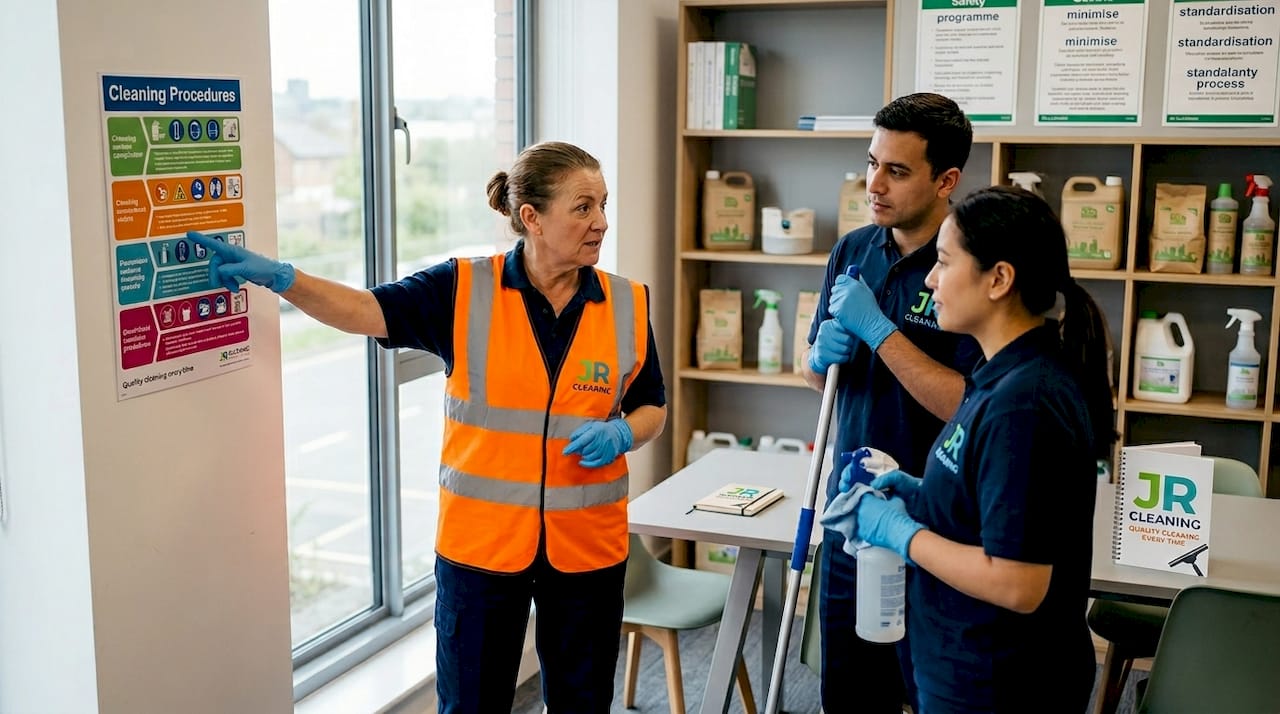
Training is the clearest indicator of whether a cleaning company will deliver consistent results over time. Structured onboarding paired with continuous education programmes, as recommended by the ISSA, reduces mistakes, prevents chemical misuse, and produces measurably better outcomes for clients.
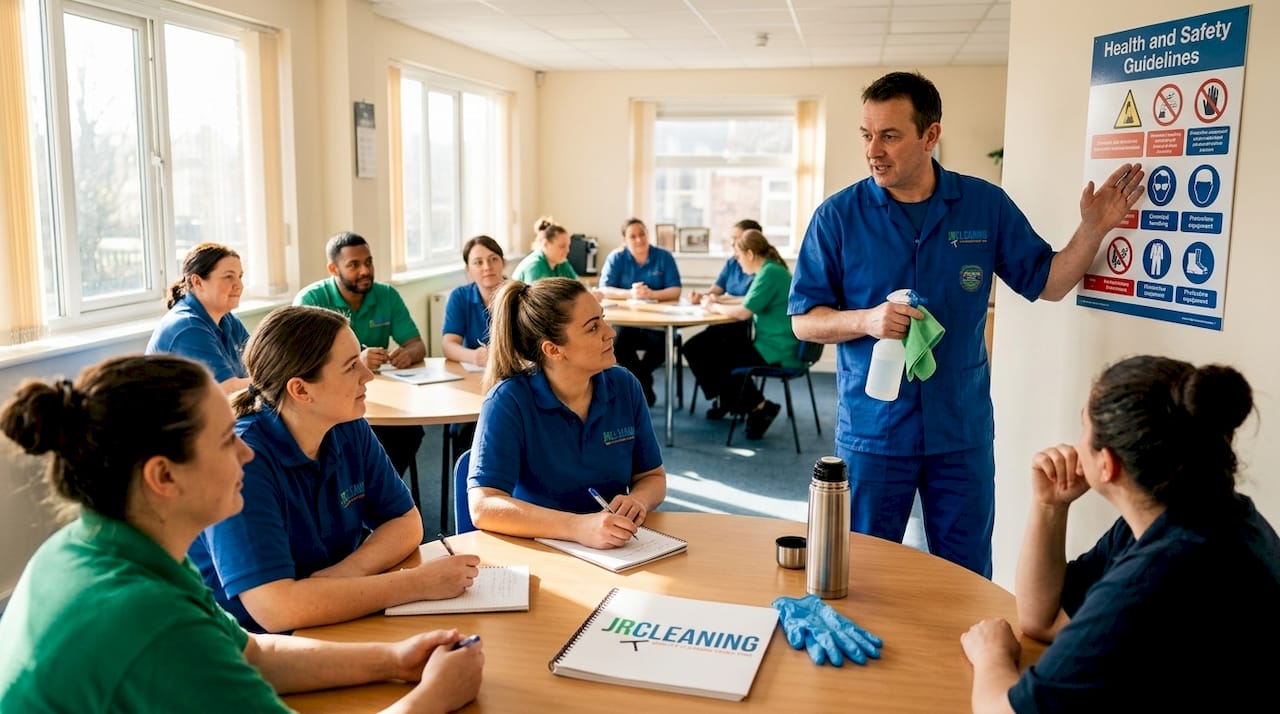
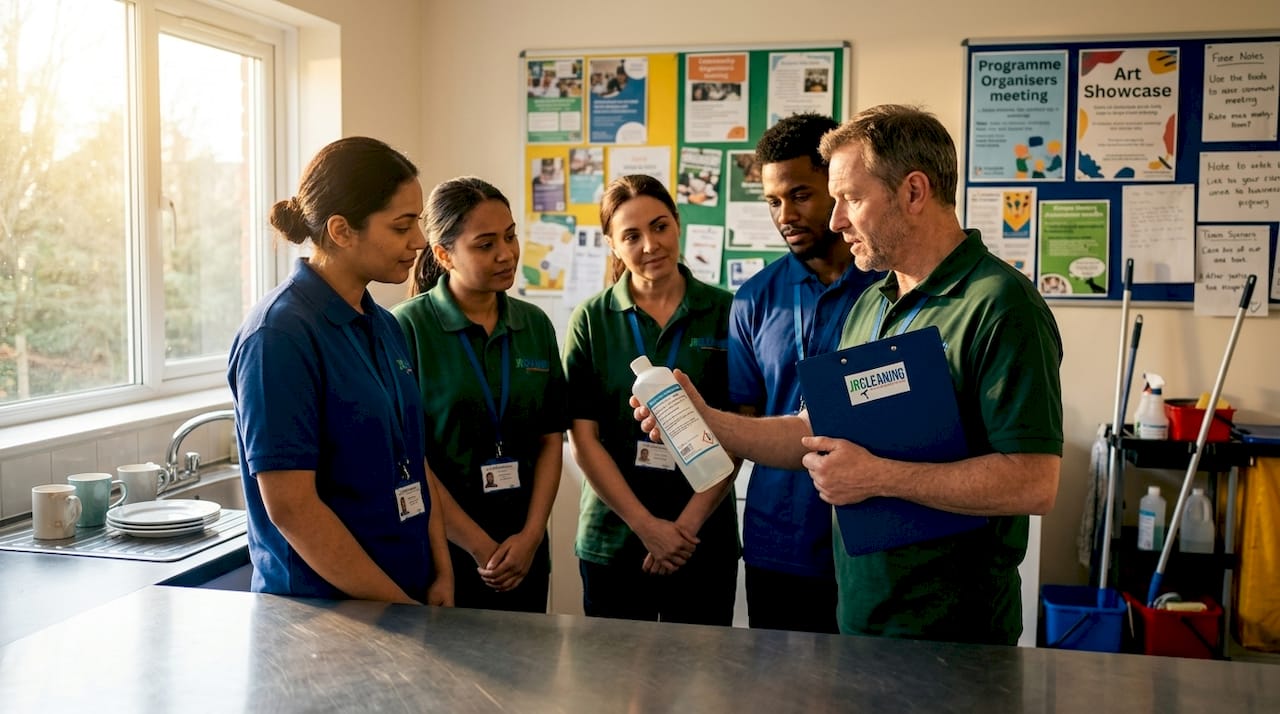
1780288604233 Cleaning staff attending a training session indoors - J R Cleaning

A company that invests in training is telling you something important: it takes quality seriously enough to spend money on it before a cleaner ever enters your property. One that relies on common sense and on-the-job learning is gambling with your floors, surfaces, and equipment.

When speaking to a potential cleaning company, ask these specific questions:

  • How are new staff members inducted before their first solo assignment?
  • Is there a mentorship or shadowing period for new hires?
  • How are cleaning products and chemical safety covered in training?
  • What happens when a client raises a quality complaint? Is there a review process?
  • Are staff trained differently for commercial versus residential environments?

The answers reveal a great deal. Vague responses like “we train everyone properly” without any specifics suggest the process is informal at best.

“Commercial cleaning quality depends more on the consistency of procedures and structured training programmes than individual cleaner talent alone.” — ISSA

This matters particularly for business leaders managing commercial premises. A single talented cleaner cannot guarantee the consistency your facility requires. Only a company with documented procedures and ongoing supervision can do that. Jrcleaning, for example, applies structured quality standards across both its residential and commercial operations, precisely because consistency cannot be left to chance.

How should you read reviews and references for cleaning services?
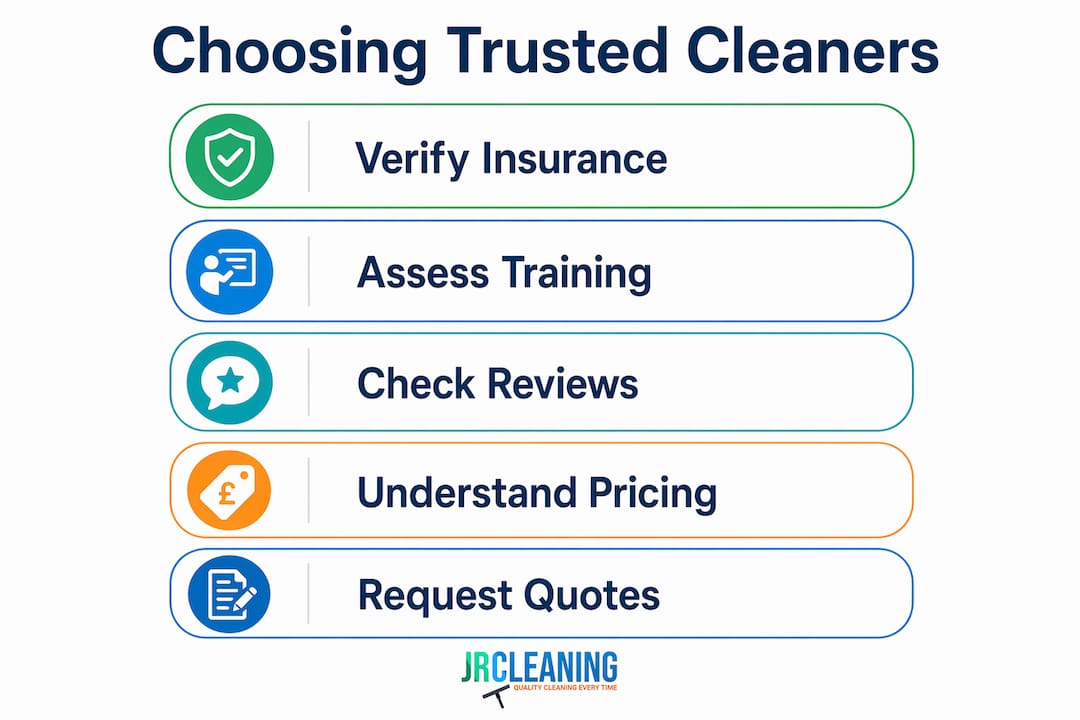
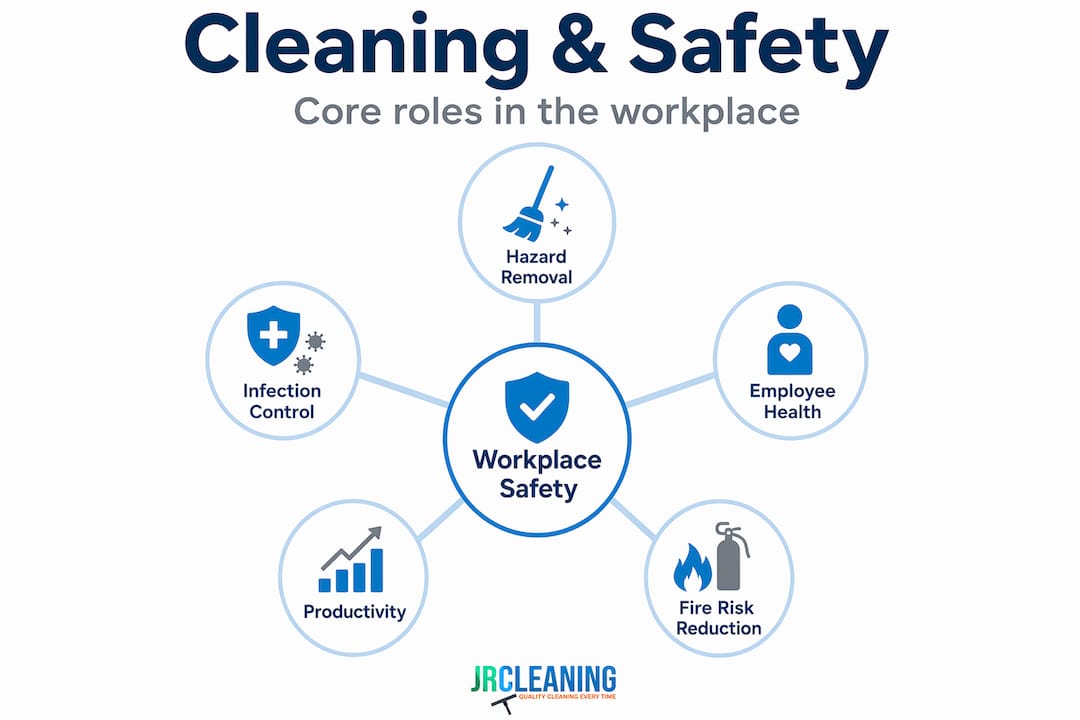
1780289239684 Infographic outlining steps to choose a trusted cleaning company - J R Cleaning

Star ratings alone are a poor guide to reliability. Review volume and recency give a far more accurate picture of how a company performs day to day. A company with 200 reviews averaging 4.3 stars is almost always a safer choice than one with 12 reviews averaging 5 stars.

Finding reliable cleaners through reviews requires a methodical approach rather than a quick glance at the overall score. Follow these steps when assessing any cleaning company’s reputation:

  1. Check Google and Yelp separately. Each platform attracts different reviewers, and discrepancies between them can flag inconsistency or selective reputation management.
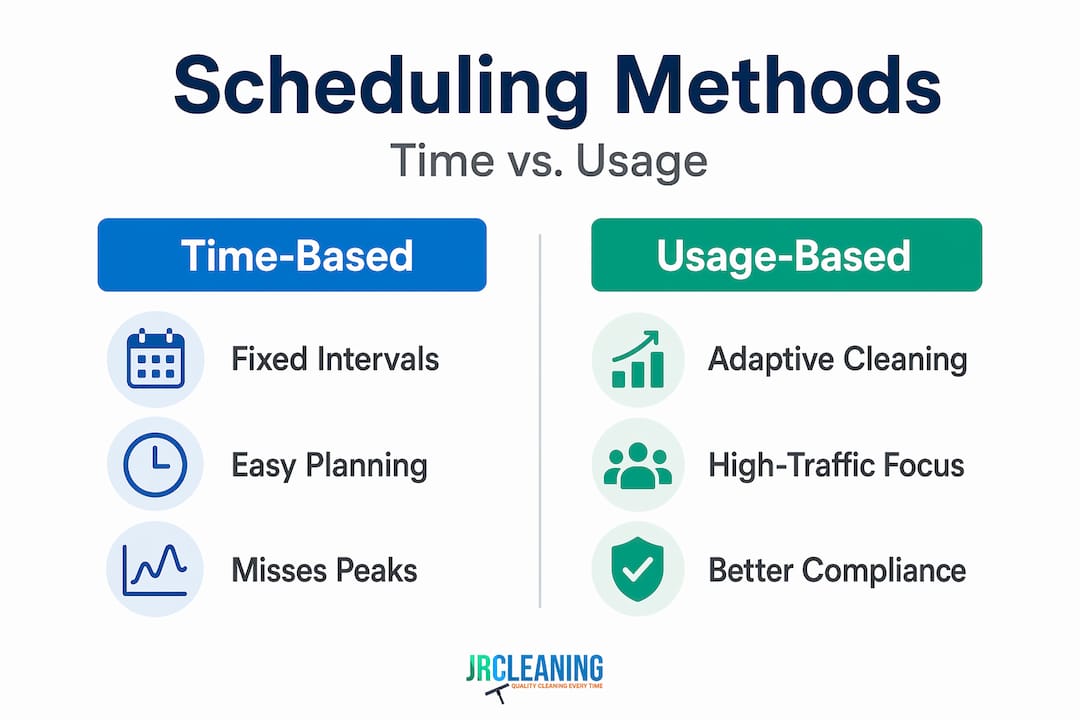
  2. Filter by most recent. Look at reviews from the past three months. A company that was excellent two years ago may have changed staff, management, or standards since then.
  3. Read the negative reviews carefully. How a company responds to criticism tells you more about its professionalism than five-star praise ever will.
  4. Look for patterns, not outliers. One complaint about a missed spot is noise. Five complaints about the same issue in six months is a signal.
  5. Ask for direct references. Personal referrals and community recommendations consistently outrank online reviews in trustworthiness. Ask neighbours, colleagues, or local business owners who they use and whether they would recommend them.
  6. Verify references by phone. Email references can be staged. A brief phone call with a genuine past client is far harder to fabricate.

Do not rely on a single review source. A company that looks flawless on its own website testimonials page but has mixed feedback on Google is showing you exactly where its priorities lie. You can find a useful starting list of questions to ask cleaners before you hire to help structure these conversations.

Comparing pricing models: what does good value actually look like?

Pricing in the professional cleaning sector follows two main formats: hourly rates and flat rates. Typical charges range from £20 to £35 per hour for standard residential cleaning, while flat rates for a full clean can run from £100 to £250 depending on property size, service type, and frequency. This range is wide enough that price alone tells you almost nothing about quality.

Pricing modelBest suited forKey consideration
Hourly rateFlexible or irregular cleansCosts can vary if scope expands
Flat rateRegular scheduled cleansClarity on cost but check inclusions
Frequency discountWeekly or fortnightly bookingsConfirm what changes between visits
Specialist service rateDeep cleans, commercial kitchensVerify what specialist equipment is included

A suspiciously low quote almost always signals one of three things: the company is uninsured, staff are undertrained, or the scope of work is far narrower than you expect. Lowest quotes frequently reflect corners being cut rather than genuine efficiency. The cost of a damaged surface, a missed deep clean, or an uninsured incident will exceed any saving you made on the initial rate.

When requesting quotes, ask for a written breakdown that specifies which rooms and tasks are included, which products are used, and what the cancellation or rescheduling policy is. Understanding why detailed quotes matter before you sign protects you from scope disputes later.

Pro Tip: If two companies quote significantly different prices for what appears to be the same job, ask both to walk you through exactly what their price includes. The differences in their answers will tell you far more than the numbers themselves.

Key takeaways

Choosing a cleaning company correctly requires verifying insurance and bonding, assessing staff training standards, reading reviews with volume and recency in mind, and comparing detailed quotes rather than headline prices.

PointDetails
Verify insurance and bondingRequest written proof before any work begins and treat missing documentation as a dealbreaker.
Assess staff trainingAsk about structured onboarding and ongoing education; vague answers signal informal processes.
Read reviews methodicallyPrioritise volume and recency on Google and Yelp over star ratings alone.
Get detailed written quotesA full breakdown of inclusions protects against scope disputes and reveals hidden cost differences.
Use personal referralsCommunity recommendations and direct reference calls remain more reliable than online reviews.

What I have learned from years of watching people choose the wrong cleaner

Most people get this wrong in the same way. They focus on price first and treat everything else as secondary. I understand the instinct. Cleaning feels like a commodity. One mop and bucket looks much like another. But the difference between a company with proper insurance, trained staff, and a documented quality process and one without those things is not visible until something goes wrong.

The single most reliable signal I have found is how a company responds to the question: “Can I speak to two recent clients?” A confident, well-run operation answers immediately with names and numbers. A company that hedges, delays, or offers written testimonials instead is telling you something important about how it handles scrutiny.

I have also noticed that people underestimate the value of consistency. An independent cleaner might do an exceptional job on their first visit. But independent cleaners bring variability that companies with structured procedures do not. For a one-off deep clean, that might be acceptable. For regular residential or commercial cleaning, consistency is worth paying a modest premium for.

The other thing worth saying plainly: the cheapest option rarely stays cheap. A missed clean, a damaged surface, or an uninsured incident quickly erases any saving. Pay slightly more for a company that can show you its credentials, explain its training process, and point you to satisfied clients. You will not regret it.

— jamie

Trusted residential and commercial cleaning from Jrcleaning
1774551979294 jrcleaning - J R Cleaning

Jrcleaning has delivered professional residential and commercial cleaning services across the UK for over 20 years. Every member of the Jrcleaning team works within a structured quality framework, and the company is fully insured to protect clients on every visit. Whether you need regular home cleaning, a one-off deep clean, or specialist commercial cleaning services, Jrcleaning provides transparent quotes with no hidden costs. Contact the team today for a free, no-obligation quote tailored to your property and schedule. Visit Jrcleaning to get started.

FAQ

What credentials should I check when hiring a cleaning company?

Confirm that the company holds valid public liability insurance and bonding, and ask whether staff undergo DBS background checks. Request written documentation for all three before agreeing to any work.

Is an independent cleaner better than a cleaning company?

Independent cleaners often cost less, but vetting responsibility falls entirely on you. Established companies handle insurance, background checks, and staff training, which reduces your risk considerably.

How do I know if a cleaning company’s reviews are reliable?

Look at review volume and recency on Google rather than star ratings alone. A high volume of recent reviews across multiple platforms gives a far more accurate reliability signal than a perfect score from a handful of responses.

What should a cleaning quote include?

A reliable quote specifies which rooms and tasks are covered, which products are used, the frequency and pricing structure, and the cancellation policy. Anything less leaves room for disputes.

How do I prepare once I have chosen a cleaning company?

Before the first visit, confirm the agreed scope in writing and walk through any specific requirements with the team. Jrcleaning’s guide on preparing for a cleaning service covers exactly what to do to get the best results from day one.
How to clean industrial floors: 2026 guide

Cleaning industrial floors is the process of using specialised machinery, appropriate chemical solutions, and systematic maintenance schedules to preserve safety, hygiene, and floor longevity in commercial and industrial facilities. Faulty floors contribute to 20% of industrial slip-and-trip fatalities, which means floor cleaning is a direct safety obligation, not a housekeeping afterthought. The right approach to how to clean industrial floors combines auto scrubbers, degreasers, and structured cleaning schedules to protect both your workforce and your floor investment. Jrcleaning has worked across UK industrial sites for over 20 years, and the guidance below reflects what actually works in practice.

What equipment is essential for industrial floor cleaning?

The two primary machines in any industrial cleaning programme are sweepers and scrubbers, and they serve entirely different purposes. Sweepers remove dry debris such as dust, grit, and loose particles before any wet cleaning begins. Scrubbers apply solution, agitate the surface, and recover dirty water in a single pass, making them the workhorse of any serious floor maintenance operation.

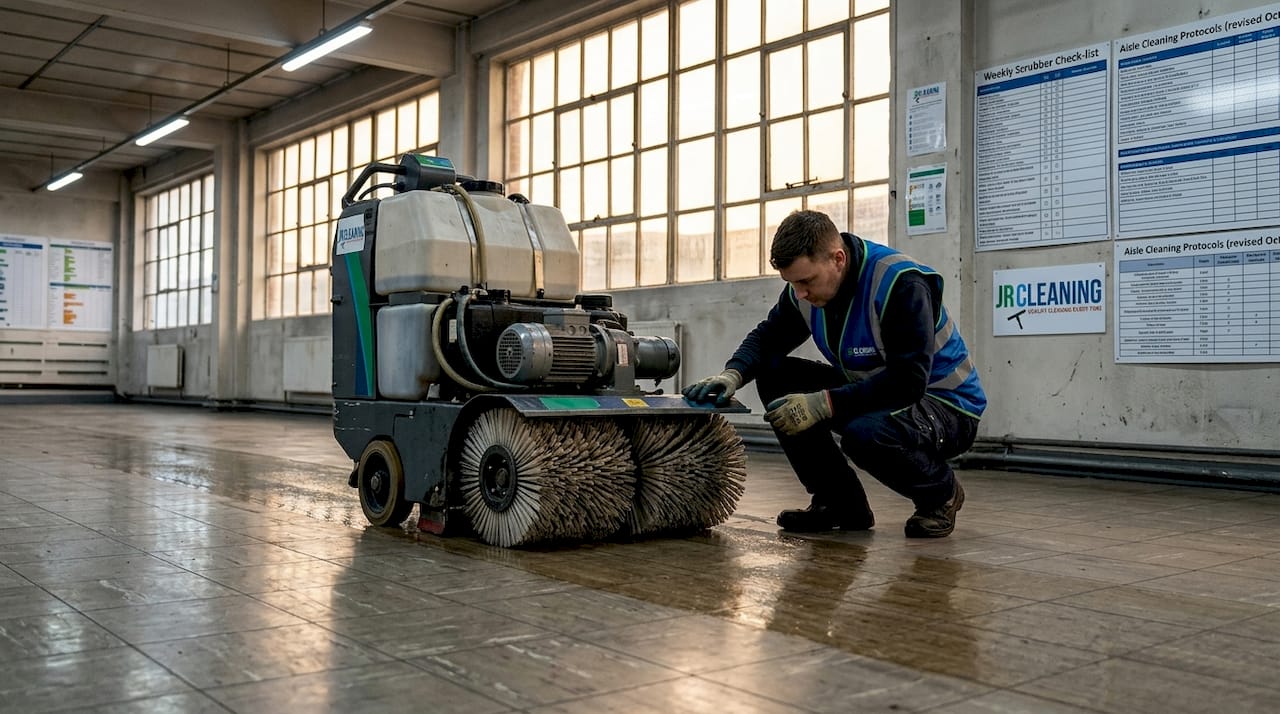
1780254350225 Operator inspecting industrial cylindrical scrubber - J R Cleaning

Sweepers vs scrubbers: choosing the right machine

Disc scrubbers work well on flat, smooth surfaces such as sealed concrete or vinyl. Cylindrical scrubbers are the better choice for uneven or grouted industrial floors because their rotating brushes penetrate crevices more effectively and many models include debris catch trays, reducing the need for a separate pre-sweep. This dual function makes cylindrical machines particularly efficient in warehouses and manufacturing facilities where floor surfaces are rarely perfectly level.

Automated scrubbers with recovery tanks improve safety by immediately removing moisture from the floor surface, cutting slip risk during the cleaning process itself. This matters in live production environments where you cannot always cordon off large areas for extended drying periods.

Maintaining your cleaning machinery

Equipment upkeep is not optional. Dirty squeegees and worn brushes cause cleaning inefficiency and can physically damage floor coatings, leaving streaks, scratches, or uneven residue. After every shift, rinse solution tanks, inspect squeegee blades for tears or warping, and check brush pressure settings. Proper brush pressure and pad selection are critical on polished concrete or coated surfaces, where incorrect settings cause irreversible surface damage.

Pro Tip: Set your scrubber’s brush pressure to the lowest effective setting when working on epoxy or urethane coatings. Increase pressure only on bare concrete or heavily soiled areas where the coating has already been stripped.

Machine typeBest surfaceKey advantage
Ride-on sweeperLarge open warehouse floorsFast dry debris removal across wide areas
Disc scrubberSmooth sealed concrete or vinylConsistent pressure on flat surfaces
Cylindrical scrubberGrouted, uneven, or textured floorsPenetrates crevices; reduces pre-sweep requirement
Walk-behind scrubberSmaller bays or congested areasManoeuvrable in tight spaces

Which cleaning solutions work best for different soil levels?

Chemical selection is where many facilities make costly errors. The correct product depends on the soil type, the floor coating, and the frequency of cleaning. Using a heavy-duty degreaser on a lightly soiled floor wastes product and risks coating damage. Using a light maintenance cleaner on heavy grease contamination leaves residue and creates slip hazards.

1780254859672 Infographic showing industrial floor cleaning schedule steps - J R Cleaning

Dilution ratios vary significantly by soil level: heavy-duty degreasing requires concentrations of 1:10 to 1:20, standard scrubber use sits at 1:32 to 1:64, light maintenance falls at 1:128 to 1:256, and minimal soiling calls for 1:512 to 1:1024. These are not interchangeable. Over-diluting a heavy-duty product leaves grease on the floor; under-diluting a maintenance cleaner leaves chemical residue that attracts more dirt.

Selecting the right product for your floor type

For epoxy and urethane concrete floors, the product choice is especially critical. Acidic cleaners such as vinegar and abrasive or soap-based products degrade the gloss and traction of epoxy surfaces over time. Use pH-neutral cleaners or products specifically formulated for coated concrete. Warm water with a diluted ammonia solution is a reliable option for routine epoxy maintenance when a specialist product is unavailable.

Rinsing is not optional after chemical application. Alkaline residue from insufficient rinsing causes wax or coating failure, leading to peeling, powdering, or a surface that will not hold a new coat. After stripping or deep cleaning, always apply a neutralising rinse before any wax or sealer goes down.

  • Heavy soil or grease: use a concentrated alkaline degreaser at 1:10 to 1:20
  • Standard maintenance: pH-neutral cleaner at 1:32 to 1:64 in your scrubber tank
  • Epoxy or coated floors: manufacturer-approved cleaner or diluted ammonia solution
  • Post-strip neutralising: apply a neutralising rinse before recoating or waxing
  • Avoid on epoxy: vinegar, bleach, soap-based cleaners, and abrasive powder products

A structured schedule is the single most effective tool for extending floor life and maintaining compliance. Without one, cleaning becomes reactive, and reactive cleaning always costs more in labour, materials, and floor repairs than a planned programme.

The recommended maintenance schedule follows a clear hierarchy: daily dust mopping or sweeping to remove loose debris, damp mopping or auto-scrubbing two to five times per week depending on traffic and soil level, and deep restoration or strip-and-wax cycles every three to six months. This framework applies to most industrial floor types and can be adjusted based on your facility’s specific conditions.

Step-by-step weekly cleaning procedure

  1. Sweep or dust mop the entire floor before any wet cleaning begins. Wet mopping over loose grit grinds particles into the surface and accelerates wear.
  2. Pre-treat heavily soiled zones such as loading bays, machinery areas, or entry points with a degreaser at the appropriate dilution. Allow a dwell time of three to five minutes.
  3. Run the auto scrubber across the full floor area, working in overlapping passes to avoid missed strips. Use the correct brush type and pressure for your floor coating.
  4. Inspect the recovery tank after each pass in heavily soiled areas. A full tank recirculates dirty water onto a clean floor.
  5. Dry the floor thoroughly using air movers or industrial fans, particularly in areas with epoxy or urethane coatings. Rushing the drying phase creates slip hazards and shortens coating life.
  6. Maintain entryway matting as part of the routine. Mats at entry points reduce the volume of dirt tracked onto the main floor by a significant margin, cutting cleaning frequency and chemical use.

Pro Tip: Schedule deep cleaning cycles to coincide with planned production shutdowns or low-traffic periods. Attempting a strip-and-wax during normal operations creates extended wet floor hazards and rarely produces a quality result.

Using maintenance scheduling software to log cleaning tasks, track chemical usage, and flag overdue deep cleans helps facility managers maintain consistency across shifts and sites.

How to clean epoxy and urethane concrete floors safely

Epoxy and urethane concrete floors require a more careful approach than bare concrete because the coating itself is the asset you are protecting. Scratching, delaminating, or chemically degrading the coating means a costly reapplication, not just a cosmetic issue.

Begin every clean with a thorough sweep using a soft-bristle broom or microfibre dust mop. Never skip this step on coated floors. Grit left on the surface acts as an abrasive under the scrubber pad and produces fine scratches that dull the finish permanently. For wet cleaning, apply a warm water solution with a pH-neutral or ammonia-based cleaner, allow a short dwell time of two to three minutes, then scrub with a soft pad or brush. Rinse thoroughly and dry completely.

Seamless urethane concrete floors with integrated sani-cove bases eliminate the wall-to-floor joint where moisture and bacteria accumulate. In food and beverage facilities, this design detail reduces contamination risk and simplifies the cleaning process considerably.

Additional protective measures for coated floors include placing rubber or nylon feet on heavy equipment, avoiding dragging metal objects across the surface, and never using solvent-based cleaners that soften or lift the coating. For industrial floor coating cleaning, the principle is straightforward: the gentler the method, the longer the coating lasts.

What mistakes do facility managers make with floor cleaning?

The most damaging errors in industrial floor maintenance are not dramatic failures. They are small, repeated oversights that compound over months until the floor requires expensive restoration.

  • Skipping equipment maintenance: a scrubber with a torn squeegee blade leaves a wet trail down the centre of every pass, creating a slip hazard and negating the entire cleaning effort
  • Incorrect dilution ratios: over-concentrated chemicals leave sticky residue that attracts dirt; under-concentrated solutions fail to lift grease and give a false impression of a clean floor
  • Rushing drying time: many facility managers overlook the drying phase, yet wet floors after cleaning are a leading cause of post-cleaning slip incidents
  • Wrong pad or brush for the surface: stiff nylon pads on epoxy produce micro-scratches that accumulate into visible dullness within weeks
  • Neglecting perimeter areas and grout joints: debris and bacteria accumulate fastest at wall edges and in grout lines, yet these zones are consistently missed by auto scrubbers that cannot reach the perimeter

Pro Tip: Walk the floor after every scrubbing cycle and check the perimeter with a torch at a low angle. Residue and missed zones are far easier to spot in raking light than under standard overhead lighting.

Key takeaways

Effective industrial floor maintenance requires the right machinery, correctly diluted chemicals, and a structured schedule applied consistently across every shift and zone.

PointDetails
Match machine to surfaceUse cylindrical scrubbers on grouted or uneven floors; disc scrubbers on smooth sealed surfaces.
Dilute chemicals correctlyHeavy soiling needs 1:10 to 1:20 concentration; light maintenance requires 1:512 to 1:1024.
Follow a structured scheduleDaily sweeping, two to five weekly scrubs, and deep restoration every three to six months.
Protect coated floorsAvoid acidic or abrasive cleaners on epoxy; always rinse thoroughly to prevent coating failure.
Never rush dryingUse air movers after wet cleaning to prevent slip hazards and protect coating adhesion.

Why I think most facilities underinvest in the drying phase

After two decades working across UK industrial sites, the single most consistent gap I see is not the cleaning itself. It is what happens in the fifteen minutes after the scrubber finishes. Facilities invest in quality machines and the right chemicals, then leave the floor to air dry in a poorly ventilated warehouse and wonder why they have slip incidents and coating failures within a year.

The drying phase is where the cleaning process either pays off or unravels. A floor that is scrubbed correctly but dried poorly is more dangerous than one that was not cleaned at all, because it looks clean while remaining wet. Air movers are not expensive relative to the cost of a slip claim or a floor recoat.

I have also seen facilities where the cleaning programme is technically sound but the results are inconsistent because staff are not trained to check their equipment before each shift. A scrubber with a worn brush and a cracked squeegee is not a cleaning machine. It is a machine that spreads dirty water across a floor and leaves a maintenance record that says the floor was cleaned. Training staff to inspect equipment takes twenty minutes. Failing to do so costs far more.

The industry is moving towards automated scrubbers with onboard sensors and antimicrobial floor coatings that reduce bacterial load between cleans. Both are worth evaluating for high-traffic or regulated environments. But no technology replaces a well-trained operative following a documented procedure. The industrial site cleaning process that produces consistent results is always the one that is written down, monitored, and reviewed.

— jamie

Professional support for industrial floor maintenance

Managing industrial floor cleaning in-house requires the right machinery, trained staff, and a consistent programme. When any of those elements are missing, floors deteriorate faster and liability exposure increases.

1774551979294 jrcleaning - J R Cleaning

Jrcleaning provides commercial and industrial cleaning services across the UK, backed by over 20 years of experience and full compliance with health and safety regulations. Our teams use professional-grade auto scrubbers, appropriate chemical solutions for each floor type, and structured cleaning schedules tailored to your facility’s traffic and soil levels. Whether you need a one-off deep restoration or an ongoing maintenance contract, Jrcleaning removes the operational burden and delivers floors that are clean, safe, and compliant. Contact us for a free quote or visit our full services page to see the complete range of cleaning solutions available.

FAQ

How often should industrial floors be cleaned?

Daily dust mopping, two to five weekly scrubs, and a deep restoration every three to six months is the standard schedule for most industrial facilities. High-traffic or food-production environments may require more frequent wet cleaning.

What cleaning solution is safe for epoxy floor coatings?

pH-neutral cleaners or diluted ammonia solutions are safe for epoxy floors. Avoid vinegar, bleach, and soap-based products, as these degrade the coating’s gloss and traction over time.

What is the difference between a disc and cylindrical scrubber?

Disc scrubbers suit flat, smooth surfaces, while cylindrical scrubbers penetrate grouted or uneven floors more effectively and often combine sweeping and scrubbing in a single pass.

Why do industrial floors become slippery after cleaning?

Slippery floors after cleaning are usually caused by chemical residue from incorrect dilution or insufficient rinsing, or by a floor that has not been dried properly. Using air movers and rinsing thoroughly after chemical application resolves both issues.

How do I prevent floor coating damage during cleaning?

Use the correct brush pressure setting on your scrubber, avoid abrasive pads on coated surfaces, and always neutralise the floor after stripping before applying any new wax or sealer. Alkaline residue causes coating failure if left on the surface before recoating.

Facility maintenance tips for managers and owners

Facility maintenance tips are systematic practices that keep buildings, equipment, and critical systems operating safely, efficiently, and within regulatory compliance. Known formally as planned preventive maintenance (PPM) in the UK facilities management sector, these strategies cover everything from HVAC filter checks to fire safety inspections and seasonal exterior upkeep. Whether you manage a commercial site, run a business from a dedicated premises, or own a residential property, a structured approach to upkeep prevents costly reactive repairs, protects asset value, and keeps occupants safe. Tools like CMMS software, standards from NFPA and ASHRAE, and documented checklists form the backbone of any credible programme.

1. Build a preventive maintenance programme first

A documented PM schedule with task-specific checklists is the single most important foundation for consistent, auditable facility upkeep. Without it, maintenance becomes reactive, expensive, and impossible to audit. The programme should cover frequency tiers: daily walkthroughs, weekly system checks, monthly inspections, quarterly servicing, and annual full assessments.

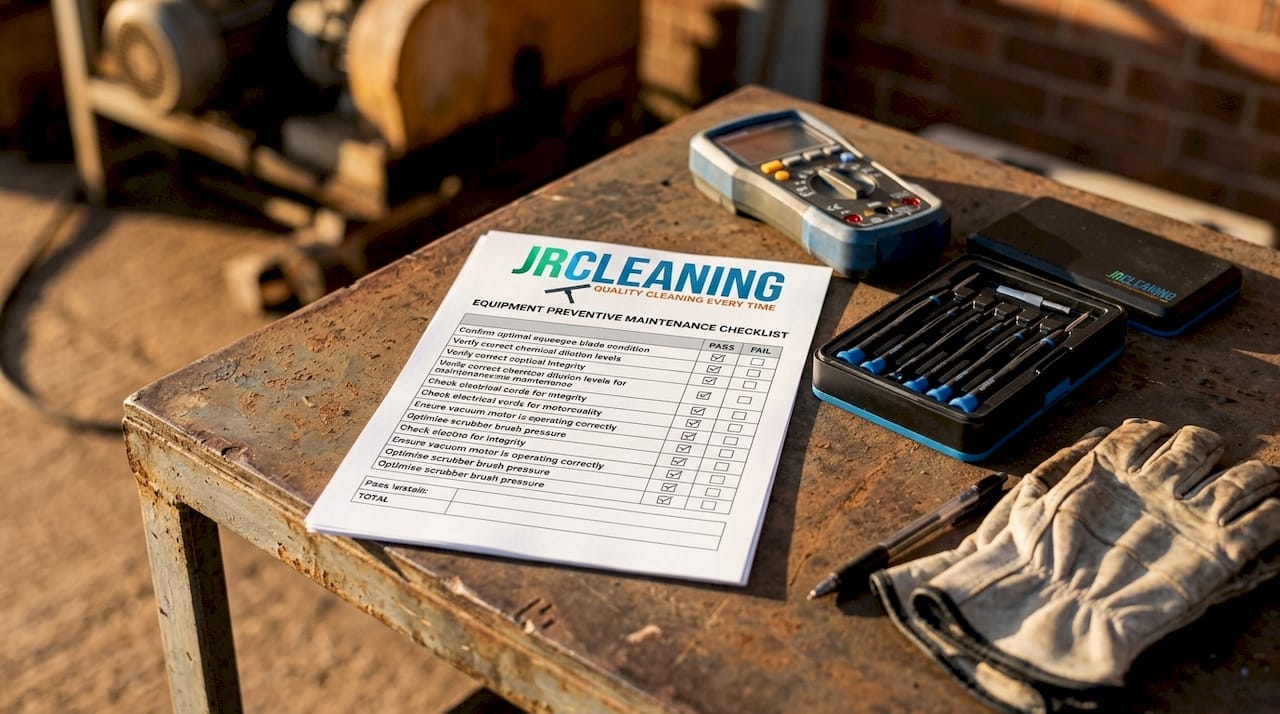
Each checklist must go beyond a simple tick-box. Specify the exact inspection steps, the tools required, pass/fail criteria, and who is accountable. Link every task to a specific asset ID in your inventory so nothing falls through the gaps. Common maintenance failures include treating checklists as the end goal rather than the means, and failing to connect tasks to individual assets, which leads to missed or incorrect work.

1780361512903 Maintenance checklist and inspection tools on table - J R Cleaning

Assign a named owner and a backup for every critical task. If one person is absent, the work still gets done. Review your schedule quarterly and adjust based on actual failure history, not assumptions.

Pro Tip: Start with your five most critical assets, build detailed checklists for those first, then expand. A focused programme you actually follow beats a comprehensive one you ignore.

2. Maintain HVAC systems with condition-based triggers

HVAC is the highest-energy system in most facilities, and poor maintenance directly raises running costs and degrades indoor air quality. ASHRAE 180 recommends monthly inspections with filter replacement triggered by measured pressure differentials rather than fixed calendar dates. This condition-based approach protects system components and air quality far more reliably than swapping filters on a set schedule regardless of actual loading.

Beyond filters, coil cleaning is frequently neglected. Dirty evaporator and condenser coils reduce heat transfer efficiency and force the system to work harder, shortening its lifespan. Airflow checks across supply and return registers identify blockages or duct leaks before they become expensive faults.

For commercial facilities, energy management frameworks such as ISO 50001 integrate HVAC maintenance with systematic energy planning and performance measurement, reducing operational costs over time. Even for smaller sites, tracking energy consumption alongside maintenance activity reveals patterns that justify investment in upgrades.

3. Follow NFPA schedules for fire safety systems

Fire safety compliance is non-negotiable, and the consequences of missed inspections extend well beyond fines. NFPA 25 mandates tiered schedules for fire sprinkler systems: monthly gauge checks, quarterly flow alarm tests, annual full inspections, and five-year internal pipe inspections. Each tier must be completed independently. Skipping one because another is due soon creates compliance gaps and genuine safety risk.

Fire alarm systems, extinguishers, and suppression systems each carry their own inspection frequencies under NFPA codes. Multi-component life-safety compliance requires tracking sprinkler heads, valves, gauges, and detection devices separately, with clear documentation for every test. A single missed record can fail an audit even when the physical work was completed.

Use licensed contractors for annual and five-year inspections. In-house staff can handle weekly visual checks and monthly gauge readings, but statutory tests require qualified third parties and formal sign-off.

Pro Tip: Keep a dedicated fire safety compliance folder, physical or digital, with every test record, contractor certificate, and corrective action note. Auditors look for the paper trail first.

4. Protect electrical and emergency power systems

Electrical systems are the most frequently overlooked area in routine building maintenance advice, yet failures here cause the most disruptive and costly downtime. Weekly visual inspections of distribution boards, cable runs, and emergency lighting units catch early signs of overheating, moisture ingress, or physical damage before they escalate.

Emergency generators require particular attention. Generator failures are most commonly linked to missed routine checks rather than catastrophic component failure. A proper generator PM programme includes weekly inspections, regular load testing, oil and filter changes on schedule, and keeping the unit clean and free of debris. A generator that has not been load-tested recently is not a reliable backup, regardless of how new it is.

UPS systems protecting servers, medical equipment, or security infrastructure need battery tests at least annually. Most batteries degrade silently and fail under load without warning. Testing under realistic conditions is the only way to confirm readiness.

5. Apply seasonal maintenance to reduce risk and cost

Seasonal facility maintenance aligned with specific risk windows targets the right hazards at the right time, improving resilience and reducing energy waste. Each season brings distinct priorities:

  • Winter: Lag exposed pipework, inspect boilers and heating systems before the cold sets in, and clear gutters of leaf debris to prevent ice damming and water ingress. Winter gutter maintenance is one of the most cost-effective seasonal tasks for UK properties.
  • Spring: Inspect roofing and flashings for freeze-thaw damage, check drainage systems after heavy rainfall, and service air conditioning units before summer demand peaks.
  • Summer: Focus on fire safety for exterior areas, inspect cooling systems under load, and address any vegetation encroaching on the building envelope.
  • Autumn: Prepare heating systems, inspect window seals and external cladding, and clear drainage before the wet season begins.

Seasonal checklists work best when they sit alongside, not instead of, your routine monthly and quarterly schedules. They address weather-driven risks; your standard programme covers everything else.

Pro Tip: Schedule your spring and autumn inspections at least four weeks before the season peaks. Contractors book up fast, and reactive repairs in peak periods cost significantly more.

6. Common mistakes that undermine your maintenance programme

Even well-intentioned facilities teams make errors that erode the value of their maintenance work. Recognising these patterns is the first step to correcting them.

  1. Relying solely on calendar-based schedules. Fixed dates ignore actual equipment condition. HVAC filters replaced on the first of every month regardless of pressure differential waste money when clean and fail to protect when heavily loaded.
  2. Ignoring manufacturer and regulatory standards. NFPA 25, ASHRAE 180, and equipment manufacturer guidelines exist for good reason. Substituting your own judgement for these standards creates both safety and liability exposure.
  3. Poor documentation and no follow-up on failures. A failed inspection that generates no corrective action is worse than no inspection at all. It creates a paper record of a known fault without resolution.
  4. Underusing technology. Paper-based maintenance systems produce PM compliance rates of 55 to 70 per cent. Digital CMMS platforms raise compliance by 20 to 35 percentage points, reaching 90 per cent or above within months. That gap represents real safety and cost exposure.
  5. No named accountability. Tasks without a named owner and backup get skipped when people are busy or absent. Accountability is structural, not motivational.
  6. Insufficient training. Technicians who do not understand what they are looking for cannot identify early failure signs. Checklists guide the process; training builds the judgement to act on what is found.

7. Measure maintenance performance with clear KPIs

A maintenance programme without measurement cannot improve. The primary leading indicator is PM compliance rate: the percentage of scheduled tasks completed on time. A target of 90 per cent or above is the recognised benchmark, and digital CMMS tools make tracking this straightforward through automated reporting and alerts.

Beyond compliance rate, track these metrics to build a complete picture:

MetricWhat it tells you
Mean time between failures (MTBF)How reliably assets perform between maintenance interventions
Corrective action close-out rateWhether failed inspections are being resolved, not just logged
Reactive vs. planned work ratioA high reactive ratio signals the PM programme is not preventing failures
Energy consumption per square metreWhether maintenance activity is translating into efficiency gains

Use failure trend data to adjust PM frequencies. If a specific pump consistently fails between quarterly services, move it to monthly. If a piece of equipment has had no issues in three years of monthly checks, quarterly may be sufficient. Combining regular inspections with preventive maintenance beats reactive fixes for sustained reliability, but the schedule must reflect real-world performance data, not initial assumptions.

Continuous training keeps the programme sharp. Standards update, equipment changes, and team knowledge must keep pace. A quarterly briefing on recent failures, near misses, and regulatory changes costs little and pays back significantly.

Key takeaways

Effective facility maintenance combines a documented preventive programme, condition-based system checks, and seasonal strategies to protect assets, maintain compliance, and reduce costs.

PointDetails
Preventive programme firstBuild a schedule with frequency tiers and asset-linked checklists before anything else.
Condition-based HVAC careReplace filters on pressure differential, not fixed dates, to protect performance and air quality.
Fire safety complianceFollow all NFPA 25 interval tiers independently and document every test with corrective actions.
Seasonal alignmentMatch maintenance tasks to seasonal risk windows to reduce reactive repairs and energy waste.
Measure PM complianceTarget 90 per cent or above using CMMS reporting; adjust schedules based on actual failure data.

What 20 years of maintenance work has taught me

The most consistent pattern I see across both residential and commercial sites is the gap between having a maintenance plan and actually trusting it. Facilities teams often build solid PM schedules, then override them the moment something more urgent appears. The schedule slips, compliance drops, and the first sign of trouble is a boiler failure in January or a failed fire inspection.

The uncomfortable truth about preventive maintenance for homeowners and facility managers alike is that the programme only works when it is treated as non-negotiable. The tasks that feel least urgent, checking a generator under load, inspecting a backflow preventer, clearing gutters before the first frost, are precisely the ones that prevent the most expensive failures.

Digital tools have genuinely changed what is achievable here. When I see teams move from paper checklists to a CMMS platform, the compliance rate improvement is almost immediate. Not because the work changes, but because nothing falls through the gaps. Automated reminders, linked asset records, and audit-ready reports remove the reliance on individual memory and goodwill.

My advice: stop treating your maintenance programme as a document and start treating it as infrastructure. It deserves the same investment of time and attention as the systems it protects. The facilities that perform best over a decade are not the ones with the newest equipment. They are the ones with the most consistent maintenance culture.

— jamie

Keep your facility in top condition with Jrcleaning

1774551979294 jrcleaning - J R Cleaning

Maintaining a facility goes beyond scheduled inspections. Cleaning is a core part of commercial facility upkeep, and neglected surfaces, drainage, and kitchen environments create compliance risks and accelerate asset deterioration. Jrcleaning has delivered professional residential and commercial cleaning services across the UK for over 20 years, fully insured and operating to strict health and safety standards.

From commercial kitchen cleaning that meets hygiene regulations to gutter clearing that protects your drainage and roofline through every season, Jrcleaning handles the specialist tasks that sit alongside your maintenance schedule. Contact the team for a free quote via phone, email, or WhatsApp.

FAQ

What is preventive maintenance in facility management?

Preventive maintenance (PM) is a planned programme of scheduled inspections, servicing, and repairs designed to prevent equipment failure before it occurs. It covers frequency tiers from daily checks to annual assessments, with documented checklists linked to specific assets.

How often should HVAC filters be replaced?

ASHRAE 180 recommends replacing HVAC filters based on measured pressure differential rather than fixed calendar dates. Monthly inspections allow you to assess actual filter loading and replace only when performance thresholds are reached.

What does NFPA 25 require for fire sprinkler systems?

NFPA 25 mandates weekly, monthly, quarterly, annual, and five-year inspection and testing cycles for different sprinkler system components. Each tier must be completed independently, with full documentation retained for audit purposes.

What is a good PM compliance rate to target?

A PM compliance rate of 90 per cent or above is the recognised benchmark for effective facility maintenance. Digital CMMS platforms consistently achieve this level, whereas paper-based systems typically produce compliance rates of 55 to 70 per cent.

How does seasonal maintenance differ from routine maintenance?

Seasonal maintenance targets weather-driven risks specific to each time of year, such as freeze-thaw damage in spring or drainage preparation in autumn. Routine maintenance covers ongoing system checks and servicing on fixed frequency cycles regardless of season.

What is routine cleaning? A practical home guide

Routine cleaning is defined as the regular removal of dirt, dust, and germs from household surfaces to maintain a hygienic and comfortable living environment. Most homeowners and renters treat it as the backbone of home hygiene, yet few have a clear picture of what it actually includes, how often tasks should happen, or how it differs from a deep clean. The CDC confirms that cleaning with soap and water removes most harmful viruses and bacteria from surfaces, making it sufficient for day-to-day disease prevention. Get the basics right, and you protect your health without spending your weekends scrubbing.

What does routine cleaning include?

Routine cleaning covers the recurring tasks that keep your home functional and hygienic between deeper periodic cleans. Think of it as maintenance rather than renovation. The industry term for this practice is regular domestic cleaning, and it sits at the foundation of any home hygiene programme.

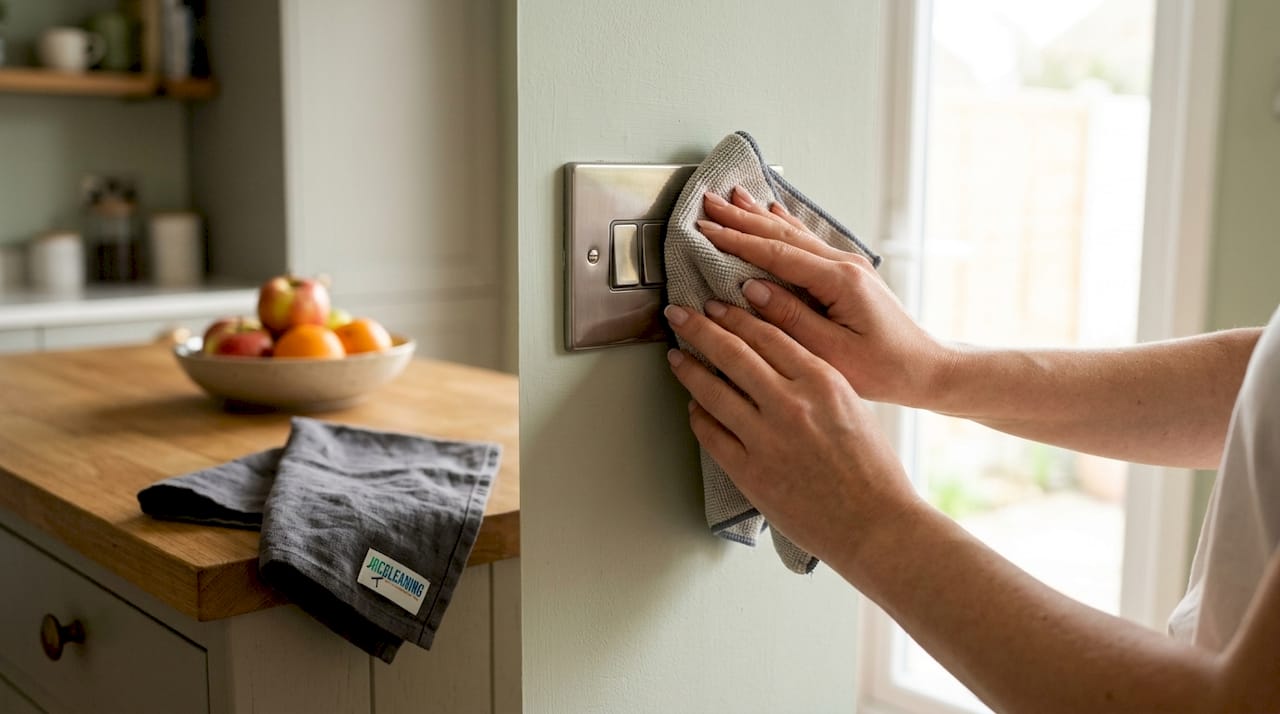
1780076055842 Hands cleaning living room light switch - J R Cleaning

Daily tasks that matter most

Daily tasks form the core of any routine cleaning checklist. These are the quick actions that stop small messes from becoming large problems.

  • Wipe kitchen counters and hob after cooking
  • Wash up or load the dishwasher
  • Sweep or spot-mop hard floors in the kitchen and hallway
  • Wipe the bathroom sink and tap handles
  • Empty bins that are full or odorous
  • Tidy clutter from living areas and surfaces

The CDC advises paying particular attention to high-touch surfaces such as doorknobs, light switches, and countertops, especially when household members are unwell or visitors have been present. These spots transfer germs far more frequently than walls or ceilings, so targeting them daily gives you the greatest return for your effort.

Weekly tasks that round out the routine

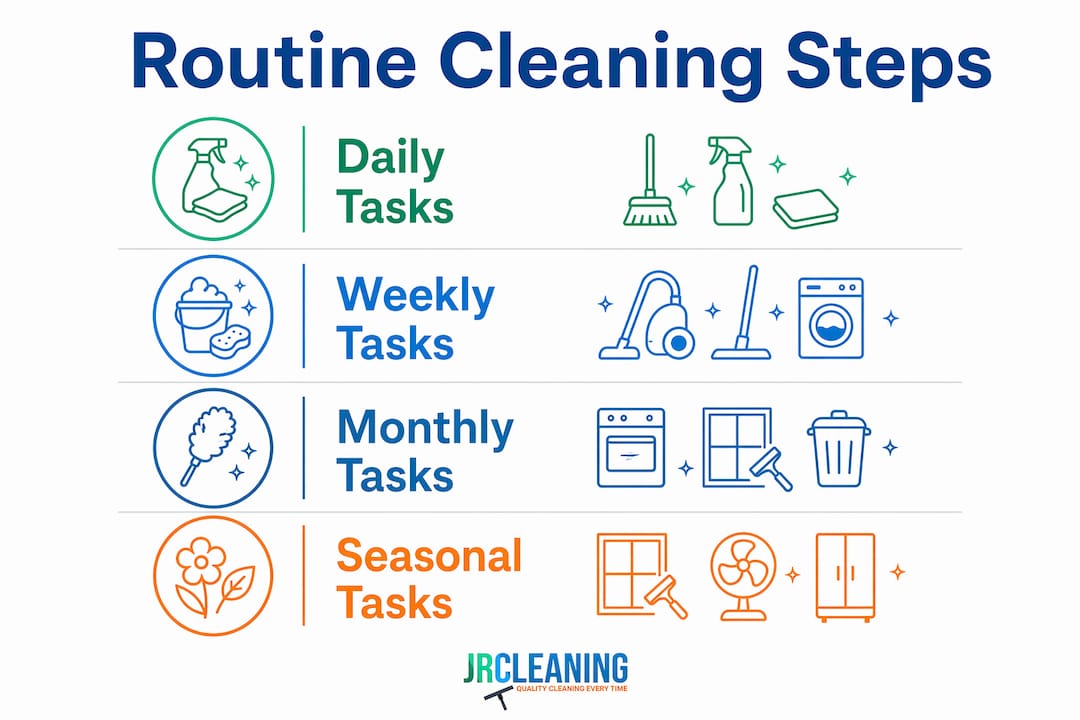
Weekly maintenance tasks build on daily resets and address areas that accumulate grime more slowly. A practical weekly routine blends daily upkeep with weekly targets such as dusting blinds, cleaning the refrigerator exterior, mopping all hard floors, and scrubbing the toilet and shower. Washing towels weekly is also recommended by cleaning experts to prevent bacterial build-up in damp fibres.

1780076718243 Infographic outlining routine cleaning schedule steps - J R Cleaning

Pro Tip: Keep a small caddy of cleaning supplies in each bathroom and under the kitchen sink. When supplies are already where you need them, you remove the mental barrier of fetching equipment, and tasks get done far more consistently.

How to build a routine cleaning schedule that sticks

A cleaning schedule works when it matches your actual life, not an idealised version of it. The goal is consistency, not perfection.

  1. Start with a daily reset. Identify the five to eight tasks that, if done every day, keep your home from descending into chaos. These typically include wiping surfaces, washing up, and a quick tidy of shared spaces. A 10-minute micro-reset focused on high-impact chores is enough on very busy days to maintain the baseline.

  2. Assign weekly tasks to specific days. Spreading tasks across the week prevents the dreaded “whole-house clean” on a Saturday morning. Monday might mean vacuuming, Wednesday the bathrooms, Friday the kitchen floor. This approach, recommended in the Full Circle with Jess cleaning system, separates daily resets from weekly maintenance and deep-clean rotations to manage workload sustainably.

  3. Build in a monthly rotation. Some tasks do not need weekly attention but cannot be ignored indefinitely. Cleaning inside the oven, washing windows, wiping skirting boards, and descaling the kettle all belong in a monthly or bi-monthly rotation. Slot one or two into your weekly plan each fortnight so they never pile up.

  4. Prepare your space before a scheduled clean. Decluttering surfaces before you wipe them saves significant time. Our guide on how to prepare for a cleaning service covers this in detail and applies equally to your own routine.

  5. Review and adjust every month. A schedule that worked in summer may not suit winter. Reassess what is and is not getting done, and shift tasks accordingly.

Pro Tip: Set a recurring phone reminder for your weekly cleaning day. Treating it like a meeting you cannot cancel is the single most effective way to maintain a consistent routine over months rather than weeks.

How does routine cleaning differ from deep cleaning?

Understanding the distinction between routine cleaning, deep cleaning, and sanitising helps you allocate your time and effort correctly.

Routine cleaning removes visible dirt and most germs using soap, water, and physical scrubbing. It is the first and most frequent layer of home hygiene. Deep cleaning targets accumulated grime in less accessible areas, such as behind appliances, inside cupboards, grout lines, and extractor fan filters. It is triggered when routine cleaning alone can no longer maintain hygiene, typically every three to six months. Sanitising reduces germ counts further using chemical agents, but it is only effective after surfaces have been physically cleaned of dirt first.

TypeFrequencyWhat it targetsTools typically used
Routine cleaningDaily and weeklyVisible dirt, dust, and surface germsSoap, water, cloths, vacuum
Deep cleaningEvery 3 to 6 monthsAccumulated grime, hidden areasDegreasers, steam cleaners, specialist brushes
SanitisingAs neededResidual germs after cleaningDisinfectant sprays, antibacterial solutions

The practical takeaway is that deep cleaning complements rather than replaces regular maintenance. Homes that are routinely cleaned need far less effort when a deep clean eventually comes around. Homes that skip routine cleaning and rely on periodic deep cleans tend to accumulate grime faster and require significantly more time and product to restore.

Practical tips and tools to make routine cleaning easier

The right tools and habits reduce the time and effort routine cleaning demands. This is where many people give up on their schedules, so removing friction here pays dividends.

  • Use a robotic vacuum. Models such as the Roomba or Eufy range handle daily floor maintenance automatically. Robotic vacuums and ergonomic tools like extended shower scrubbers save meaningful time and reduce the physical effort of routine cleaning, making it far easier to sustain as a habit.
  • Stock supplies in multiple locations. Placing a spray bottle, cloth, and toilet brush in each bathroom means you can clean a sink or toilet in under two minutes without fetching anything. This single change, highlighted in Southern Living’s 2026 guide, is one of the most effective ways to increase routine adherence.
  • Address pet areas daily. Pet beds, feeding mats, and litter trays accumulate bacteria and odour quickly. Wiping feeding areas and spot-cleaning pet beds daily prevents smells from embedding into flooring and soft furnishings.
  • Manage laundry hygiene as part of your routine. Washing towels and bed linen weekly, as experts recommend, reduces allergen levels and keeps fabrics fresh. Leaving damp towels folded for days creates conditions for mould growth.
  • Use a printed or digital checklist. A visible routine cleaning checklist removes the cognitive load of deciding what to clean. Apps such as Tody or OurHome let you track tasks and set reminders across a household.

Pro Tip: If motivation is the barrier, try the “one-room rule.” Commit to cleaning just one room fully before stopping. Most people continue once they have started, and even if they do not, one clean room is better than none.

For a deeper look at the interior cleaning essentials that make daily habits easier to maintain, Jrcleaning has put together a practical guide covering the tools worth investing in.

Key takeaways

Routine cleaning is the most effective daily and weekly practice for maintaining a healthy, comfortable home, and it works best when tasks are organised by frequency and supported by the right tools.

PointDetails
Definition is specificRoutine cleaning removes visible dirt and surface germs using soap, water, and physical scrubbing.
Prioritise high-touch surfacesDoorknobs, light switches, and tap handles transfer germs most frequently and deserve daily attention.
Schedule by frequencySeparate daily resets, weekly maintenance, and monthly rotations to prevent burnout and missed tasks.
Routine and deep cleaning are differentDeep cleaning addresses accumulated grime every few months and complements rather than replaces regular upkeep.
Tools reduce frictionRobotic vacuums and strategically placed supplies make it far easier to maintain a consistent cleaning habit.

Why I think most people overcomplicate this

People tend to treat routine cleaning as something that requires a full Saturday afternoon and a complete overhaul of the house. That framing is what causes most cleaning routines to collapse within a fortnight.

What I have observed, both personally and through years of working alongside professional cleaners at Jrcleaning, is that the homes that stay cleanest are not cleaned the most thoroughly. They are cleaned the most consistently. A five-minute wipe of the kitchen after dinner every night does more for long-term hygiene than a two-hour deep scrub once a month. The mental wellbeing benefits of a consistently clean home are real too. Clutter and visible dirt create low-level background stress that most people do not notice until it is gone.

The other thing worth saying plainly: your routine does not need to look like anyone else’s. A single person in a flat has different needs to a family of four with pets. The right routine is the one you will actually do. Start smaller than you think you need to, build the habit, and add tasks once the basics feel automatic. That is how sustainable cleaning routines are built. For those who want to understand the broader picture of domestic cleaning methods before building their own system, that resource is worth reading first.

— jamie

When professional cleaning makes sense for your home

Even the most disciplined home cleaner benefits from professional support at certain points in the year.

1774551979294 jrcleaning - J R Cleaning

Jrcleaning offers residential cleaning services across the UK, covering both routine maintenance cleans and thorough deep cleans for when life gets in the way of your schedule. With over 20 years of experience and full insurance, the team works to the same high-touch surface priorities the CDC recommends, using professional-grade equipment that goes further than standard household tools. Whether you need a one-off refresh before guests arrive or a regular scheduled clean to complement your own efforts, Jrcleaning makes it straightforward. Visit the Jrcleaning services page to explore options and request a free quote.

FAQ

What is routine cleaning in a home?

Routine cleaning is the regular practice of removing dirt, dust, and surface germs from a home using soap, water, and physical scrubbing. It covers daily tasks like wiping counters and weekly tasks like vacuuming floors and cleaning bathrooms.

How often should routine cleaning tasks be done?

Daily tasks such as wiping kitchen surfaces and washing up should happen every day, while weekly tasks like mopping floors, cleaning toilets, and washing towels are recommended by experts to maintain hygiene and reduce allergens.

What is the difference between routine cleaning and deep cleaning?

Routine cleaning maintains day-to-day hygiene on visible surfaces, while deep cleaning targets accumulated grime in hard-to-reach areas such as behind appliances and inside cupboards. Deep cleaning is typically needed every three to six months.

Does routine cleaning prevent illness?

The CDC states that cleaning with soap and water removes most harmful viruses and bacteria from surfaces, making it sufficient to prevent the spread of most common illnesses in a home setting without the need for daily disinfection.

What should a routine cleaning checklist include?

A practical checklist covers kitchen surfaces, hob, and sink daily; bathrooms, floors, and high-touch surfaces weekly; and tasks like oven cleaning and window washing on a monthly or bi-monthly rotation.

Why commercial cleaning compliance matters in 2026

Cleaning a workplace looks straightforward until a regulator walks through the door. Many businesses assume that if surfaces look clean, they are compliant. They are not. Why commercial cleaning compliance matters goes far beyond appearances: it determines whether your chemical handling is legally defensible, your staff are adequately protected, and your business survives an audit without a six-figure penalty. This guide covers the current regulatory frameworks, the health and safety links that most compliance guides skip over, and the practical steps you need to build a system that actually holds up under scrutiny.

Key takeaways

PointDetails
Compliance is not just cleanlinessMeeting regulatory standards requires documented training, correct product use, and up-to-date records.
Documentation gaps trigger enforcementMost fines result from missing or outdated paperwork, not visible accidents or health incidents.
Chemical management is regulatedSafety Data Sheets, hazard labels, and staff training must be kept current with each product change.
Non-compliance carries serious costsOSHA penalties for hazard communication violations can reach $16,131 per violation in 2026.
A compliant contractor supports your auditProfessional cleaning firms should provide cleaning logs and training records as part of their service.

Why commercial cleaning compliance matters

The phrase “cleaning compliance” is widely used in commercial settings, but the recognised regulatory term is occupational health and safety compliance within cleaning operations. Understanding that distinction matters because it signals what regulators actually inspect: not whether floors are shiny, but whether you have a written hazard communication programme, whether your staff have been trained on every chemical they handle, and whether your records match your current operations.

1779986690791 Cleaning supervisor training staff on compliance procedures - J R Cleaning

In the UK, commercial cleaning falls under the Health and Safety at Work Act 1974, the Control of Substances Hazardous to Health (COSHH) Regulations, and sector-specific guidance from the Health and Safety Executive (HSE). In workplaces with US regulatory exposure or multinational operations, OSHA HazCom compliance deadlines for the updated Hazard Communication Standard run to May and November 2026, giving UK-facing multinationals a live compliance obligation right now.

The critical difference between commercial and residential cleaning obligations is accountability. A residential cleaner who mixes the wrong chemicals risks harming themselves. A commercial cleaning contractor who does the same risks harming dozens of employees, triggering an enforcement investigation, and exposing both the contractor and the client business to regulatory penalties.

Here is a summary of the key regulatory frameworks you need to know:

FrameworkJurisdictionWhat it governs
COSHH Regulations 2002UKHazardous substance assessment, exposure control, training
Health and Safety at Work Act 1974UKEmployer duty of care across all workplace activities
OSHA HazCom Standard (1910.1200)US/multinationalHazard communication, SDS, labelling for chemicals
EPA FIFRAUS/multinationalDisinfectant registration, efficacy claims, label legality
HSE cleaning guidanceUKSector-specific cleaning standards and inspection expectations

Key obligations across most commercial environments include:

  • Maintaining a written hazard communication programme that reflects current chemicals in use
  • Providing workers with access to current Safety Data Sheets (SDS) for every product
  • Ensuring all chemical labels are legible and compliant with current GHS standards
  • Documenting employee training at initial assignment and whenever new hazards are introduced
  • Selecting only registered disinfectants whose label claims match the pathogens and surfaces in your environment

Compliance and health and safety outcomes

The link between cleaning compliance and workplace safety is not abstract. It is causal. When cleaning staff handle chemical products without documented training on contact times, dilution ratios, or incompatible surfaces, accidents follow. Skin burns, respiratory incidents, and cross-contamination events are the most common outcomes, and all of them are preventable through a functioning compliance programme.

Infection control is where the gap between looking clean and being compliant becomes most visible. Using disinfectants inconsistently with label instructions undermines compliance regardless of whether the product carries EPA registration. A disinfectant that requires a four-minute contact time on a surface achieves nothing if staff wipe it off in thirty seconds. The label is a legal document, and deviation from it is a compliance failure, full stop.

Pro Tip: Print and laminate the required contact times for each disinfectant product used in your facility and post them at the point of use. This one step closes one of the most common audit gaps without any additional cost.

There is also a fire safety dimension that most cleaning guides overlook entirely. Stored cleaning chemicals that are incorrectly labelled or segregated can create fire risks and complicate emergency response. Clean, well-organised chemical storage areas aligned with COSHH guidance directly reduce these risks.

Common hazards that a compliant cleaning programme actively controls include:

  • Chemical exposure through skin contact, inhalation, or accidental ingestion
  • Slip and fall risks from incorrectly diluted floor cleaning products
  • Cross-contamination between food preparation areas and non-food surfaces
  • Respiratory sensitisation from cleaning aerosols used in inadequately ventilated spaces
  • Fire hazards from incompatible chemical storage

Operational benefits and risk management

Beyond health outcomes, the importance of cleaning compliance translates directly into business performance. The most underappreciated risk is what regulators call permit drift: operational changes that outpace documentation updates, leaving businesses exposed not because of an accident but because their records no longer reflect reality. One US enforcement case resulted in a $781,175 Clean Air Act fine triggered precisely by this kind of documentation mismatch.

The operational case for maintaining cleaning standards for businesses builds across four areas:

  1. Audit readiness. Inspectors from the HSE or environmental agencies do not give advance notice. A business with current SDS files, signed training records, and accurate cleaning logs survives an unannounced visit. A business with a folder of outdated paperwork does not.

  2. Insurance validity. Many commercial insurance policies require evidence of health and safety compliance as a condition of cover. A liability claim arising from a cleaning-related incident in a non-compliant workplace can result in a rejected claim, leaving the business to absorb the full cost.

  3. Reduced liability exposure. OSHA HazCom violations carry serious penalties of up to $16,131 per violation in 2026, with wilful or repeat violations reaching $161,323. For UK businesses, HSE enforcement notices, prohibition orders, and prosecution carry equivalent financial and reputational weight.

  4. Reputation and confidence. Employees who see a business actively managing cleaning protocols trust their employer more. Clients visiting commercial premises notice the difference between a building that is merely tidy and one where compliance is visibly managed.

Compliance gapLikely consequence
Missing or outdated SDS filesAudit citation, potential HSE enforcement notice
Untrained staff handling chemicalsLiability exposure, insurance complications
Incorrect disinfectant contact timesInfection control failure, regulatory non-compliance
Documentation not matching current operationsFines triggered by permit drift

Practical steps to achieve cleaning compliance

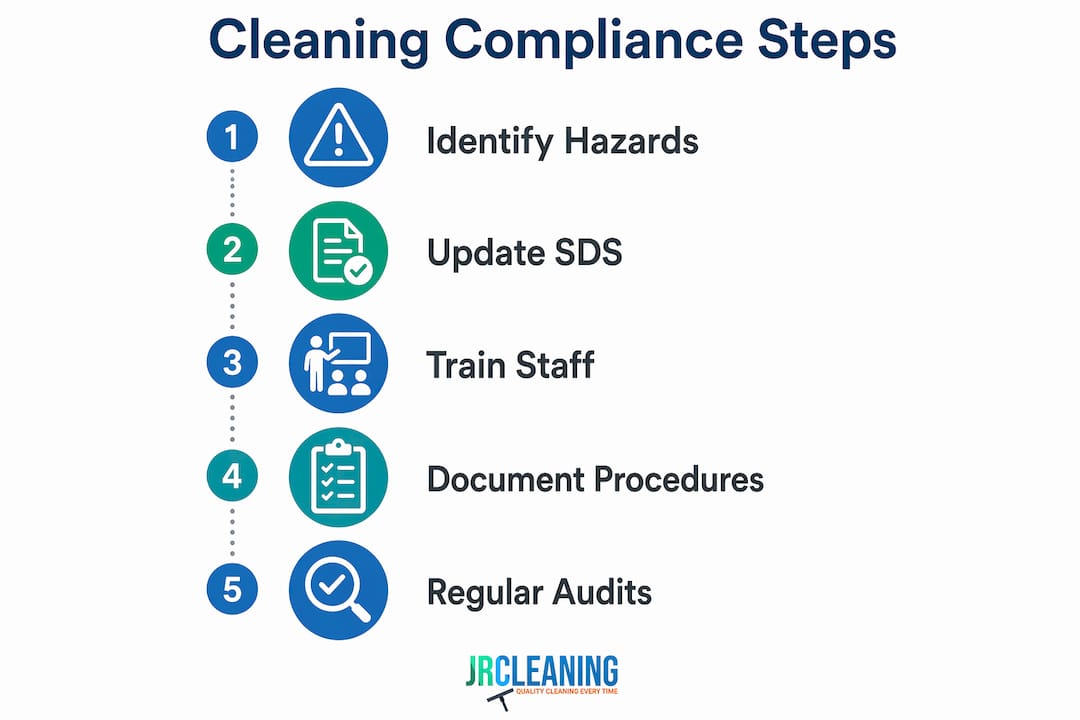
1779987393008 Infographic illustrating steps for cleaning compliance - J R Cleaning

Building a compliant cleaning programme does not require a dedicated regulatory team. It requires a system. The most important shift is treating compliance as a live control mechanism rather than a box ticked at setup and forgotten.

Outdated SDS and labels are among the most common audit citations, precisely because businesses update their chemical stock without updating the associated documentation. Every time a cleaning product changes, even a like-for-like swap, the SDS must be updated and the relevant staff must be retrained on any new hazards.

Your practical compliance checklist should include:

  • Chemical inventory audit. Review all cleaning products currently in use quarterly. Remove anything not on the approved list and update SDS files immediately when products change.
  • SDS accessibility. SDS must be accessible to all workers at all times, not filed in a locked office. Digital SDS management systems make this straightforward and create an automatic audit trail.
  • Training records. Document every training session, who attended, what chemicals were covered, and when the next update is due. Training must be ongoing, covering initial assignment and any introduction of new hazards.
  • Disinfectant procurement protocol. EPA-registered disinfectants require that their registered uses match your actual environment. A product registered for food contact surfaces cannot be assumed safe for general environmental use unless the label says so.
  • Cleaning logs and schedules. Professional cleaning firms should provide these as standard. Cleaning logs and training records are the documentation that auditors reach for first, and a contractor who cannot supply them is a liability, not an asset.

Pro Tip: Set a recurring calendar reminder every six months to cross-check your current chemical inventory against your SDS files and training records. This single habit prevents the documentation drift that causes most compliance failures.

For a practical starting point, a commercial cleaning checklist tailored for UK businesses gives you the structure to begin systematising your approach without having to build everything from scratch.

My perspective on cleaning compliance culture

I have spent years watching businesses treat compliance as a filing exercise rather than a management discipline, and the pattern is consistent. The businesses that get cited are almost never the ones that were negligent in spirit. They genuinely thought they were compliant. The problem was that their documentation had quietly fallen out of step with their actual operations.

The most dangerous compliance state is not knowing you are non-compliant. I have seen businesses confidently hand over their SDS folders during an audit, only for an inspector to identify that three of the listed products had been replaced months ago and the replacement chemicals had no corresponding SDS, no training record, and no label update. That is a serious citation waiting to happen, and the business had no idea.

What I find works is treating the cleaning compliance programme as something with a named owner who is accountable for keeping it current, not just setting it up. The health and safety guidance for UK properties makes clear that duty of care is ongoing. It does not lapse between audits.

Beyond the regulatory obligation, there is a genuine business case for getting this right. A workplace that demonstrably manages cleaning compliance communicates professionalism to clients, lowers insurance risk, and builds the kind of employee trust that reduces turnover. Those benefits are not incidental. They are the impact of cleaning compliance done properly.

— jamie

How Jrcleaning supports your compliance needs

If you have read this far, you already know that cleaning compliance is not a one-time project. It is an ongoing commitment to documentation, training, and verified operational practice. Jrcleaning brings over 20 years of commercial cleaning experience and a working knowledge of current health and safety regulations to every contract.

1774551979294 jrcleaning - J R Cleaning

Whether you need a compliant commercial kitchen cleaning service with full hygiene documentation, or a wider commercial cleaning contract that keeps your audit records current, Jrcleaning delivers. Our fully insured team works to recognised cleaning standards and provides the logs, schedules, and training evidence your business needs to meet inspection requirements with confidence. Get in touch today for a free quote tailored to your compliance requirements.

FAQ

What does commercial cleaning compliance actually mean?

Commercial cleaning compliance means meeting all applicable health, safety, and environmental regulations governing how cleaning is carried out, which products are used, and how staff are trained. It covers documentation, chemical management, and audit readiness, not just cleanliness.

What are the risks of non-compliance in commercial cleaning?

Non-compliance can result in HSE enforcement notices, prosecution, insurance claim rejections, and significant fines. OSHA penalties for hazard communication violations reach up to $16,131 per violation in 2026, and equivalent UK enforcement carries comparable financial and reputational consequences.

How often should cleaning compliance records be updated?

Compliance records must be updated whenever a new chemical is introduced, a product changes, or new hazards are identified. Training records should also be reviewed at least annually and refreshed whenever cleaning protocols change.

Does using a professional cleaning company help with compliance?

Yes. A reputable commercial cleaning contractor provides cleaning logs, product SDS files, and training records that support your audit readiness. These documents form the core of what inspectors review during an unannounced visit.

What is the biggest cause of cleaning compliance failures?

Most compliance failures result from documentation drift, where operational practices or chemical stock changes but the associated records are not updated. This mismatch between what is written down and what is actually happening is the primary trigger for regulatory enforcement.

What is high-level cleaning? A practical guide

Most people picture industrial warehouses or factory floors when they hear the phrase “high-level cleaning.” But what is high-level cleaning, really? At its core, it refers to the cleaning of any surface above shoulder height or beyond comfortable arm’s reach. That includes the ceiling fan you haven’t touched in two years, the gutters slowly filling with leaf debris, or the beams above your kitchen. It’s just as relevant to a terraced house in the Midlands as it is to a commercial warehouse. And if you’ve been overlooking it, your property’s hygiene and condition are paying the price.

Table of Contents

Key takeaways

PointDetails
High-level cleaning definedIt covers any surface above shoulder height, indoors or outdoors, in homes and businesses.
Not just for industryHomeowners and small business operators benefit just as much as large commercial facilities.
Right equipment mattersExtension poles, specialist vacuums, and mechanised platforms make the work safer and more thorough.
Neglect causes real damageBlocked gutters, dusty vents, and debris-laden beams can lead to structural damage and fire risk.
Know when to call professionalsSome tasks require trained operatives and specialist equipment. DIY has clear limits at height.

What high-level cleaning actually covers

The industry term you’ll encounter most often is “working at height cleaning,” though “high-level cleaning” is widely used across residential and commercial contexts. It covers a broader range of surfaces than most people expect.

Indoors, the typical areas include:

  • Ceilings, coving, and ceiling roses
  • Exposed beams and rafters (common in barn conversions and older properties)
  • Light fittings and pendant fixtures
  • Ceiling fans and extractor units
  • Air conditioning vents, grilles, and ductwork
  • High shelving and storage racking
  • Tall windows and upper window frames
  • Skylights and roof lights from the interior

Outdoors, the list extends to:

  • Roof surfaces, including tiles and flat roof sections
  • Gutters, downpipes, and fascia boards
  • Soffits and barge boards
  • Exterior cladding on upper storeys
  • High external windows and glazing
  • Canopies and covered walkways

The reason these areas need specific attention comes down to how dust and debris behave. Particles settle on elevated surfaces and accumulate undisturbed for months, sometimes years. In a home setting, ceiling cobwebs and dusty light fittings are unsightly. In a commercial property, debris on beams and vents can become a serious hygiene and fire risk if left unchecked. Outdoors, accumulated gutter debris causes water to back up and eventually damages fascias, ceilings, and brickwork.

Tools and techniques that make it work

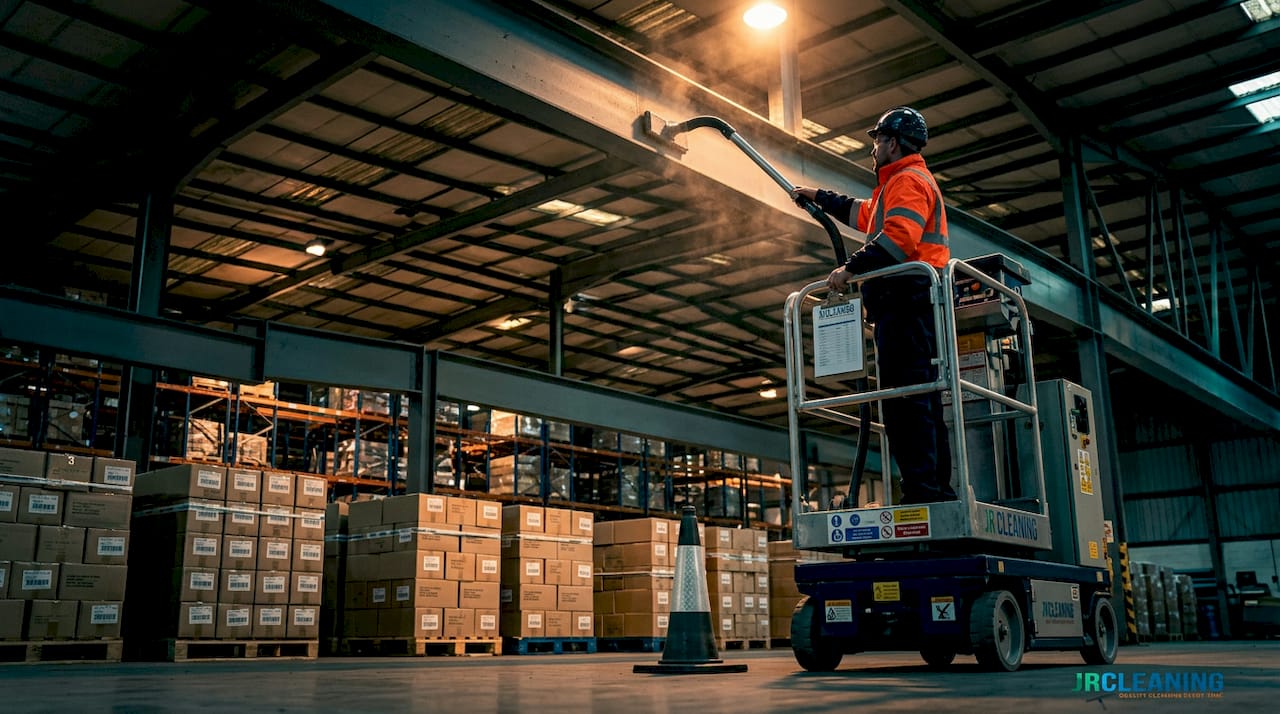
1779895064812 Technician cleaning high warehouse beams with lift - J R Cleaning

Understanding how to perform high-level cleaning safely depends largely on choosing the right equipment for the height and surface involved.

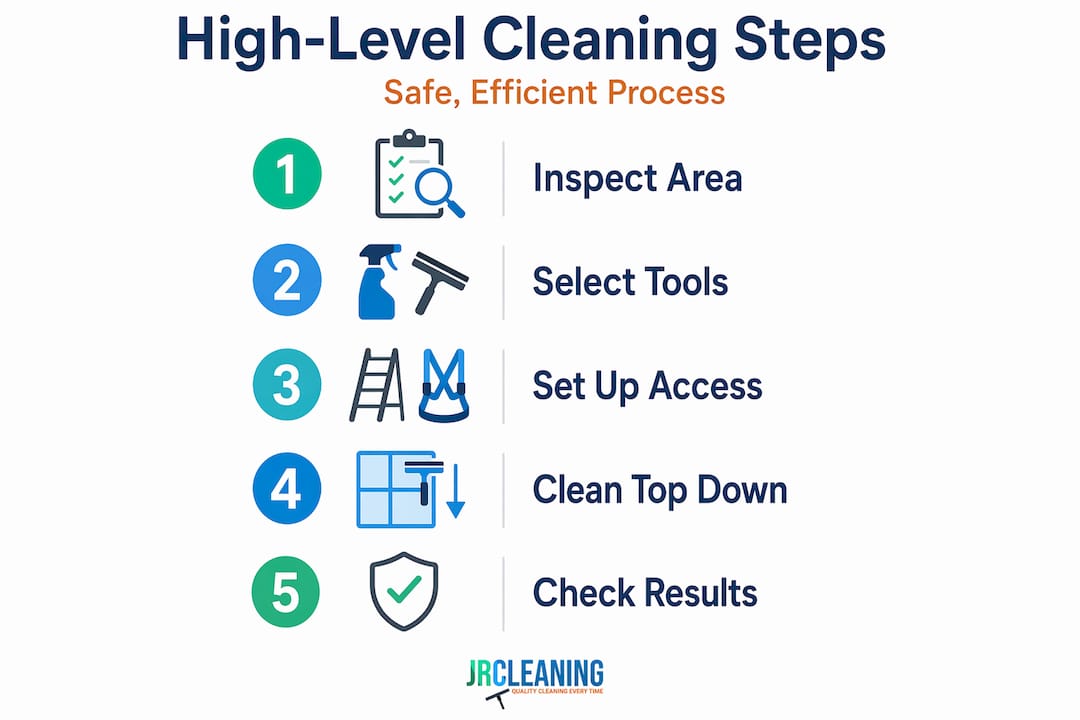
1779895922401 Infographic showing key high level cleaning process steps - J R Cleaning

Manual tools for accessible heights

For surfaces between roughly two and five metres, telescopic extension poles fitted with dusting heads, squeegees, or microfibre pads are the standard starting point. Lightweight aluminium or fibreglass ladders give direct access for spot-cleaning tasks such as wiping light fittings or treating localised staining on ceiling tiles. These are appropriate for most domestic properties where ceilings are a standard height.

Mechanised and specialist systems

For anything higher, the equipment steps up significantly. Mobile elevated work platforms (MEWPs), sometimes called cherry pickers or scissor lifts, allow operatives to work safely at significant height without the instability of a ladder. Scaffolding is used for prolonged access on building exteriors or renovation-style cleaning projects.

At the more advanced end, vacuum-based systems such as the SpaceVac ATEX Ultra use a carbon fibre pole capable of reaching over 20 metres, making exterior cleaning of very tall structures possible without any access platform at all. Mechanised equipment consistently reduces both labour time and the risk of accidents compared with manual approaches at height.

MethodBest suited forApproximate height rangeRisk level
Extension pole with dusterCeilings, fan blades, light fittingsUp to 5mLow
Step ladder or platform stepsSpot-cleaning fixtures and fittingsUp to 3mLow to moderate
MEWP (scissor lift or cherry picker)External cladding, soffits, tall interior spaces5m to 30m+Moderate (trained use)
ScaffoldingProlonged external accessAny heightModerate (trained use)
Specialist vacuum pole systemDusting beams, vents, ceilingsUp to 20m+Low to moderate

Pro Tip: Always clean from the top down. Start at ceilings and beams, then work toward the floor. Dust dislodged from high surfaces settles lower, so cleaning downward means you’re never re-contaminating surfaces you’ve already cleaned.

Why the benefits go well beyond appearances

People tend to think of high-level cleaning as cosmetic. The ceiling looks tidier, the beams stop looking grey. That’s true, but it undersells the real-world advantages considerably.

  • Fire risk reduction. Dust and organic material that accumulates on exposed beams, above ceiling tiles, and within ventilation grilles is combustible. Regular removal of this material is a genuine safety measure, particularly in commercial kitchens, warehouses, and older properties with timber beams.
  • Better air quality. Dusty vents and ceiling fans don’t just look neglected. They actively recirculate particles through the air every time a fan runs or a heating system kicks in. Cleaning these surfaces reduces airborne contaminants, which matters considerably for anyone with asthma or allergies.
  • Structural protection. Outdoor structural elements such as gutters and roofs require regular attention to prevent real damage. Blocked gutters cause water to overflow against fascias and walls. Moss on roof tiles, if left to spread, accelerates the decay of pointing and tiles beneath it. Scheduling roof moss removal before it takes hold is far less costly than dealing with the structural consequences later.
  • Property value and kerb appeal. Stained ceilings, grimy soffits, and blocked gutters send a clear signal to potential buyers or tenants. Regular high-level maintenance keeps a property looking well cared for.
  • Regulatory compliance for businesses. For commercial properties, particularly those in food production, healthcare, or manufacturing, maintaining clean elevated surfaces is often a legal requirement under health and safety legislation, not simply a preference.

The health and property value case for cleaning these neglected areas is well established. The decision to delay it is almost always a false economy.

A practical high-level cleaning checklist

Knowing what to do and in what order makes the task far more manageable. Whether you’re tackling a domestic ceiling yourself or briefing a contractor, this step-by-step approach covers the essentials.

  1. Assess the area first. Walk through the space and identify which surfaces need attention. Note the height, material, and any specific hazards such as fragile ceiling tiles, exposed wiring near light fittings, or areas directly above electrical equipment.

  2. Choose the right access equipment. For a standard domestic ceiling, a sturdy stepladder and an extension pole will handle most tasks. For anything above four to five metres, or for exterior work above the ground floor, call in professional equipment or a specialist service.

  3. Prepare the space below. Remove or cover furniture, equipment, and flooring directly beneath the work area. Dust and debris will fall. This step saves considerable clean-up time.

  4. Dust before washing. Use a dry microfibre head on an extension pole to remove loose dust and cobwebs first. Applying moisture to a heavily dusty surface before dry removal turns dust into a paste that smears rather than cleans.

  5. Work systematically. Move across the space in sections rather than tackling it randomly. This avoids missing sections and prevents dust from being redistributed to areas already cleaned.

  6. Vacuum, then wipe. After dry dusting, use a specialist vacuum with an appropriate head to capture fine particles from surfaces like grilles and vents. Follow with a damp wipe on hard surfaces where appropriate.

  7. Know when to stop. Safe high-level cleaning requires proper hazard assessment and the correct technique. If a task requires working above a comfortable ladder height, involves fragile or unstable surfaces, or is on an exterior structure, it belongs with a trained professional.

Pro Tip: Set a maintenance schedule rather than cleaning reactively. Ceiling fans, extractor vents, and gutters should all have a set cleaning interval noted in your calendar. Quarterly checks for indoor surfaces and biannual exterior checks work well for most properties.

Common pitfalls that catch people out

Even with good intentions, high-level cleaning is an area where mistakes are common and the consequences can be more serious than with ground-level tasks.

  • Ignoring corners and recesses. Dust gathers fastest in the spots that are hardest to reach: where a beam meets a wall, inside a vent cover, or in the track of a ceiling-height window. Standard dusters miss these completely. Flexible or articulated cleaning heads are needed to address them properly.
  • Using the wrong ladder. A domestic stepladder placed on an uneven surface, or one that’s too short, causes more accidents than almost anything else in home maintenance. Always check the load rating, use the ladder on a stable surface, and never lean it against a surface you’re actively cleaning.
  • Skipping outdoor elements. Gutters and soffits are consistently among the most neglected parts of any property. Most homeowners don’t inspect them until there’s a visible problem, by which point the damage is already underway.
  • Underestimating seasonal timing. Autumn is the peak season for gutter cleaning because leaf fall is at its highest. Roofs should be checked in late spring when moss growth accelerates. Timing maintenance to these natural cycles keeps intervention costs low.
  • Misuse of equipment. Using extension poles designed for light dusting to attempt heavy pressure washing, or using MEWPs without proper training, dramatically increases the risk of accidents and surface damage.

My honest take on high-level cleaning

I’ve seen the same pattern more times than I can count. A homeowner finally decides to tackle the ceiling fans, the beams above the stairs, and the gutters at the side of the house. They spend an afternoon on it and declare the job done. But the corners are still full of dust, the gutters are partially cleared at best, and the soffit boards haven’t been touched in years.

The problem isn’t effort. It’s that most people genuinely underestimate how much surface area exists above shoulder height, and how quickly it accumulates grime when ignored. High-level cleaning is not a once-a-year job. It’s a scheduled, systematic part of property maintenance.

What I’ve also found is that the equipment gap is real. A good quality extension pole with a microfibre head makes an enormous difference to what’s achievable at home without professional help. But there’s a clear point where domestic tools run out of road. Anything external, anything above a single storey, and anything involving vents in a commercial setting belongs with a properly equipped, insured service provider.

The technology has improved dramatically. Systems that use long carbon fibre poles with high-powered vacuum suction mean that trained operatives can clean surfaces at 15 or 20 metres without a platform, and do it faster and more consistently than manual methods ever allowed. That changes the cost calculation for commercial high-level cleaning significantly.

My honest advice: tackle what you can safely manage at home, schedule it properly, and bring in professionals for anything that requires working above a standard ladder height or on any exterior surface. The savings from doing it yourself are rarely worth the risk.

— jamie

Ready to take high-level cleaning off your to-do list?

If this article has made you realise just how much has been accumulating above eye level, you’re not alone.

1774551979294 jrcleaning - J R Cleaning

Jrcleaning has over 20 years of experience delivering residential and commercial cleaning services across the UK, with the specialist equipment and fully insured teams to handle everything from gutter clearing to exterior roof washing. Whether you need a one-off deep clean of high-level interior surfaces or a scheduled exterior maintenance programme, the team at Jrcleaning is equipped to deliver it safely and thoroughly. Get in touch for a free, no-obligation quote and find out what a proper high-level clean can do for your property.

FAQ

What is high-level cleaning in simple terms?

High-level cleaning refers to the cleaning of surfaces above shoulder height or beyond easy arm’s reach. This includes ceilings, beams, light fittings, vents, gutters, and exterior roof structures in both domestic and commercial properties.

What does high-level cleaning include for a typical home?

In a home, it typically covers ceiling fans, light fittings, coving, exposed beams, high shelving, extractor vents, gutters, fascia boards, and upper-storey exterior surfaces such as soffits and cladding.

How often should high-level cleaning be done?

For most homes, interior high-level surfaces benefit from cleaning every three to six months. Gutters should be cleared at least twice a year, ideally in autumn and spring, and roofs inspected annually or after severe weather.

Is high-level cleaning something I can do myself?

Many tasks, such as dusting ceiling fans or wiping light fittings with an extension pole, are straightforward for DIY. However, safe working at height for anything above a standard ladder height or on exterior structures requires professional equipment and training.

Why is commercial high-level cleaning particularly important?

In commercial settings, dust and debris on elevated surfaces such as beams, vents, and racking poses fire hazards and can breach health and safety regulations. Regular professional cleaning of these areas protects both the premises and the people working in them.

The real role of cleaning schedules explained

Most people think a cleaning schedule means picking a day and sticking to it. That assumption is precisely where things go wrong. The role of cleaning schedules goes well beyond ticking off tasks at fixed intervals. A properly designed schedule is a control system. It determines which areas get cleaned, how often, by whom, and to what standard. Get it right and you protect health, cut wasted labour, and satisfy regulators. Get it wrong and you end up cleaning empty rooms while the busiest areas fall below standard. This guide breaks down why scheduled cleaning matters and how to build a schedule that actually works.

Table of Contents

Key takeaways

PointDetails
Schedules are control systemsA cleaning schedule without verification is just a list of intentions, not a guarantee of outcomes.
Usage beats fixed time intervalsCleaning based on actual footfall and contact risk prevents hygiene gaps and wasted resource.
Layered cycles improve claritySeparating daily, weekly, and monthly tasks helps allocate the right effort to the right areas.
Documentation supports complianceTimestamped records and corrective action trails are now expected by health and safety regulators.
Verification failures are handover failuresWhen teams change over frequently, sign-off processes must be actively managed, not treated as a formality.

The role of cleaning schedules in hygiene and operations

A cleaning schedule does several jobs at once, and it helps to understand each one separately before trying to design your own.

The most obvious function is hygiene maintenance. Routine cleaning removes contaminants before they accumulate to levels that cause illness or deterioration. Routine cleaning leaves up to 20 to 40% of high-touch surfaces contaminated despite standard cleaning rounds, which means a schedule without targeted task allocation is not doing the job you think it is.

Schedules also serve a compliance function. In regulated environments such as food preparation areas, healthcare facilities, and commercial washrooms, a cleaning log is not optional. It is evidence. Regulatory bodies want to see that cleaning happened, when it happened, and what was done when something fell short. For commercial properties, understanding cleaning contract quality and how records support inspections is worth thinking about before you set anything up.

The third function is workforce organisation. A clear schedule tells staff exactly what needs doing and when, which removes ambiguity and reduces the chance that tasks get duplicated or skipped. This is where the efficiency of cleaning routines becomes measurable. Less time deciding what to do means more time actually cleaning.

Finally, schedules support quality control. When tasks are documented and completion is recorded, managers can spot patterns. If a particular area is consistently marked incomplete or generating complaints, the record shows it.

  • Prevents contamination build-up through timely, targeted cleaning
  • Supports health and safety compliance with documented evidence
  • Organises staff workloads clearly and reduces task duplication
  • Enables quality tracking and corrective action when standards slip
  • Applies equally to homes and commercial premises, though the formality of documentation differs

Pro Tip: For residential settings, a printed checklist stuck inside a cupboard door works just as well as any app. The point is consistency, not complexity.

Time-based vs. usage-based schedules

Understanding why specific cleaning schedules help different environments requires looking at the two main approaches.

The fixed-interval method

A time-based schedule assigns cleaning tasks to specific clock intervals regardless of what is happening in the space. Clean the toilets at 9am, noon, and 4pm. Polish the lobby every Monday. The simplicity is appealing, and in low-traffic settings it works perfectly well. The problem is that most spaces do not have uniform usage.

1779806177205 Janitor cleaning kitchen by clock schedule - J R Cleaning

Cleaning by clock rather than usage causes inefficient resource allocation and missed cleaning during peak traffic. A restroom cleaned at 4pm in an office building might be spotless at 5pm but wrecked by 6pm during the evening rush. Meanwhile, a seldom-used meeting room gets cleaned on the same schedule as the main corridor.

The usage- and risk-based approach

An adaptive schedule maps how a space is actually used and assigns cleaning frequency accordingly. High-traffic, high-touch zones get cleaned more often. Low-risk areas with little footfall are cleaned less. The result is better hygiene where it matters and less wasted effort where it does not.

1779806848642 Infographic comparing time and usage based cleaning - J R Cleaning

Facilities should disinfect touchpoints every 2 to 4 hours during public and shared use, with healthcare settings potentially requiring hourly attention. That kind of frequency is only justifiable in genuinely high-contact zones, which is the whole point.

ApproachAdvantagesDisadvantages
Time-basedSimple to plan and communicateMisses peak usage windows; wastes resource in low-traffic areas
Usage-basedMatches cleaning intensity to actual needRequires monitoring data or staff judgement to implement
Risk-basedPrioritises infection-critical surfacesNeeds initial assessment and regular review as usage patterns change

Pro Tip: Start with a one-week observation period before designing any schedule. Map footfall peaks in each zone and note which surfaces get the most contact. That data is worth more than any template.

How to create cleaning schedules that work

Knowing why schedules matter is one thing. Building one that holds up in practice is another. The importance of cleaning schedules is only realised when the design reflects how a space is actually used.

Step-by-step approach

  1. Map your facility or home. List every area and note its purpose, typical occupancy, and peak usage times. A kitchen in a family home is different from a breakroom serving 80 staff.
  2. Identify critical zones. High-touch surfaces such as door handles, light switches, taps, and shared equipment need their own cleaning intervals, not just inclusion in a general room clean.
  3. Assign layered cycles. Separate tasks by frequency. Daily tasks cover hygiene-critical items. Weekly tasks cover surfaces that accumulate over time. Monthly and quarterly tasks cover deep cleaning and maintenance items that do not need daily attention. Separating high-frequency hygiene tasks from lower-frequency maintenance improves schedule clarity and resource allocation.
  4. Assign ownership. Every task needs a named role or person responsible. Shared responsibility is no responsibility.
  5. Build in sign-off. Whether it is an app, a paper log, or a simple tick sheet, completion must be recorded at the time of cleaning, not later.
  6. Review regularly. Usage patterns change. A schedule that worked in January may miss the mark in summer. Quarterly reviews keep the schedule aligned with reality.

Common pitfalls worth avoiding include:

  • Designing for the average space rather than the actual space. Schedules designed for average spaces without considering usage variations lead to wasted labour and neglected high-traffic areas.
  • Skipping staff training. A schedule only works if the people following it understand it.
  • Treating the schedule as fixed. It should evolve as your space and usage evolve.

For practical guidance on preparing spaces and coordinating with cleaning staff, the Jrcleaning guide on preparing for a cleaning service is a useful starting point.

Pro Tip: Use colour-coded zones on a floor plan when briefing staff. Visual cues reduce misunderstandings and help new team members learn priorities faster than reading a written schedule.

Recordkeeping and verification in cleaning schedules

Documentation is where cleaning schedule benefits become provable. Without records, you have no way to demonstrate compliance, no data to improve performance, and no protection if a complaint or audit arises.

Digital systems provide timestamped completion records, photo evidence, quality scoring, and escalation alerts for overdue tasks. This is now standard practice in professional facilities management. For businesses operating under health and safety legislation, the bar is rising. Under 2026 OHSA regulations in Ontario, for example, documented cleaning logs must be maintained for at least 12 months, including task frequency and corrective action evidence. The direction of travel is the same in the UK.

Key elements of a strong verification process:

  • Timestamped sign-offs completed at the time of the task, not retrospectively
  • Named responsibility for each task so accountability is traceable
  • Photo evidence for high-priority or compliance-critical cleans
  • Escalation protocols when tasks are overdue or standards fall short
  • Regular audits or spot checks carried out by a supervisor or manager

“Without inspection scores and corrective action trails, managers lose operational visibility.” Schedules function as control systems in janitorial management, and the records are what make them function.

One underappreciated problem is verification failure during high-turnover changeovers. When teams change frequently, paperwork sign-offs replace meaningful checks, and critical communication breaks down. This is not a cleaning failure. It is a handover failure. The fix is a structured verbal or written brief at every shift change, not simply more forms to sign.

For residential users thinking about maintaining standards between professional visits, tips on maintaining cleanliness between deep cleans can help keep your schedule from slipping.

My take on rigid schedules and why they need rethinking

I have seen fixed-interval cleaning schedules fail in virtually every busy environment I have encountered. Not because the people following them were careless, but because the schedule was designed in an office, for a theoretical space, and then never updated.

In my experience, the worst outcome is not a dirty building. It is a building that looks clean on paper while the genuinely critical areas are being missed. A washroom signed off at 3pm that nobody checks again during a six-hour evening rush is a compliance record, not a hygiene record. That distinction matters enormously.

What actually works is treating the schedule as a living document. Usage changes. Seasons affect footfall. Staff change. The schedule needs to reflect all of that, and the only way to know whether it does is to audit it regularly and actually walk the space.

The shift to digital recordkeeping has made this far more achievable than it was a decade ago. Timestamped logs, photo evidence, and real-time escalations remove the guesswork. But technology is only as good as the culture behind it. If staff see verification as a box-ticking exercise, it will function as one. Building genuine accountability into the process is what separates a schedule that performs from one that just exists.

I also think residential users underestimate how much a structured approach helps at home. You do not need a full facilities management system. A written weekly plan with defined zones and a quick review every month is enough to prevent the slow drift toward a home that never quite feels clean. Understanding the value of structured routines on health and property reinforces why putting that effort in is worth it.

— jamie

How Jrcleaning can help you get this right

If designing and managing a cleaning schedule feels like more than you want to take on yourself, that is exactly where professional support adds the most value.

1774551979294 jrcleaning - J R Cleaning

Jrcleaning has over 20 years of experience delivering residential and commercial cleaning services across the UK. The team understands how to adapt schedules to different environments, from family homes to commercial premises with specific compliance requirements. Every service is fully insured and delivered to strict health and safety standards, with documentation available where required. Whether you need a one-off deep clean or an ongoing managed schedule, the cleaning services at Jrcleaning can be tailored to your space and usage patterns. Contact Jrcleaning for a free quote and a cleaning plan built around your actual needs, not a generic template.

FAQ

What is the main role of cleaning schedules?

A cleaning schedule organises tasks by frequency, area, and responsibility to maintain hygiene, support compliance, and use staff time efficiently. It functions as a control system rather than just a task list.

Why do fixed-time cleaning schedules often fail?

Fixed-interval schedules clean spaces at set times regardless of actual usage, which means high-traffic areas can be missed during peak periods while low-use areas receive unnecessary attention. Usage-based schedules allocate effort where it is genuinely needed.

How often should high-touch surfaces be cleaned?

High-touch surfaces should be disinfected every 2 to 4 hours during public or shared use, with the frequency increasing in healthcare or high-risk settings.

What records should a cleaning schedule include?

A cleaning log should capture the date and time of each task, the name of the person responsible, any defects or corrective actions taken, and, in regulated environments, timestamped evidence such as photos or digital sign-offs.

Do residential homes need a formal cleaning schedule?

A formal log is not legally required for homes, but a structured written plan with defined zones and regular review prevents tasks from being overlooked and makes it far easier to maintain consistent standards between professional cleans.

The real role of cleaning in home value

Most homeowners think of cleaning as routine tidying. Something you do before guests arrive, not something that shapes what a buyer will offer you. That framing costs sellers money. The role of cleaning in home value goes far beyond appearances. It signals to buyers, appraisers, and estate agents that a property has been cared for, that nothing has been left to fester, and that the asking price is justified. This article covers the financial mechanics, the practical priorities, and the selling psychology behind keeping your home genuinely clean.

Table of Contents

Key takeaways

PointDetails
Cleaning is preventive maintenanceRegular cleaning prevents costly damage and protects your home’s long-term market value.
Focus on high-visibility areasKitchens, bathrooms, and entryways influence buyer decisions more than any other rooms.
Odours cost you moneyPet and smoke smells reduce buyer offers regardless of how good the rest of the property looks.
Exterior cleaning boosts sale priceGutter and window cleaning can raise sale price by up to 7% through better curb appeal.
Documentation builds buyer confidenceKeeping records of professional cleaning and maintenance reduces perceived buyer risk.

The financial role of cleaning in home value

Here is where most sellers get it wrong. They think of cleaning as something separate from maintenance, a cosmetic layer on top of the real work. In reality, cleaning is maintenance. It is how you catch problems before they become expensive and how you signal to buyers that nothing has been deferred.

Experts recommend budgeting 1 to 3% of your home’s value every year for maintenance and cleaning. On a property worth £350,000, that is between £3,500 and £10,500 annually. That range might sound high until you consider what neglect actually costs. A blocked gutter that goes uncleaned leads to water ingress. Water ingress leads to damp. Damp leads to mould. And mould damage reduces home value far more than the cost of a yearly gutter clean ever would.

1779696332540 Infographic showing home cleaning impact statistics - J R Cleaning

Beyond damage prevention, there is an appraisal dimension that rarely gets discussed. Appraisal discounts apply for deferred maintenance, the kind of accumulated neglect that is obvious to any surveyor who walks through. A documented cleaning history, receipts from professional services, and evidence of regular upkeep signal to lenders and appraisers that a property is low-risk. That translates directly into a cleaner valuation and fewer post-survey price reductions.

Pro Tip: Keep a simple maintenance folder with receipts from professional cleaners, window cleaning visits, and gutter clears. This takes minutes to assemble and can meaningfully shift buyer confidence during negotiations.

Cleaning taskIf regularly doneIf neglected
Gutter cleaningPrevents water ingress and structural dampLeads to fascia rot and damp surveys
Window cleaningProtects glass from etching; boosts kerb appealGlass deterioration; poor first impressions
Kitchen deep cleanRemoves grease that causes long-term damageLingering odours; reduced offers
Carpet and floor cleaningExtends lifespan; signals careStaining; perceived age and wear

Cleaning priorities that move the needle with buyers

Not all cleaning is equal. You can spend two days cleaning the utility room and loft and barely move the needle. Spend the same time on the right rooms and buyers will walk in ready to make an offer. Sellers should prioritise high-impact cleaning zones to genuinely influence buyer perception, and those zones are predictable.

The rooms and areas where cleaning attention pays off most:

  • Entryway and hallway. This is the first thing a buyer sees in person. Scuffed skirting boards, dusty light fittings, and a cluttered coat area all set a negative tone that is hard to reverse in the rest of the viewing.
  • Kitchen. Buyers inspect kitchens more closely than any other room. Clean the hob, degrease the extractor fan, wipe down the inside of the oven, and scrub the grout between tiles. Tidy kitchens associate strongly with well-maintained properties in buyers’ minds.
  • Bathrooms. Limescale, mildew on sealant, and dirty grouting are the three most common buyer objections in bathrooms. All are fixable with the right products and an hour of effort.
  • Floors throughout. Dirty carpets and grimy hard floors are noticed immediately. A professional carpet clean before listing is one of the highest-return investments a seller can make.
  • Windows, inside and out. Regular window cleaning protects glass from irreversible etching and dramatically improves how light moves through a property during a viewing.
  • Exterior and gutters. Exterior cleaning lifts sale price by up to 7% according to research from the University of Texas at Arlington. In a slower market, the effect can be even more pronounced.

Odour is in its own category. Pet and smoke odours reduce buyer offers regardless of how clean everything looks. A home that smells neutral or faintly fresh costs buyers nothing psychologically. A home that smells of pets or old cooking activates doubt. Steam clean upholstery, wash curtains, and ventilate thoroughly several days before any viewing.

How cleanliness affects sale speed and negotiation

Clean homes do not just attract more buyers. They remove the buyer’s negotiating ammunition. Understanding that changes how you think about cleaning before a sale. It is not preparation. It is protection.

Here is the sequence of what happens when a buyer walks into a poorly maintained property:

  1. They notice the dirt first. Even subconsciously, smells, grime, and clutter register before anything else. The buyer immediately begins building a mental list of what needs fixing.
  2. The list becomes their offer justification. Every cleaning issue they spotted becomes a line item in their head. “The carpets need replacing. The kitchen grout is black. There’s mould around the bathroom sealant.” Each one is a reason to come in low.
  3. Their solicitor or surveyor confirms the concerns. A survey that highlights maintenance neglect gives buyers grounds to renegotiate after the offer. Sellers who have not maintained their home often face post-survey price reductions they did not anticipate.
  4. Clean homes eliminate those friction points. Removing visible neglect signals does not add a fixed amount to your asking price, but it removes the reasons buyers feel justified in going below it.
  5. Speed is the other outcome. Staged and cleaned properties in the UK average 32 days to offer compared to 199 days for unstaged, unkempt equivalents. In a market where time on the market affects buyer perception, this difference is substantial.

Combining cleaning with maintenance and staging

Cleaning does not operate in isolation. The most compelling properties in any market combine cleanliness, minor repairs, and thoughtful presentation as a single unified effort. When these three things work together, buyers perceive a home as genuinely well-cared-for rather than recently tidied up.

1779694379010 Woman cleaning everyday kitchen surfaces - J R Cleaning

The 2026 market shift is clear: buyers increasingly reward long-term proactive maintenance over last-minute cosmetic treatments. Painting over damp patches or placing diffusers to mask pet smells used to work better than it does today. Buyers and their surveyors are more experienced and more sceptical. What actually moves them is evidence of consistent care.

Professional cleaning plays a specific role here. Professional cleaning investments positively influence how estate agents and appraisers prioritise and present a listing. A property that has been professionally cleaned signals that the seller takes the transaction seriously, which in turn encourages agents to price confidently and appraisers to view the condition favourably.

Pro Tip: Book a professional deep clean at least two weeks before listing, not the day before. This gives you time to air the property, make any touch-up repairs the clean reveals, and present it at its best for photography and viewings.

Documentation ties this all together. Keeping records of cleaning and maintenance history reduces buyer concern about what might be hidden. A folder of receipts covering gutter cleaning, window washing, boiler servicing, and carpet cleaning is a surprisingly powerful trust signal when you place it on the kitchen table during a viewing.

Practical routines for sellers preparing to list

You do not need to clean your entire home to perfection every day. What you need is a system that keeps the key areas in viewing condition without exhausting yourself.

Practical cleaning habits for homeowners preparing to sell:

  • Use a viewing basket. Keep one per floor. When a viewing is confirmed, sweep through and place any clutter, personal items, or paperwork into the basket. Put it in the boot of your car. Fast and effective.
  • Zone clean daily. Divide your home into zones and rotate through them. Kitchen one day, bathrooms the next, living areas the day after. Nothing gets neglected but nothing becomes overwhelming either.
  • Keep surfaces clear. Worktops, windowsills, and hallway consoles should stay as clear as possible throughout the sale period. Buyers physically look at surfaces. Clutter makes rooms feel smaller and less valuable.
  • Neutralise odours proactively. Do not rely on candles or plug-in diffusers. Open windows daily, wash soft furnishings weekly, and avoid cooking strong-smelling food in the 24 hours before a viewing.
  • Touch up high-traffic areas before each viewing. Wipe down the front door, hoover the entrance hallway, and re-clean the kitchen surfaces and bathroom sinks. These take ten minutes and make a disproportionate impression.
  • Hire professionals for the deep work. Professional cleaning services handle the tasks that take DIY effort out of proportion to the result: oven cleans, carpet extraction, exterior washing, and window cleaning at height.

My honest view on cleaning and home sales

From my experience working with homeowners preparing their properties for market, the biggest mistake I see is confusing cleaning with tidying. Tidying is what you do when guests come over. Cleaning is what you do to protect the value of what is probably your largest financial asset.

I have seen properties where the seller genuinely could not understand why buyers were offering 5 to 8% below asking. Then you walk through and you smell the dog in the carpet. The oven has never been touched. The gutters are overflowing and moss is creeping down the exterior wall. Buyers are not being difficult. They are doing the maths.

The counter-intuitive truth is that buyers do not consciously think about cleaning during a viewing. They just feel more comfortable, more confident, and more urgent in a clean space. That feeling converts directly into stronger offers. The sellers who get asking price are rarely the ones who spent more on renovation. They are the ones who took ongoing property care seriously before the sale sign went up.

Do not leave cleaning until the week before listing. Make it a habit, document it, and bring in professionals where it matters. The return is real.

— jamie

How Jrcleaning helps protect your home’s value

If you are preparing to sell, or simply want to maintain your property at its best, professional cleaning is one of the most cost-effective investments you can make. Jrcleaning has over 20 years of experience delivering residential and commercial cleaning across the UK, fully insured and to strict safety standards.

1774551979294 jrcleaning - J R Cleaning

From window and gutter cleaning that protects your exterior condition and kerb appeal, to deep kitchen cleans and upholstery care that remove the buyer objections you cannot afford at negotiation, Jrcleaning covers the full range of tasks that genuinely move the needle on value. Explore the full range of residential cleaning services or get in touch for a free, no-obligation quote tailored to your property and sale timeline.

FAQ

Does cleaning actually increase home value?

Cleaning does not add a fixed amount to your valuation, but it prevents buyers from negotiating your price down. Removing visible neglect signals protects your asking price and speeds up the sale.

Which rooms should I clean first before selling?

Prioritise the kitchen, bathrooms, entryway, and floors. These are the highest-impact areas that buyers inspect most closely and that most influence their overall impression of the property.

How much should I budget for cleaning before selling?

Experts recommend spending 1 to 3% of your home’s value annually on maintenance and cleaning. Before a sale, a professional deep clean plus exterior work is a focused, high-return spend.

Can odours really affect my sale price?

Yes. Pet and smoke odours reduce buyer offers regardless of the property’s physical condition. Neutralising smells through deep cleaning, ventilation, and soft furnishing washes is one of the most financially important things a seller can do.

Is exterior cleaning worth doing before listing?

Exterior cleaning is worth doing before listing. Research shows it can raise the sale price by up to 7%, with the effect doubling in slower markets where first impressions carry even more weight.

What is post-construction cleaning?

Post-construction cleaning is one of the most underestimated tasks in any building or renovation project. Most people assume a quick sweep-up is sufficient once the tradespeople have packed up and left. It is not. What is post-construction cleaning, really? It is a multi-phase, specialist process that removes hazardous dust, chemical residues, and construction debris from every surface in a newly built or renovated space. Get it wrong and you risk health problems, failed inspections, and a property that simply is not ready to live or work in.

Table of Contents

Key takeaways

PointDetails
It is a specialist processPost-construction cleaning goes far beyond routine cleaning, covering hazardous dust, residues, and structural debris.
Three distinct phases existRough, light, and final cleaning must follow a set sequence to avoid recontamination and rework.
Construction dust is a health riskSilica and wood dust require HEPA-grade equipment to remove safely from the air and surfaces.
Contractors rarely cover deep cleaningBuilders typically deliver broom-swept conditions only, leaving detailed cleaning to owners or managers.
Timing and planning matterMost residential post-construction cleans take one to three days, so scheduling early avoids handover delays.

What is post-construction cleaning, and how it differs from regular cleaning

Post-construction cleaning is a systematic top-to-bottom process that removes dust, debris, adhesive residues, paint splatter, plaster, and safety hazards left behind after construction or renovation work. It applies equally to residential homes, commercial offices, retail units, and industrial spaces. The scope covers floors, ceilings, fixtures, glass, air vents, skirting boards, and every surface in between.

Regular domestic cleaning deals with everyday grime, grease, and light dust. Post-construction cleaning is a different discipline entirely. Construction dust is finer, more pervasive, and far more persistent than household dust. It penetrates HVAC ducts, settles inside light fittings, and coats surfaces that appear clean to the naked eye. A standard mop or household vacuum cannot deal with it effectively, and in many cases, those tools make the problem worse by redistributing particles rather than capturing them.

The typical scope of post-construction cleaning includes:

  • Removal of large debris, off-cuts, and packaging materials
  • Dust removal from all horizontal and vertical surfaces, including ceilings and wall cavities
  • Cleaning of windows, glass panels, and frames to remove smearing and adhesive stickers
  • Vacuuming and washing of floors, including grout lines in tiled areas
  • Wiping down fixtures, fittings, cabinetry, and appliances
  • Clearing air vents and return grilles of accumulated dust

Pro Tip: Always work from the top of a room downward. Cleaning skirting boards before wiping down ceiling cornices means you will be redoing work you have already finished.

What is post-renovation cleaning in practice? It follows the same principles as post-construction cleaning but is more targeted. Renovation projects tend to leave localised dust and residue rather than site-wide debris, though the fine particulate problem is just as serious.

The three phases of post-construction cleaning

Post-construction cleaning progresses in phases, each building on the last. Skipping a phase or rushing through it is the most common cause of costly rework. Here is how the process works.

Phase 1: Rough clean

This is the foundation of the entire clean. The rough clean involves removing all large debris: timber off-cuts, plasterboard scraps, packaging, tape, and waste materials. Skips or waste bags are filled at this stage. Floors are broom-swept, and any nails, screws, or sharp materials are collected and disposed of safely. The goal is not a finished result. It is a safe, cleared space that the next phase can work from.

Phase 2: Light clean

Once the major debris is gone, the focus shifts to surfaces. Dust and smudges are tackled on walls, windows, and fixtures. Paint splatter is carefully removed from glass and tiles. Surfaces are wiped down and any adhesive residue from protective films is dissolved. At this stage, the space begins to look habitable, but it is not yet ready for occupancy.

1779624154694 Cleaner wiping window with dust and footprints - J R Cleaning

Phase 3: Final clean

This is where the real detail work happens. The final clean involves HEPA vacuum filtration of all surfaces, polishing of glass and mirrors, sanitisation of kitchens and bathrooms, cleaning of light switches and outlet covers, and floor finishing. This is the stage that prepares a space for inspection or occupancy. Nothing is overlooked.

1779624768826 Infographic showing post construction cleaning phases - J R Cleaning

Pro Tip: Run an air scrubber during and after the final clean phase. It captures airborne particulates that vacuuming alone stirs back into the air, giving you a genuinely clean environment rather than just clean-looking surfaces.

Here is a quick comparison of what each phase delivers:

PhasePrimary focusEnd result
Rough cleanDebris and waste removalSafe, clear space
Light cleanSurface wiping and smudge removalVisually improved space
Final cleanHEPA dust removal, polishing, sanitisationMove-in ready condition

Health and safety: construction dust and HEPA filtration

Construction dust is not the same as the dust on your bookshelf. It is a genuine health hazard, and treating it as anything less creates real risk for the people who will occupy the space.

Silica dust from drywall, concrete, and tile work is the most serious concern. When inhaled repeatedly, fine silica particles can cause permanent lung damage, including conditions such as silicosis. Wood dust generated during carpentry work carries its own risks, particularly for people with respiratory conditions or sensitivities. Neither can be managed with a standard domestic vacuum.

Construction dust particles are so fine they remain suspended in the air long after work has stopped. You can walk into a freshly built room, see no visible dust, and still be breathing in hundreds of thousands of particles per cubic metre.

This is why HEPA filters removing 99.97% of fine particulates are the baseline standard for post-construction cleaning, not an optional upgrade. HEPA-rated vacuums capture what standard vacuums cannot. Air scrubbers with HEPA filtration clean the air itself over repeated cycles, progressively reducing the particle count in the room.

Standard vacuums with ordinary filters actually worsen the problem. They capture larger particles in the bag but exhaust fine dust directly back into the room through their filtration system. If you are managing your own post-renovation clean-up, this is the single most important equipment consideration you will face. For insights into professional hygiene standards and why they matter after construction work, the difference in equipment quality is stark.

Following sanitising stages after any kind of contamination is a principle that applies equally to construction dust. Thorough sanitisation of kitchens and bathrooms is part of any credible final clean.

Who is responsible and how to manage the process

This is where many homeowners and property managers get caught out. There is a common assumption that the builder handles cleaning once work is complete. In practice, contractors generally provide broom-swept conditions only. Detailed surface cleaning, HEPA-level dust removal, and polishing are rarely included in a standard building contract.

That means the responsibility for post-construction cleaning services typically falls on the homeowner, property manager, or project manager. Getting ahead of this early saves time and budget. Here is how to manage the process effectively:

  • Specify scope in writing. Before work begins, agree on what the builder’s clean will include and what will not be covered. A broom-swept clean is the norm. Anything beyond that needs to be contracted separately.
  • Book cleaning professionals early. Post-construction cleaning services are in high demand. Booking a specialist team before the build finishes prevents handover delays.
  • Confirm equipment standards. Any cleaning company you hire for post-build work should be using HEPA-rated vacuums as a minimum. Ask directly.
  • Allow adequate time. Most residential projects complete in one to three days, though a single bathroom remodel with a professional crew can be done in around three hours. Factor this into your handover schedule.
  • Use a punch list. Walk through the space with your cleaning team before they start and agree on a checklist. This prevents disputes and ensures nothing is missed.
  • Do not rush the sequence. The three-phase process exists for a reason. Attempting to merge phases to save time results in recontamination and a space that does not pass inspection.

For post-construction commercial cleaning, the management process is the same but at a larger scale. Commercial properties often have stricter occupancy requirements and greater floor area, so scheduling buffer time is particularly worth doing.

Exterior cleaning after construction

The exterior of a property needs as much attention as the interior after a build or renovation. Debris removal, pressure washing, and window cleaning are all part of a complete post-renovation clean-up.

Key tasks for exterior post-construction cleaning include:

  • Removing construction waste from gardens, driveways, and pathways
  • Pressure washing patios, decks, and external walls to remove cement splatter and dust
  • Cleaning all external window frames and glass to remove residue and adhesive
  • Clearing gutters and drainage points blocked by debris during the build
  • Conducting a final exterior inspection against the punch list before sign-off

Specialised tools including pressure washers and air scrubbers make exterior restoration both faster and safer than attempting it with domestic equipment. Safety footwear and eye protection are non-negotiable when clearing construction debris from external areas.

My honest take on post-construction cleaning

I have seen enough post-build cleans to know where things go wrong, and it almost always comes back to one of two problems: wrong sequencing or the wrong equipment.

The sequencing issue is predictable. Someone decides to skip the rough clean and go straight to the light clean to save time. Within an hour, the floor they just mopped is covered again because unsettled debris is still falling from above. Then the final clean has to compensate for two phases instead of one, and the whole job takes longer than if they had followed the process from the start.

The equipment problem is subtler but just as costly. I have visited properties where the owner had done their own post-renovation clean-up with a standard household vacuum, and the space looked fine. Then we tested with an air quality monitor. The particulate count was still far above safe occupancy levels. The dust was not visible, but it was absolutely there. Professional cleaning methods make a measurable difference in outcomes you cannot assess with your eyes alone.

The other thing I would urge you to do is read your building contract carefully before the job starts. Most contractors deliver a broom-swept condition and nothing more. If you wait until the builder has left to work that out, you are already behind. Specifying the cleaning scope upfront, and separating the post-construction cleaning services from the build contract so you control the quality, is the smartest thing you can do for your budget and your timeline.

Thorough post-construction cleaning also matters for property value. A badly cleaned handover can obscure defects, delay inspections, and leave lasting odours or staining that reduces perceived quality. Do it properly and the space genuinely shows better.

— jamie

How Jrcleaning can help after your build

If you are managing a post-build project and need professional support, Jrcleaning has over 20 years of experience delivering residential and commercial cleaning across the UK. The team works across all three cleaning phases, using HEPA-grade equipment for dust control and specialist tools for glass, floor finishing, and exterior restoration.

1774551979294 jrcleaning - J R Cleaning

Whether you are a homeowner preparing for occupancy, a builder arranging handover cleans, or a property manager overseeing a commercial refurbishment, Jrcleaning offers tailored plans built around your project timeline. Explore the full range of post-build cleaning services on the website, request a free quote, or get in touch directly by phone, email, or WhatsApp. A professionally cleaned space is not just about appearances. It is about safety, compliance, and getting the result your project deserves.

FAQ

What does post-construction cleaning involve?

Post-construction cleaning involves a three-phase process covering rough debris removal, surface wiping, and a detailed final clean with HEPA vacuuming, glass polishing, and sanitisation. It covers all interior surfaces, fixtures, floors, and glass, and often extends to exterior areas.

Is post-construction cleaning the same as post-renovation cleaning?

Post-renovation cleaning follows the same principles and phases but is typically more targeted, addressing localised dust and residue from specific renovation work rather than full site debris. Both require HEPA-grade equipment to deal safely with fine construction dust.

Do builders include cleaning in their contract?

Most builders deliver only broom-swept conditions as standard, meaning detailed cleaning is rarely included in a basic building contract. Homeowners and property managers typically need to arrange specialist post-construction cleaning services separately.

How long does post-construction cleaning take?

Residential post-construction cleans typically take one to three days, depending on the size and complexity of the project. Smaller jobs such as a single bathroom renovation can be completed by a professional crew in approximately three hours.

Why can’t I use a regular vacuum for construction dust?

Standard vacuums do not have the filtration capacity to capture fine silica and drywall dust. They exhaust harmful particles back into the air through their filter systems, which can worsen air quality rather than improve it. HEPA-rated vacuums, which filter 99.97% of fine particles, are the required standard for safe post-construction cleaning.

The role of cleaning in workplace safety

Most employers think of cleaning as background maintenance. Something that happens after hours, keeps the office presentable, and occasionally gets forgotten. That framing is costly. The role of cleaning in workplace safety goes far beyond appearance. It directly determines whether your workers go home unharmed, whether your site stays compliant, and whether an outbreak of illness takes a third of your team offline in a single week. This article explains exactly how cleaning functions as a frontline safety tool, and what you need to do to make it work.

Table of Contents

Key takeaways

PointDetails
Cleaning prevents physical hazardsRemoving spills, debris, and clutter stops the majority of slip, trip, and fall incidents before they happen.
Fire risk falls with routine cleaningRemoving flammable waste, dust, and chemical build-up from ducts reduces ignition risk significantly.
Infection control depends on written protocolsCleaning teams need documented procedures for biohazards, not just general tidying habits.
Cleaning itself introduces hazardsWet floors and chemical use during cleaning must be managed with proper signage and access controls.
Shared responsibility drives resultsSafety through cleaning only works when employers, safety officers, and cleaning staff all own their part.

How cleaning controls workplace hazards

The most common accidents in UK workplaces are not the dramatic ones. They are slips, trips, and falls caused by wet floors, cluttered walkways, and debris that nobody got around to clearing. These are entirely preventable, and cleaning is the mechanism that prevents them.

Think about what actually happens in a busy warehouse, production facility, or commercial kitchen over a single working day. Liquids get spilled. Packaging accumulates. Off-cuts and scraps build up around workstations. Each of those hazards is minor on its own. Together, in an environment without a disciplined cleaning routine, they become a pattern of recurring incidents.

Slips and trips are not the only hazard cleaning controls. Fire risk is another area where routine cleaning makes a measurable difference. Flammable material accumulation, whether that is sawdust in a joinery workshop, paper waste in an office, or grease deposits in kitchen ductwork, creates ignition risk that grows silently until something goes wrong. Clearing it as part of a structured schedule is one of the simplest things you can do to reduce that risk.

Equipment safety is also connected to cleaning in ways that do not always get the attention they deserve. Machines that are not regularly cleaned accumulate debris that can interfere with moving parts, obscure warning indicators, and degrade performance in ways that create operator risk. A dirty piece of equipment is not just unsanitary. It is a maintenance liability.

  • Spills cleared immediately prevent the compounding risk of wet and contaminated floor surfaces
  • Poorly stored materials left in walkways cause struck-by incidents and block emergency egress
  • Flammable waste removed on a scheduled basis keeps fire risk at a manageable baseline
  • Equipment cleaned as part of a maintenance routine performs more reliably and safely

Pro Tip: Clean As You Go (CAYG) is not just a kitchen policy. Applied to any workplace, it prevents the build-up of hazards that turn a routine day into an incident report.

Cleaning, infection control, and employee health

The importance of workplace hygiene extends beyond physical hazards. Contaminated surfaces, shared equipment, and poor sanitation practices create conditions for disease transmission that are entirely controllable with the right cleaning protocols.

Biohazard management is one of the most under-discussed aspects of cleaning’s role in health and safety. In any workplace where staff interact with the public, handle food, provide care, or work in close proximity, the risk of exposure to blood, bodily fluids, or pathogenic contamination is real. A cleaning team that is not equipped with the knowledge to handle those materials safely does not just put themselves at risk. They can spread the problem.

“Closing the gap between knowing hazards exist and doing something effective about them is critical. In cleaning, that gap has direct consequences for public health.”

This is why written, actively practised cleaning protocols matter so much. A general instruction to “keep things clean” is not a protocol. A protocol specifies what surfaces are cleaned, how often, with which products, by whom, and what to do when a biohazard is encountered. It is the difference between vague good intentions and a defensible, repeatable safety system.

Staff training sits at the centre of this. Cleaning personnel who hold IOSH-certified safety training are meaningfully better equipped to identify hazards, respond appropriately, and maintain compliance in complex or high-traffic environments. For employers, investing in that training is not a soft benefit. It reduces incident rates, reduces absenteeism, and reduces the legal exposure that comes from inadequate health and safety practices.

1779539632686 Cleaning staff in group training session - J R Cleaning

The impact on absenteeism alone makes the case. A poorly cleaned workplace spreads illness. Illness reduces productivity, increases pressure on remaining staff, and creates a cycle that compounds over time. Addressing workplace hygiene at source breaks that cycle before it starts.

Managing the hazards that cleaning itself creates

Here is something that does not appear often enough in safety planning: cleaning activities introduce their own hazards. Wet floors from mopping cause slips. Chemical products used without proper handling create exposure risks. Access areas being cleaned while still in use create conflict between workers and the cleaning process itself.

Understanding what is health and safety in cleaning means recognising that the activity carries risk as well as reducing it. The HSE’s guidance on slip prevention during cleaning is explicit on this point. Warning signs are necessary, but they lose their effectiveness when left out too long. Staff begin to ignore them, a phenomenon the HSE describes as “sign blindness.” The fix is simple in principle but requires discipline in practice: put signs up immediately, remove them the moment the hazard is resolved.

Here is a practical process for managing cleaning hazards safely:

  1. Schedule cleaning during low-occupancy periods. Early morning, late evening, or lunchtime for lower-traffic zones reduces the number of people walking through freshly cleaned areas.
  2. Use physical barriers, not just signs. Cones alone do not stop determined foot traffic. Barriers that redirect movement are more effective in high-traffic corridors.
  3. Rotate signage use. Reserve wet floor signs for genuine wet floor situations. Overuse degrades their warning value.
  4. Brief cleaning staff on chemical handling. Products that are safe to use in well-ventilated spaces become respiratory hazards in confined areas. Staff need to know the difference.
  5. Log cleaning activities. A simple record of when and where cleaning took place creates accountability and supports compliance evidence.

Pro Tip: When scheduling cleaning tasks, treat signage placement and removal as a defined step in the process, not an afterthought. A sign left standing when the floor is dry has the same effect as no sign at all.

The industrial site cleaning process makes this point clearly. In complex facilities, cleaning cannot be an ad hoc activity fitted in around everything else. It requires planning, clear procedures, and staff who understand the risks on both sides of the mop.

Shared responsibility for cleaning and safety

The most durable safety improvements come from culture, not from a deep clean done once a quarter. Employers must provide clear expectations about who is responsible for what, how cleaning standards are monitored, and what happens when standards slip. Without that structure, cleaning becomes everyone’s problem and nobody’s priority.

The table below illustrates how responsibilities should be distributed across a typical workplace safety framework:

PartyResponsibilityMeasure of success
Employer / safety officerDefine standards, schedule audits, provide resourcesIncident logs, inspection pass rates
Cleaning supervisorImplement protocols, manage team, maintain recordsCompliance rates, sign-off documentation
Cleaning staffExecute daily tasks, report hazards, use PPE correctlyTask completion, hazard reports raised
All workersClean as you go, report spills, maintain own workspaceReduction in reported near-misses

This kind of distributed ownership is what shared responsibility in cleaning looks like in practice. It does not mean that everyone mops floors. It means that everyone understands their part in maintaining a safe environment, and that the cleaning team is seen as a professional function rather than a service that operates invisibly in the background.

Commercial cleaning for UK businesses consistently shows that workplaces with structured cleaning schedules, clear accountability, and trained staff experience fewer incidents, better staff morale, and stronger regulatory inspection outcomes. The link between cleaning standards and occupational health compliance is not theoretical. It is measurable.

1779540061961 Hierarchy infographic linking cleaning to workplace safety - J R Cleaning

My view: cleaning deserves a seat at the safety table

I have worked with a lot of facilities over the years, and one pattern keeps appearing. Cleaning gets treated as a cost to be managed rather than a safety function to be invested in. The moment that mindset takes hold, you start to see the consequences. Not always in dramatic accidents. More often in the slow drip of near-misses, minor injuries, and sickness absence that never quite gets traced back to its source.

What I have found is that the facilities with the best safety records do not just have clean floors. They have cleaning teams who are trained, respected, and integrated into the safety conversation. Supervisors who hold IOSH training qualifications do not just carry out cleaning tasks more safely. They identify hazards that operational staff walk past every day without noticing.

The uncomfortable truth is that the perceived low status of cleaning work creates a real safety blind spot for organisations. When you invest in professional cleaning standards, you are not just paying for clean surfaces. You are paying for a layer of hazard management that your other safety systems will not catch.

My advice: treat your cleaning team as safety professionals. Give them documented protocols, proper training, and regular inclusion in safety briefings. The return on that investment shows up in your incident data within months.

— jamie

How Jrcleaning supports safer workplaces

If you are reviewing your approach to cleaning and safety, Jrcleaning brings over 20 years of experience in delivering professional commercial cleaning services across the UK. Whether you manage an office, an industrial facility, or a food preparation environment, our team understands what proper workplace hygiene requires at a practical level.

1774551979294 jrcleaning - J R Cleaning

Jrcleaning’s commercial and specialist services cover everything from routine scheduled cleaning to specialist tasks including kitchen duct cleaning, which is one of the most frequently overlooked fire risks in commercial premises. We operate to strict health and safety standards, carry full insurance, and work with employers and safety officers to build cleaning programmes that genuinely reduce risk rather than just maintain appearances. If you want to understand what professional cleaning can do for your safety record, contact Jrcleaning for a free quote tailored to your site.

FAQ

What is the role of cleaning in workplace safety?

Cleaning removes physical hazards such as spills, debris, and flammable waste, and controls the spread of pathogens through infection prevention protocols. It is one of the most direct and cost-effective tools available to employers for reducing incidents and maintaining regulatory compliance.

How does cleaning reduce fire risk in the workplace?

Routine cleaning schedules that remove sawdust, paper waste, and grease deposits from ducts and surfaces eliminate the fuel sources that allow fires to start and spread. Keeping emergency exits clear of stored materials is equally important for safe evacuation.

How do you manage the safety risks created by cleaning activities?

Wet floors and chemical use during cleaning must be controlled through scheduled timing, physical barriers, correctly used warning signage, and staff training in chemical handling. Removing wet floor signs promptly once hazards are resolved prevents the sign blindness that undermines their effectiveness.

Who is responsible for cleaning safety in the workplace?

Responsibility is shared. Employers set standards and provide resources, cleaning supervisors implement and document protocols, cleaning staff execute tasks and report hazards, and all workers maintain their own areas and report spills. Clear roles and regular monitoring are what make this shared model work.

Why does staff training matter in cleaning safety?

Cleaning staff trained in health and safety are better equipped to identify risks, handle biohazards appropriately, and maintain compliance in demanding environments. This training reduces the likelihood of incidents caused by the cleaning process itself, not just the hazards it addresses.